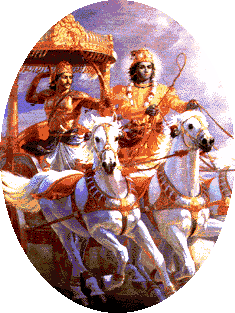
CHAPTER I: ARJUNA GRIEF
The Bhagavad Geeta speaks both esoterically and pragmatically to embrace the
broad spectrum of human seeking. Counsel and solace is found in the verses of
the Geeta... it cites not only the practical application of spiritual principles
required by a student of Vedanta, but expresses the principles as realized by
a yogi, in this case Krishna.
The First Chapter of the Geeta serves as an introduction to the holy discourse
that follows. It is not just a backdrop to be taken lightly. Vyasa introduces
the basic principles of the science of Yoga and describes the initial struggles
of a seeker on the path of Kaivalya or liberation for the purpose of attaining
oneness with God.
In this Chapter, the stage is set. Arjuna is sad at the prospect of fighting
his kith and kin, even though he knows that an injustice has been done against
them. Arjun knows the tyrant and certainly wishes to retaliate, but his strength
to avenge has been mired with a sense of helplessness which has robbed him of
his potency.
The first stanza of the Bhagavad Geeta is the only verse wherein the blind King
Dhritarashtra asks a question. The rest of the 700 verses in the 18 chapters
is Sanjaya's report on what is happening on the Kurukshetra battle field, just
before the war.
The blind king is very conscious of the injustices against his nephews, the
Pandavas. Dhritarashtra is also aware of the relative strengths of the two armies
and is confident of the larger strength of his son's army. The viciousness of
the crimes perpetrated by his sons is weighing heavily upon the heart of the
blind king and therefore he has doubts about the outcome of this war.
Vyasa has given Sanjaya the power to see and hear the happenings in far off
Kurukshetra, even while sitting beside Dhritarashtra in the Hastinapur palace.
Dhritarashtra asks Sanjay to explain to him about what is happening on the battle
field of Kurukshetra. Chapter I is about a psychological survey on the spiritual
battlefield.
Verse 1 is Dhritarashtra
saying: "O Sanjay, what are the two armies, meaning, those of Panadavas
and the Kauravas, doing on the plains of Kurukshetra, where they are assembled
to fight?"
Since Sanjay has the divine insight for self-analysis and discerning introspection,
he has the ability to describe the universal battle that rages in man's mind
and life. After all, man is certainly able to determine the favourable and unfavourable
outcome of our actions, whether these are inner or outer conflicts.
In Verse 2, Sanjay
says: "Having seen the armies of the Pandavas in battle array, Duryodhana
approached his teacher and mentor, Drona and said ...."
The second stanza of the Geeta indicates that as soon as a spiritual aspirant
introspects and discriminates, there is immediate opposition from the senses
and desire that Duryodhana represents.
Drona represents samskars and old habits gathered over many previous births.
Duryodhana therefore seeks to reinforce his need for worldly enjoyment by consulting
with the inner urges, tendencies and propensities that influence the intelligence..
this is represented by Drona who allows us to repeat the same thoughts and actions
to create impulses of compelling habits.
Duryodhana continues
his train of thought in verse 3 with: "Oh teacher, behold this great army
of the sons of Pandu, arranged in battle order, by the talented disciple, son
of Drupad"
The son of Drupad, called Dhrisht-dyumna, was born of extreme spiritual ardor
and devotion. He represents the calm inner light of perception that awakens
in a spiritual seeker's heart.. he was therefore, very skilful in the art of
psychological wars. Dhritarashtra knew that Dhrisht-dyumna, was a fit general
to lead the forces of discrimination, that the Pandavas represent.
Verses 4, 5 and 6
indicate how inner tendencies have the power to deter a seeker from pursuing
spiritual practice. Sense lures distract one into indulgences. Past habits create
restlessness despite good intentions and inclinations. Duryodhana therefore
lists his concerns - they are all archers of discrimination which must be practised
in all spiritual endevours:
4. "Here present are mighty heroes, extraordinary bowmen as skilful in
battle as Bheema (Life Force Control) and Arjun (Self Control).. the veteran
warriors: Yuyudha (Devotion), Virat (Samadhi of Meditation), and Drupad (Dispassion)"
5. "The powerful Dhrishta-ketu (Power of Mental Resistance), Cheki-tana
(Spiritual Memory), Kashi-raja (Discrimination); eminent among men: Puru-jit
(Interiorization), and Kunti-bhoj (Right Posture or asana) and Shai-bya (Mental
Adherence)";
6. "The strong Yudh-manyu (Life Force Control), the valiant Uttam-aujas
(Celibacy), the son of Subadhra (Abhimanyu for Self Mastery)... and the sons
of Draupadi (Control of Senses and Habits of kama, krodha, lobha, moha, matsya,
mada and ahankar).. all lords of great chariots"!
By enumerating these heroes, Duryodhana implies that although the Pandava forces
were less in number, their effectiveness was much greater than the larger and
better equipped army of the Kauravas.
In the next two verses, he now addresses Drona as a "twice born" or
brahmin... he lists the names of his own great army:
7. "Know also, Oh best among the twice born, the names of those who are more distinguished amongst ourselves, the leaders of our own army; these I name for your information".
8. "Yourself
(Drona) (Tendencies of past births), Bhishma (Ego), Karna (Attachment or "raaga"
born of "likes") and also Kripa (Delusion or avidya) - all victorious
in battle. Ashvathama (Latent Desire or vasanas), Vikarna (Non-attachments or
"dvesha" born of "dislikes") and also the son of Som-dat
and Jaya-drath (Fear of Death)"
The vanity of the dictatorial tyrant, Duryodhana, is clear when he arrogates
unto himself, the stupendous honour that such a vast array of heroes are ready
to lay down their lives for "my sake", for he says:
9. "And many
other heroes also who are determined to give up their lives for my sake, armed
with various weapons and missiles, all skilled in battle"
He then continues to make further statements that are revealing..he admits that,
his forces of unlimited desires and sensory temptations which are protected
by ego, is still inadequate. Duryodhana admits that the minimal forces of life's
guides would likely be more capable of destroying them, for he says:
10. "These our
forces, protected by Bheeshma, are unlimited but may be insufficient ... whereas,
their army, led by Bheem, is limited but adequate"
Therefore, he warns:
11. "All of you,
remain stationed in your places, in each division of the army. Please protect
Bheeshma"
The metaphysical meaning of this verse asserts that all the sense inclinations
and habits should remain firm in their respective locations on the bodily field
of Kurukshetra and the pranic (life force) centres to protect Bheeshma, the
elder statesman who has lived many lives as the Ego!
It is only through the desires (Duryodhana) and habits (Drona) that man remains
mired in body identifications. However, for every evil tendency, there is a
good quality (Pandus) capable of destroying the sloth preventing man from sitting
at the seat of meditation!
The soldiers of the soul are:
1. Sahadev who has the power to negate all earthly lusts (kama) by following
the rules of "thou shalt not" (yama) through restraint
2. Nakul who is capable of following prescribed spiritual rules. These are rules
as yet without form, like the water. They are the "thou shalt" (niyama)
rules acquired through adherence and application and without invoking anger
(krodh)
3. Arjun who is the fire force of patience and self-control capable of negating
all greed (lobha). Much of this is attained through correct asanas and meditation.
4. Bheem, the valiant son of Vayu (air) who controls all physiological life
force (prana). His ability of introversion and detachment (pranayama) leads
him to mastery over attachments of all "my and mine" (moha).
5. Yudhishtra, the soldier of calmness has won over all the preceding elements
that drag a seeker to becoming a "bhoga" or extrovert. He recognises
his intuitional oneness with the Spirit which is likened to space, but is not
space! He has overcome pride (mada) and therefore capable of discrimination.
6. Krishna, the "I".. the Spirit of the Soul, who can be contacted
at the Kutastha Chaitanya, between the two eye-brows in the seat of meditation
through love and surrender ...for only through Love can one destroy Ego (Bhishma
or ahankar) and reach the realm of superconscious ecstasy of Divine Consciousness!
Synchronization of the different operations is the backbone of an army's success..
as a strategist, Duryodhana is instructing his various commanders working in
their different wings to work out the single policy of protecting Bheeshma.
Sanjaya notes that the lack of response from Drona, makes Bheeshma send a strong
message of pride and determination to prevent Duryodhana from getting discouraged.
Bheeshma blew the conch of restlessness which interrupts the stillness of the
army on alert.
12. With the purpose of cheering Duryodhana, the grandsire Bheeshma, the oldest of the Kauravas, blew his conch shell with a resounding roar of a lion.
13. Then suddenly
(after Bheeshma's first note), a great chorus from the shells, kettledrums,
cymbals, tabors and cowhorn-trumpets sounded from the Kaurava side; the noise
was terrific.
The spiritual interpretation of the 12th and 13th verses describe the agitations
of the physical body as it is trying to uplift the mind in meditation... but
is interrupted by the demands of the senses!
Verses 14 to 18, in
contrast, describe the spiritual experiences of an uplifted mind of a soul who
is trying very hard to free the body of its physical restlessness and wandering
thoughts.
14. Then, also Madhav (Krishna) and the son of Pandu (Arjun), seated in their
magnificent chariot (body seated in meditation) with white horses (senses and
organs of action), blew their divine conches
15. Hrishi-kesha (Lord of the Senses with short hair) blew the Pancha-janya
(that which generates the five elements or tattvas) and Dhanam-jaya (winner
of wealth or Arjun) blew the Deva-data (that which gives joy) and Vriko-dara
(Bheem), the doer of terrible deeds, blew the conch called Paundra (that which
destroys the lower states)
16. King Yudhishtra, the son of Kunti, blew the Anata-vijaya (that which conquers
infinity); Nakul and Sahadev blew the Su-ghosha (that which sounds clearly and
sweetly) and the Mani-push-paka (that which manifests by a sound)
17. The King of Kashi, an excellent archer, Sikhandi the mighty commander of
eleven thousand archers, Dhrishta-dyumna and Virat and Satyaki, the unconquered
18. Drupad and the sons of Draupadi, O Lord of the Earth (Dhritarashtra) and
the son of Subhadra, the mighty armed, blew their respective conches
These verses make reference to the various sounds of Aum coming from the different
conch shells of the Pandavas. The "pranava' or the sound of the creative
Aum vibration, which works through the tattvas (elements) is what the meditator
"hears" intuitively. It is the vibration that links Spirit with matter.
19. That tumultuous
sound reverberated throughout the heaven and earth and pierced the hearts of
the Dhritarashtra clan
In Verse 19, Sanjay warns Dhritarashtra ...it is a vivid description of the
superiority of the Pandava forces. Perhaps, the blind king can be persuaded
to stop the war!
Verses 20 to 23 describe
Arjun observing his enemies that have to be destroyed
20. Then, seeing the Dhritarashtra dynasty standing ready to discharge their
weapons of war, Arjun, the son of Pandu who bears the flag of the monkey emblem,
took up his bow and addressed Krishna
21. & 22. Arjuna said: O Krishna, Lord of the earth, please take me between
the two armies, that I may see those who stand ready in battle formation. On
the eve of this war, let me understand with whom I must fight
23. Here on this field of Kurukshetra, I wish to observe all those who have
gathered with a desire to fight on the side of Dhritarashtra's wicked son (Duryodhana)
Verses 24 and 25 are
introspective conclusions of Sanjay which are being revealed to the blind king
who is a descendent of King Bharat, the common ancestor of both the Kauravs
and Pandavas.
Sanjay said to Dhritarashtra: 24. Thus addressed by Guda-kesha, O Bharata, Hrishi-kesha
having stationed the best chariot between the two armies
25. In front of Bhishma and Drona and all the rulers of the earth, he (Krishna)
said: O Partha (Arjun), behold the Kurus gathered together
Gudakesha is Arjun, the worthy spiritual aspirant who has conquered sleep and
sloth for the purpose of long and deep meditations. Only a partially advanced
devotee (Arjun) of Hrishi-kasha (Krishna) has the ability to centralise (in
meditation) his chariot (senses) on the plains of Kurukshetra (organs of action),
to identify with the struggles and goals of spiritual practices.
A yogi, the likes of Arjun, is ever conscious and mindful of good and evil tendencies
in man. His discriminating tendency make him ask his charioteer (Krishna) to
take him to the battlefield to review his habits (Drona) and Bhishma or ego-state!
Partha is the son of Prithiva meaning "clay-made" or Kunti, to remind
us that the Immortal Song of the Gita is being sung to a mortal, of which Arjun
is representative
26. Then Partha saw
stationed there in both the armies, fathers, grandfathers, teachers, maternal
uncles, brothers, sons, grandsons and friends too
27. He saw father-in-law and friends also in both the armies
If these two verses are taken for their esoteric meaning, Arjun, the consummate
devotee of Krishna has come about, midway, in the initial stages of his meditation
sadhana.
He now beholds the psychological grandfathers and relatives.. they are good
and evil ego-consciousness, negative tendencies, delusion intoxicating desires
and sensory inclinations
Krishna shows Arjun his enemy lines of kith and kin, many of whom are beloved
members on both sides of the army forces.. he realises the full import of the
sacrifices he will have to make. He also realizes the extent of sacrifice that
society will be called upon to make in order to avenge the Duryodhan's cruelty.
Pity and compassion are natural and instinctive, but not necessarily noble...
one's weaknesses cannot be given angelic names of goodwill. Pity is a shattering
of mental equilibrium which is subjective and divorced from objectivity of knowing
right from wrong.
Very few wish to speak of Spirituality in earnest, because they believe they
cannot do without "minor" evil or pleasures they are addicted to!
28. Arjuna said: Seeing
these my kinsmen, O Krishna, arrayed and eager to fight
29. My limbs fail, my mouth is parched, my body quivers and my hair stands on
end
30. The Gandiva bow slips from my hand and my skin burns all over; I am unable
to stand and my mind is whirling around
Verses 28 to 30 is a true description of the state experienced by seekers who
have travelled some distance on the spiritual path. The initial soul contact
is of eager happy souls basking in the flush of Krishna contact.
With further progress, the sense desires and diehard instinctive tendencies
require killing in order to make further progress in spiritual aspirations.
In meditation, body perceptions and tendencies must be "killed" in
order that Arjun can take possession of the calmness of inner awareness... to
deepen the gains of sadhana, the subconscious has to be uprooted of its samskars
of wrong past actions. Arjun feels a loneliness and behold a mental desert created
by renunciation of materialism. He refuses to fight!
31. And I see adverse
omens, O Keshav; nor do I see my good in killing my kinsmen in battle
In this state of mental confusion, when mind is totally divorced from the intellect,
the subjective mind is hysterical and although it desires pleasures, the self
confidence for success, through self sacrifice is undermined!
32. For I desire no
victory, O Krishna, neither kingdom nor pleasures. Of what avail is dominion
to us, O Govinda? Of what avail are pleasures or even life itself?
33. They for whose sake we desire kingdom, enjoyment and pleasures, stand here
in battle, having renounced life and wealth
34. Teachers, fathers, sons and also grandfathers, maternal uncles, fathers-in-law,
grandsons, brothers-in-law and other relatives
In verses 32 to 34, Arjun continues to justify his retreat from the post of
duty. He repeats what he said earlier because of Krishna's pregnant silence,
which is itself a criticism of Arjun's attitude.
35. These I do not
wish to kill..though they kill me, O Madhusudhana; even for the sake of dominion
over the three worlds; how much less for the sake of the earth
Feeling he has not stated his case strongly enough, Arjun declares in a mock
spirit of renunciation, that he would kill none even if they kill him!
36. Killing these
sons of Dhritarashtra, what pleasure can be ours, O Janar-dana? Sin alone will
be our gain by killing these felons
In spite of all that Arjun has said so far, Krishna is silent! Sin is a mistake
committed by a misunderstood ego against its own Divine Nature, the Soul! Arjun's
seeming "learned" objections to kill enemies is a gross misinterpretation
of the sacred texts of our culture! Krishna understands his friend's hysterical
raving which must be exhausted!
37. Therefore, we
shall not kill the sons of Dhritarashtra, our relatives; for, how can we be
happy by killing our own people, O Madhava?
False reasoning has led Arjun to wrong conclusions... the intelligence loses
more and more of its discriminative and intuitive powers and now relies on rationalization
to justify his convictions.
38. Through these,
with their intelligence clouded by greed, see no evil in the destruction of
the families of society; and no sin in their cruelty to friends
39. Why should not we, who clearly see evil in the destruction of the family
units, learn to turn away from this sin, O Janardana?
The blind senses are eclipsed by greed and therefore do not see the decay of
the human personality. Arjun reasons that sense inclinations are necessary to
experience the world, which was made by the Lord himself! He sincerely believes
that sense indulging habits can live side by side with good habits to thus make
the kingdom of life complete.
This is a negative state of an advancing spiritual seeker who cannot distinguish
between reason governed use of the senses and greed governed sense appetites
It takes anywhere from eight to twelve years to substitute a good habit for
a strong bad habit. Man is plagued by such soul-humiliating defeats at the hands
of his/her own particular habits until consciousness is securely anchored to
one's true divine nature.
40. In the destruction
of a family, the immemorial religious rites of the family will perish; on the
destruction of spirituality, impiety will overcome the whole family
41. By the prevalence of impiety, O Krishna, the women of the family become
corrupt; and when women are corrupted, O descendent of the Vrishni clan, there
is intermingling of castes
The members of this family include the five senses: touch, sight, smell, taste
and hearing...the five organs of action, the mind (chariot) harnessed to 5 physiological
life forces (prana) and the intelligence.
The family members that need destroying are not the senses but their offsprings,
inclinations and the objects of desires, both materialistic and subjective or
astral!
The philosophy of "Active resistance to evil" is the central doctrine
expounded by Krishna in the Geeta and the very seed of Hindu way of living!
Nonetheless cultural experiments were preoccupations of our forefathers... they
knew that culture and tradition of each family was a unit of the total culture
and integrity of the nation.
42. Confusion of castes
leads the slayer of the family to hell; for their forefathers fall, deprived
of offerings of pinda (rice) and water (oblations)
43. By these evil deeds of the "destroyer of the family" causes confusion
of castes, the eternal religious rites of the caste and the family is destroyed
Verse 42 and 43 re-assert the oft-mention fact that the Hindu culture is a technique
by which this spiritual culture is maintained and worked by the community.
Esoterically, the seeker wonders if he should enter the battles of the senses....
there is apprehension that the discriminative faculties will disintegrate owing
to a lack of interaction with the senses.
44. We have heard,
O Janardana, that it is inevitable for those men, in whose families the religious
practices have been destroyed, to dwell in hell for an unknown period of time
45. Alas! We are involved in a great sin... in that we are prepared to kill
our kinsman, for the sake of greed for the pleasures of a kingdom
46. If the sons of Dhritarashtra, weapons in hand,slay me in battle, unresisting
and unarmed, that would be better for me
A beginner at meditation is at first forced to be quiet to peer behind the screen
of darkness. The seeker wonders at the foolishness of relinquishing tangible
pleasures for a "possible" glimpse of the Spirit!
At this stage, the seeker is dissatisfied both with the lack of spiritual progress
and the long separation from the accustomed sense habits!
This state is finally overcome by concentrating on the peace born of partial
renunciation in meditation.
47. Sanjaya said:
Having thus spoken, in the midst of the battle-field, Arjun sat down on the
seat of the chariot, casting away his bow and arrow, with a mind distressed
with sorrow
The concluding verse of the First Chapter of the Geeta contains the words of
Sanjay... he reports that Arjun or Self-control, casts away his bow of meditation
and ignorance piercing arrows. He is standstill in the middle of the psychological-
metaphysical battlefield with the senses. Arjun tries to attune himself to the
guidance and grace of the Charioteer, Krishna, who in the next chapter of the
Geeta, comes to the aid of the seeker who suffers "Arjuna Grief"!
CHAPTER II : YOGA OF WISDOM
(Sankhya Yoga )
This chapter is titled "Sankhya Yoga". It contains the summary of
the entire Bhagavad Geeta. The discourse encompasses the essence of the ponderous
four Vedas, 108 Upanishads and the six systems of Hindu philosophy... truly
a universal message of Cosmic Wisdom for the solace and emancipation of all
mankind! In the first ten verses, Arjun surrenders to Krishna. From verses 11
to 46, we are introduced to the "logic of thought in philosophy" or
"Gyana Yoga". Verses 47 to 60 is an exhaustive sketch on the "Yoga
of Action" or Karma Yoga. Verses 61 to 70 describes the "Path of Love"
or "Bhakti Yoga" Verses 71 to 72 indicate the "Path of Renunciation"
or "Sannyasa Yoga"
In the first ten verses, Krishna responds to Arjun's plea for guidance
1. Sanjay said to
Dhritarashtra: Madhusudana (Krishna) then addressed him whose eyes were full
of tears and who was overcome with pity and discouragement
Having gained happiness neither from the senses nor from meditation, Arjun,
the devotee weeps. The despondency is a longing for spiritual progress.
The Lord, who is the destroyer of ignorance, must now come to the aid of the
distraught devotee, Arjun, who pleads for consolation!
The first chapter of the Geeta is about the sorrow in the aspirant's initial
effort to attain union (yoga) with God. Development is the result of one's hard
and steady work in meditation.
Although the aspirant feels the attempts of controlling the mind are fruitless,
yet if one continues believing in the teacher, the aspirant will certainly find
a response from God , intimated through long silent meditation.
God may counsel a devotee by assuming the form of a guru or saint.. but the
Lord usually speaks through the devotee's own intuitive perception.
2. The Blessed Lord
said: In such a critical moment, whence comes upon you, O Arjun, this despondency...
a behaviour improper for an Aryan, disgraceful, detrimental to the attainment
of heaven?
Having felt God's response, the devotee's awareness soars to the transcendent
Kutastha state, where in the presence of the Spirit, immanent in all creation
and manifested in each being, as the soul...Its voice is Intuition.
Any persistent seeker can feel the urging of the Spirit.. one needs t be an
advanced devotee like Arjun to "hear" the intelligent voice of counsel!
The Lord rebukes Arjun for despondency! He points out to the aspiring yogi,
that the senses, through proximity, have established themselves as relatives...but,
as enemies can pose as friends in order to gain entry into the house as material
desires!
Great enemies of man can reside, apparently harmlessly, within consciousness
along with friends, the spiritual faculties! To lower the bridge of pity over
the moat that separates the wise castled soul and the segregated senses, is
to permit the psychic enemies to break through the ramparts of self-control.
The command is: do no evil... do not let evil be done through others, through
your command... do not tolerate evil by silence. Non-cooperation with evil is
the best way, without making pretentious display of our own "goodness"!
Man's life is a paradox.. he is a soul, made in the image of the Spirit which
can be satisfied only with divine pleasures! Yet the body that has incarnated
through many lives has experienced only sensory pleasures! Man must use discrimination
to distinguish between real soul and illusory pleasures of the senses.
A devotee who is constantly responsive to the sense gratifications of the body,
is unable to share one's joys with the rarefied joys of the Spirit!
3. O Partha, (Arjun),
surrender not to such impotence! It does not befit you, O scorcher of foes (Parantapa)!
Cast off this weakness of heart!
Every man has the power to resist the influence of sense identified and habit
bound existence...Renunciation does not involve any loss to the devotee, but
gives one the opportunity to forsake all things that retard spiritual progress.
Without positive action of the will, seekers succumb to unmanly neutrality,
the condition that has overtaken Arjun. Krishna (Spirit) therefore warns Arjun
not to be neutral, wherein there is neither attachment to God nor to the senses!
4. Arjun said: O Slayer
of Madhu, O Destroyer of Foes (Krishna)! How can I, in this war direct arrows
against Bhishma and Drona, who are fit to be worshipped!
O Slayer of the Demon of Ignorance and Inner Temptations, says Arjun...are you
wanting me to pierce my psychological grandfather Bheeshma-Ego and my teacher
Drona-Past Habits. He admits that it is frightful to destroy them through spiritual
renunciation and with the arrows of yoga meditation!
5.Arjun continues:
Even a life of beggary would be better for me than a life marred by slaying
my most noble teachers! Even if I do destroy these mentors who are intent on
wealth and possessions, then surely, here on earth, all my own would-be enjoyments
of material happiness will be stained dreadfully with blood
In ordinary consciousness, the ego is the guiding principle of thoughts, feelings
and desire aspirations. It molds desires and ambitions according to the influence
of habits. The ego and bodily habits are thus preceptors of all human activities.
Understandably, Arjun asks: without ego and habit-inclination, must he then
look upon all material things and sensory experiences as being evil (blood-stained)!
The answer is ofcourse "no"! Evil lies only in the misuse of the powers
and products of nature. All bad habits and the enjoyer... the ego, have a tenacious
claim on human beings, because of the ego's attachment to enjoyment! Bad habits
paralyse the will! The victim thinks: "What is the use of trying?"
It is only after one pleasure after another, fails the devotee, that man must
wonder if happiness is possible through the senses! This thought has a liberating
effect and the devotee disentangles himself!
Man finds joy in meditation, in silence, in wisdom, in service, in contentment
and in self-control. He forsakes old restless pursuit of desires with their
actions, ignorant behaviour and sense slavery!
Man prudently follows the guidance of the spiritually wise. The wise preceptor
does not impose his ideas or sensations on the seeker. The Teacher leads the
soul towards its inherent bliss producing qualities.
To take the mind from the senses by meditation is to destroy the physical ego
and habit tendencies!
6. I can hardly decide
which end would be better.. that we should conquer them or that they should
conquer us. Confronting us are Dhritarashtra's children, the very ones whose
death would make our own life undesirable!
Arjun continues his argument: Even though the senses in unison cry "Please
us, never mind the soul!".... man realises that they are never satisfied
with their ever-increasing demands.
Sense consciousness is active from birth..even to the advancing devotee, sense
joys are familiar and soul happiness exotic. But behind all the clamour, is
the silent call of the bliss-demanding soul.
Life energy flowing out through the senses experience an attractive familiar
feeling! When a guru asks to reverse the flow of life energy and to withdraw
the mind from the senses, the instruction is bizarre!
The Teacher is only asking man to discipline the senses... a sense slave will
ultimately find itself the victim of disease and cannot or will not relegate
his body to soul-search.
7. My heart is overpowered
by the taint of pity; my mind is confused as to my duty. I implore you to advise
me what is the best path for me to follow. I am your disciple. Instruct me,
who has taken refuge in you!
The devotee, after pleading the cause of the senses, is filled with remorse!
He acknowledges his ineptitude and surrenders to his inner Spirit... the Guru-preceptor.
In the seat of meditation, the voice of Inner Silence lacks clarity. Hence the
advice from a guru is desirable. The devotee should listen to the guru, learning
from him the deep truths of soul development.
8. I see nothing that
will remove my inner affliction that pounds at my senses...nothing! Not even
my possessions of an unrivalled and prosperous kingship over this earth and
lordship over the deities in heaven!
As long as one dwells in the body, one must experience through the senses and
enjoy the pleasures they give...why then, must I engage in battle with them?
The "earth" stands for the perishable body. Its prosperity is health,
well-being and happiness. Its three-fold troubles are impaired inner life forces
causing illness, bad karmic influences from past wrong actions and samskars
or compelling sense inclinations from past bad habits.
Through yoga the body becomes ripe with wisdom and invulnerable to physical
maladies, acquired by contacting Aum, the source of all life's powers of life!
This is spiritual prosperity on earth.
9. Sanjay said to
Dhritarashtra: Having thus addressed Hrishi-kesha (Krishna), Gudakesha-Parantapa
(Arjun) declared to Govinda (Krishna): "I will not fight"; then he
remained silent.
This stanza reveals the peculiar psychological state in which the devotee is
sufficiently developed to behold Krishna as the Lord of the Senses... yet has
not attained the determination to subdue the senses.
Arjun remains mentally inactive and neither advances or retreats! Owing to the
subconscious pull of bad habits, the devotee is not fully awakened for right
action.
10. O Bharata (Dhritarashtra),
to him who was lamenting between the two armies, the Lord of the Senses (Krishna),
as if smiling, spoke these words:
Those devotees who, during the invasion of doubt, completely give themselves
up to the Spirit in inner silence are able to perceive the Light across the
firmament of their inner perception.
Only devotees who have led clean spiritual lives ie proper eating, correct behaviour
and deep meditation, are fortunate enough to behold the "smile" of
the Spirit and to "hear" His voice of Wisdom!
11. The Blessed Lord
said: You have grieved for those not worth lamenting over! Yet you speak words
of wisdom. The wise grieve neither for the living nor for the dead.
The devotee under the influence of delusion, experiences the state in which
he utters words of wisdom even while acting like a simpleton! Mental weakness
is not wisdom... it is a sign of deep subconscious attachment to the ego and
its delusive pleasures.
The illumined synchronises actions with his speech and follows the good advice
he gives to others! To forsake such a double-life, the devotee should not be
stirred by the restless changes of life and death!
A re-education of Arjun's mind through metaphysical and psychic methods is the
last word in psycho-therapy!
Forget the past, for it is lost! Forget the future, because it is beyond reach.
Control the present! Live supremely well now! This the way of the wise.
12. It is not that
I have never before been incarnated; nor you, nor these other royal ones! Nor
shall we cease to exist in the future! Krishna here declares in unequivocal
terms, that the embodied Self is set on a great pilgrimage in which It cames
to identify Itself with varied forms, temporarily to gain a limited but determined
set of experiences.
All mortals who appear "now" to be separate individuals are mere cause-effects
expressions, in bodily form, of desires carried from past lives; and that all
new desires engendered "now" by the ego would require to find expression
through new bodies in the future.
13. Just as in this
body, the Self passes through childhood, youth and old age, so also does he
pass into another body; the wise are not disturbed or grieved by it.
The ego is constantly aware of itself as childhood, youth and old age; the soul
is also conscious not only of its present life, but also its series of "lives"
and "deaths".
The meditating devotee shifts his consciousness from changes of births and deaths
to the Changeless Being in whose bosom all changes dance!
14. O son of Kunti
(Arjun), the ideas of heat and cold, pain and pleasure are produced by the contacts
of the senses with their objects. Such ideas have a beginning and an end; they
are impermanent. Endure them with patience, O descendent of Bharata!
The sense organs are reactively sensitive; their nature is to respond pleasurably
or painfully to stimuli... they have been conditioned to have strong likes and
dislikes. These sense impressions use life force to deliver impressions to the
mind.
The resultant sensations are transitory, fickle and evanescent. They come and
go; man should bear them with patience and mental evenness (titiksha).
The masters teach that if the "feeling" is neutralised and made impervious
to dualities of likes and dislikes, then all experiences would be intellectualised
and the ideas properly acted upon!
15. O chief among
men (Arjun), he who is unruffled by these contacts of the senses with their
objects, who is calm and evenminded during pain and pleasure, he alone is fit
to attain the Immortality of the Self!
The basic principle of creation is "duality"! Man's slavish response
to these dualities is the cause of "trouble". He therefore lives under
the domination of the changing phenomenal world.
Desires are the result of indiscriminate contact with objects of senses. The
ego expresses as likes and dislikes. Desire therefore has the ability to creep
into consciousness which responds as feelings! The imposition of the ego becomes
a detriment to man's even-mindedness.
The Masters have found that happiness lies in a constant state of unruffled
peace during all experiences of earthly changeable creation. It is by meditation
alone that man can neutralise the effects of the sensory powers!
16. The unreal has
no existence; of the Real there is no nonexistence; the truth about both these
states is known by men of wisdom (Knowers of the Truth)
Can something become nothing and vice versa? The wise perceive as real only
That which does not change...they alone know the mystery of the real and the
unreal.
The Eternal substance is divided into two .. the Sat or Changeless and Asat
or Ever-changing Nature, the Cosmic Mother of twenty four attributes.
Through inward perception, one can trace the cause of all activities in creation...that
is the mystery of the unreal and the Real. Vision directed outward, sees the
waves... turned inwards, it sees the ocean!
17. Know That to be
Indestructible by which all this is pervaded. None can cause the destruction
of That.. the Imperishable
The one Life that breathes existence into all temporal things, creating them
out of His own Being, is indestructible. Even when all changeable objects of
creation melt away, nothing affects the immutability of God.
18. They have an end,
it is said, these bodies of the embodied soul. The Self is Eternal, Indestructible,
Incomprehensible. Having known this wisdom, O descendent of Bharat (Arjun)..
fight!
The devotee who is still contending with the inner persuasion and delusion of
body attachment, is afraid to relinquish his mortal consciousness.. a bird of
eternity locked in a little cage!
Krishna therefore advises Arjun to concentrate on the Inner Self, the image
of the terminal Spirit, which like It, is immortal! His advice is not to fear
the fight of the senses and destroy the attachments to the body! This, sooner
or later he will be compelled to do!
Virtue acquired through sacrifice is never lost! Better a death of righteousness
than the ordinary ignoble death on the comfortable bed of selfishness!
19. He who considers
the Self to be the slayer and he who thinks He is slain, neither of these knows
the truth. He slays not, nor is he slain!
He dreams who thinks the Self soils its hands of justice with the blood of slaughter...there
is no power by which the soul can be slain!
The immortal Self remains untouched when its cosy cloak is destroyed, just as
a man does not die when his house crumbles away. One soul cannot kill another
soul... both are reflections of the immortal Spirit.
20. This Self is neither
born nor does He ever die; after coming into existence, He will not cease to
be.It is birthless, eternal, changeless and ancient. He is not killed when the
body is killed.
The embodied soul, in essence the reflection of the Spirit, never undergoes
the pangs of birth and death. It is the body, which is Matter, that undergoes
the six changes of the impermanent Nature: birth, existence, development, change,
decay and annihilation!
The man dwelling in the perishable body forgets the imperishable soul within
it...this body identified being is only aware of its six conditions!
The wise man learns to differentiate between the indwelling immortal soul and
its perishable bodily encasement.
However, man has three bodies (each with distinguishing qualities) from which
he must free his awareness before he can achieve his final emancipation.
The physical body (body and flesh) of 16 elements of atoms or matter:
The astral body (mind and life force or prana) of 19 elements of "life":
The causal body (ideational body entwined with wisdom and bliss) of 35 elemental
"ideas" required to create the astral and physical bodies: these are
the 10 senses, 5 life forces or prana, ego, feeling, mind and intelligence....
the remaining 16 ideas are converted into the gross physical body of 16 basic
elements like iron, calcium and so forth
21. How can he who
knows the Self to be imperishable, everlasting, permanent, birthless and changeless,
possibly think that the Self can cause the destruction of another? O Partha
(Arjun), whom does it slay?
The esoteric meaning of this verse conveys that Krishna tells Arjun, the ego:
"O My own lower self (Arjun), you have to lift yourself to a higher plane
of soul-consciousness! Even if you destroy the wicked attachments of the senses,
you are foolish to think that the senses themselves will be destroyed. Your
higher Self only purifies the lower self.. It does not destroy it"
When sense pleasures are routed by self-control, their forces are first inhibited
and suppressed! The devotee's continued and persistent spiritual endeavour causes
the Self to transmute them to a finer state for the "sensing" of a
higher bliss!
Pleasure loving experiences can never be destroyed.. they can be transformed
and lifted through meditation from the plane of misery to God-attachment! It
is through the same "thirsty" mouth that a devotee drinks the transmuted
desires for immortal nectar of Bliss!
22. Just as a man
casts off his worn out clothes and puts on new ones, so also the embodied-self
casts off its worn out bodies and enters others which are new.
This verse refers to the doctrine of reincarnation... when a soul changes his
fleshy costume, it is no longer recognizable to those familiar with its identity
in a previous life-role.
The life span or durability of a physical body in any one incarnation is determined
by the Law of Karma (cause and effect governing human actions).
In sleep every night, an individual discards consciousness of the tired body
and mind and so finds peace... in the "greater' sleep, man forsakes the
disease-torn body and attachment-corroded mind for a restful sleep of happiness!
From happiness we are born...for happiness we live.. in happiness we melt at
death. Death is an ecstasy, because it removes the burden of the body and frees
the soul of all the pain arising from body identification.
23. No weapons can
pierce the soul; no fire can burn it; no water can moisten it; nor can any wind
dry it.
The unseen is always explained in terms of the seen, so that the unknown becomes
defined. Here the Changeless is being describe in terms of mutable and everchanging
world, familiar to the likes of Arjun and us!
The verse also indicates a deeper esoteric meaning which is elaborated in the
next verse
24. This Self cannot
be cut, nor burnt, nor moistened, nor dried up. It is eternal, all pervading,
ever calm, immovable and eternally the same
The mysterious soul abides forever, never changing even when the cosmos melts
into Infinity. The subtle soul sleeps in every blade of grass, in every nook
of creation and in the honeycomb of atoms.
Thoughts cannot ruffle it.... It loves to live in grottos of change, ever steadfast
and immovable. It dreams only Eternity!
Man alone suffers incarnations of soul-oblivion and body-identification, undergoing
rebirths and their attendant miseries.
Only by deeper and deeper meditation can the embodied soul attain ecstatic communion
with the Self and thus forget limitations of the body!
During meditation, the devotee does not think.. he realizes that he is formless,
omnipresent, omniscient, far above the bodily changes!
After the meditating mind comes out of an experience of ecstasy the human consciousness
expands into the Cosmic Consciousness
25. The soul is said
to be unmanifest, imponderable, unchangeable. Therefore, knowing it to be such,
you should not grieve.
Before the Self spewed Its thought waves, the soul remained in Its bosom as
an unthinkable thought, undisturbed by change. When Spirit cast Its dreams of
the universes, the soul with or without the physical and astral covering, was
still the same!
The deeply meditating yogi should delve deeper until all thoughts are dissolved
in intuition... here he sees the unruffled reflection of the moon of the soul.
Although he only sees the "image" of the Self, he knows himself to
be unchangeable, unmanifest and ever calm like the Spirit!
26. But even if you
imagine this soul to be constantly born and constantly dying, even then, O mighty-armed
one (Arjun), you should not grieve
27. For that which is born must die and that which is dead must be born again.
Why then should you grieve over the inevitable?
Verses 26 and 27 argue the materialists's point of view. According to them,
direct perception is an authority for belief. With this standard for their knowledge,
when they try to measure life, they have to accept it as a constant flux of
births and deaths.
Krishna argues that for both the atheist and the theist, life is but a repetition
of births and deaths, then why grieve over the inevitable!
28. The beginnings
of all creatures is veiled; the middle is manifested; the end again is imperceptible,
O Bharata (Arjun). What then is there to grieve about?
Every man wonders from what mystery chamber came the original man, bird, beast,
stone, flower, river, light, magnetism, electricity, worlds, stars and universes!
What happens to the two billion population of the globe, every century, that
vanishes without a trace?
The Stage of the earth is well supplied with food, air, water and fire... The
drama Director of this mystery play of lives on the earth stage is hidden somewhere,
directing the play!
Human beings, endowed with a questioning intelligence ponder over the entire
mystery. The next 10 verses (28 to 37) present the problem of Arjun, the "man-of-the-world"
materialist!
If the material manifest world follows the law of causation, then the world
is manifested "effects" or "creation!" If creation is manifest
just for a while, it will one day dissolve again into the unmanifest ...both
the unmanifest origin and the dissolving unmanifest are unknown. Knowing all
this, why is it we do not "realise" this even when repeatedly explained?
29. Some behold the
soul in amazement. Others describe it as marvellous. Still others listen about
the soul as wondrous. And there are others who, even after hearing all about
the soul, do not understand this at all!
One requires a true Master to enable a deep delving devotee to "divinely
see" the vision of the soul as an amazing, luminous wonder ... some are
led to reach the shores of meditational ecstasy to "hear" the Aum
(or Amen or Amin) vibrating within themselves and the entire manifested universe,
a feat in wisdom... the soul that "feels" and "experiences"
the exquisite continuous joy!
Then there are those, who despite repeatedly hearing the philosophy cannot grasp
the import of the great mystery... their soul does not experience and their
ears are perceptually deaf.
The three ways of perceiving the soul and Spirit are only possible by developing
the power of intuition by deeper and deeper meditation - they are; . intuitively
beholding the Light . describing its wonder through inner Wisdom of experience
and . hearing the Cosmic Sound Aum which imparts the communion of bliss
30. O Bharata (Arjun),
the one who dwells in the bodies of all creatures is eternally indestructible.
Grieve not, therefore, for any creature!
Krishna reminds Arjun of his innate soul-power to become victories over his
lower ego-nature. Devotees addicted to ego, senses, bad habits and desires are
usually reluctant to destroy these friendly enemies..they may veil man's consciousness
for a while, but can never destroy the soul.
The embodied soul awaits a rallying call of a determined divine warrior!
31. Even from the
standpoint of your own dharma (duty), you should not inwardly waver! There is
nothing more propitious for a Kshatriya than a righteous battle.
This verse makes special reference to the duty of a spiritual man who has attained
the "kshatriya state" or warrior state of spirituality! It is therefore
Arjun's duty to fight the momentary pleasurable sense attachments of body consciousness.
He is therefore asked to awaken and unwaveringly rouse the soldiers of discrimination
and meditative calmness! Assembled on the battle field of introspection, Krishna
asks Arjun to rout the invading forces of sense attachments
32. O Partha (Arjun),
fortunate indeed are the Kshatriyas when called to fight a righteous battle,
which unprovoked, becomes their lot. They find therein an opportunity of an
open door to heaven.
While Krishna advises Arjuna to his righteous duty, the Geeta also warns man
against the temptation of using the metaphysical doctrine of nonviolence as
a subterfuge for tolerating the slaughter of innocent people by consciousless
marauders!
The resistance of evil by good, not by evil, is the ideal method of eradicating
war! Wars of aggression are wrong .. they breed war!
Wars of self-defense are not wrong... but, a greater achievement is the conquer
the conquerors with non-violent resistance.
Applying this principle to Arjun, the spiritual warrior .... when a seeker finds
himself on the scene of inner psychological war when inner peace and spiritual
victory are threatened by senses, it should be seen as an opportunity to conquer
bad habits and to establish within, the heaven of perfect happiness.
33. But, if you decline
to undertake this righteous combat, then, having abandoned your duty and fame,
you shall incur sin.
This verse advises a man-of-the world as well as the seeker, that when one enters
the spiritual path, he cannot become indolent, unpractical or foolish about
worldly affairs.... forgetting to protect righteously, his interests against
unscrupulous competitors.
One can practice unselfishness without neglecting one's necessary interests!
By neglecting, man invites "sin" of uncalled for losses and failures!
Nor should anyone make money dishonestly to use for philanthropy.
In other words, every being must be a businessman in this modern competitive
life.... an embattled warrior!
Once the ego-consciousness of the body has metamorphosed by meditation into
soul-consciousness, senses have no power to invade! They are still vulnerable
and the seeker must be willing and vigilant to wage a righteous war with the
restless body-consciousness. If at any time he forsakes his duty and succumbs
to awareness of the flesh, he sins!
34. Men will ever
speak of your everlasting dishonour. To a man of repute, dishonour is worse
than death!
Men who fall into disrepute in the eyes of honourable virtue suffer pangs in
life worse than physical death! A life stripped of honour is living death of
world censure and self-recrimination. Death may have the capacity of obliterating
physical suffering, but dishonourable acts infect the living mind and body!
A deserter finds no peace within himself or in society.
Esoterically, he is a coward who permits sense temptations to devastate his
bodily kingdom. A moral deserter finds himself constantly criticized by his
own conscience, never mind, the hordes of "holier-than-thou" materialistic
people!
35. The great battalion
commanders will think that you have withdrawn from the battle through fear;
and you will be looked down upon, by them who had thought so highly of you and
your heroism in the past!
Continuing the materialistic point of view, Krishna says that not only will
the world blame him and history recount his infamy, but the commanders in the
enemy lines will ridicule him for his cowardice!
His own commanders who have always fought with him for righteousness and rejoiced
with him in his victories, will assume that he had forsaken a righteous cause
out of fear!
Esoterically, a well-disciplined devotee of deep meditation must not allow himself
to lose his resolution and composure in unexpected trials.
36. Your enemies will
speak contemptuously about your powers. What could be more painful than this?
A back-sliding devotee is thus doubly criticised by both the good and bad habits.
When the good tendencies find themselves of their Kshatriya-warrior leader,
they silently rebuke him. A self-respecting seeker can never tolerate an audacious
invasion by his past evil tendencies!
37. If you should
die while battling the enemies, you will attain heaven. If you are victorious,
you will enjoy the earth. Therefore, O son of Kunti (Arjun), stand up determined
to fight!
Life is a battle: each man must struggle for his physical existence, and is
therefore subject to his or her own peculiar problems. everyone who conscientiously
fights these problems will either win or lose at the attempt!
Those who die while engaged in a righteous battle to banish evil, fall asleep
on a soft bed of meritorious inner self-satisfaction and are lifted to heaven.
Those who win victory over darkness will bask in the glory on peace and inner
happiness... but a victor in the sense battle enjoys the peace of self-control!
A seeker whose physical death takes place amidst the continuum of spiritual
effort and constant practice at meditation, experiences a high state of spirituality
in the after-death state! Any one can ultimately master oneself and become established
in the bliss of ever-lasting cosmic consciousness!
38. After becoming
even-minded about pleasure and pain, gain and loss, victory and defeat ... engage
in battle for the sake of battle; thus you shall incur no sin.
The basic principle of yoga is that the practising mental equilibrium neutralizes
the effects of delusion. Once unruffled with inner calmness and evenmindedness,
he views life as a dream without emotional involvement. He does not become an
automaton; he remains in control of all contrary emotions, attachments, repulsions,
longings and unwillingness.
Even when seeking material fulfilment, one needs to keep the mind unruffled
during success or failure!
39. The ultimate wisdom
of Sankhya I have explained to you. But now you must hear about the wisdom of
Yoga, equipped with which, O Partha, you will cast off all bonds of action (karma).
What has to date been covered consists of "Sankhya", meaning, the
logic of reasoning by which the true nature of the Self or Spirit or Reality
is comprehended, so that a seeker can end all sorrows arising from grief, attachment
and desire.
Verses 39 to 46 will deal with "Yoga", the route by which Self-realization
can be attained, meaning, the way that leads one out of the prison of law of
karma!
When by yoga the ego is united to the soul and then soul to the Spirit, the
ego loses its delusion that he is a mere mortal!
By dissolving himself, the yogi merges his consciousness of "feelings"
into the primordial cosmic vibration of Aum in consciousness, until it merges
with the Cosmic Aum. He thereby reaches the Ultimate Unity, the One from whom
sprang the many!
By making gradual steps, the seeker converts all awareness of the body into
consciousness of the Self or Spirit. It is not attained by logic or imagination!
It comes only through intuitive experience, which in turn is dependent upon
intense meditation, as taught by the great Masters of India!
A seeker who knows the art of meditation (yoga) cauterises his past tendencies
with the experience of bliss!
40. In this path (Yoga
of Action), there is no loss of effort, nor is there creation of contrary effects.
Even a tiny bit of this real knowledge, protects one from the great fear (suffering
inherent in repeated cycles of birth and death).
Yoga is the path of "spiritual" action... the only way known wherein
a "concept" is transmuted into realization. For those who embrace
the path of righteousness, there is no loss of effort. Mathematically certain,
right spiritual endeavour produce salutary results, unlike materialistic pursuits
which are like wanderings in blind alleys and hazardous encounters.
Spiritual results start as subtle transformations in the inner being. They are
measured according to their peace-giving qualities. To maintain such peace within,
in spite of the ever-changing circumstances of life,is to be happier than a
king!
41. In this Yoga,
O Scion of Kuru (Arjun), there is but a single, one pointed determination; the
reasoning of the undecided mind are unending and variously ramified!
This verse points out the difference between the meditating seeker who is intent
on finding the Self and the restless individual who is content with "theoretical"
teachings!
The spiritual aspirant needs to forsake indecision. Following one teacher, one
definite path, he will save himself from endless wandering.
42. O Partha (Arjun),
no single pointed resolution for samadhi in meditation is possible in those
who cling to power
43. Those who are full of desires, there discriminative intelligence is led
astray by flowery declamations of the spiritually ignorant. They promise new
birth as the reward of their actions and prescribe various specific actions
for the attainment of power and a pleasurable heaven (astral world).
44. For such persons, who cling to pleasure and power, whose minds are drawn
away from spiritual wisdom; these are neither determinate nor resolute nor are
they fit for meditation and samadhi.
Verses 42 to 44 is Vyasa's advice to the materialistic seekers. Those attached
to sense indulgences as well as those who seek "powers" cannot attain
the mental equilibrium of meditation..they fail to receive the ecstasy of samadhi.
A seeker should avoid undiscriminating belief in the convincing words of the
unwise. He is advised to guard his spiritual discrimination, lest it be stolen
by the sophisticated who espouses the philosophy of sensory aggrandization.
The seeker should not concentrate on psychic and astral powers, whether in this
world or for astral pleasures in heaven. Nor should he desire a heaven after
death. He who desires other heavens also is in delusion. A devotee must want
"one-ness" with the very Source of Bliss!
45. The Vedas are
concerned with the three universal qualities or gunas. O Arjun, free yourself
from the triple qualities and from pairs of opposites (raag-dvesha). Remain
calm, harbouring no thoughts of receiving and keeping; become established in
the Self!
This verse acknowledges the Vedic praise and worship of the creative force of
Nature (Prakriti) which spews forth the names and forms from the three qualities
(gunas) .... but. says Krishna, concentrate on the Spirit (Self) and free yourself
from the emotional involvement in Nature's dream of desires and attachments!
The verse also points to the relative inefficacy of external rites, no matter
how austere and perfect! Only an inner cleansing (deep meditation) has the power
to free man from the three-fold re-incarnation making gunas.
46. To the knower
of Brahman (Spirit), all the Vedas (scriptures) are of no more utility than
a reservoir of water in a place where there is a flood everywhere
This verse categorically states that the world scriptures are superseded by
the fullness experienced by a devotee who has mingled his consciousness with
the ocean-like Cosmic Consciousness.
The experience of joyous wisdom renders him with a sense of intuitive wisdom
which exceeds the satisfaction of "theoretical" knowledge from studying
books!
The meditating seeker goes into the depths of silence and "sees" his
embodied consciousness and life force withdraw from body-consciousness. He soars
first into soul-consciousness and finally into cosmic-consciousness! Enthroned
in that palace of bliss, he never again yearns for the suffocating sense pleasures!
47. Your human right
is to work only, never for its fruits; let not the fruit-of-action be your motive,
nor should you be attached to non-activity.
Verses 47 to 53 defines the yogic art of right action (Karma Yoga) that leads
a mortal to infinite wisdom!
The actions of a seeker of the Divine are for the Infinite alone, not to please
mankind and not to satisfy his own material desires. Krishna admonishes that
Arjun should not concentrate on the expected rewards, but instead, to perform
right action for its own sake. To work towards liberation is to please the Divine;
to please the Divine is to become liberated! Man is then on the right path when
he concentrates on the performance of duties, only to please the Divine.
He does not succumb to inactivity (which is, in reality, the ego's escape for
comfortable lethargy); nor does he perform action to satisfy his own egoistic
desires... the seeker acts to fulfil the cosmic plan!
The esoteric meaning for a meditating devotee is that once he reaches the shores
of deep meditation, he experiences the joy of an embodied-soul withdrawn form
body-identifications. This feeling of joy can render the seeker inactive, with
no further desire to progress. He is being advised to delve deeper in meditation,
to reach the shores of Cosmic Consciousness!
48.O Dhanan-jaya,
remain immersed in yoga, perform all actions, forsaking all attachments to the
fruit of action, being indifferent to both failure and success. This mental
evenness is termed yoga
To remain even-minded during activity as well as "inactivity" of meditation,
is to preserve even-mindedness in all types of changing circumstances.
Krishna addresses Arjun as the "winner of wealth" (dhanan-jaya) for
one who has the wealth of divine union. This state of evenness is then the alter
for further progress towards the Self!
49. Ordinary action
performed with desire is greatly inferior to action united to the guidance of
wisdom; therefore, Arjun, seek shelter in the ever-directing wisdom. Miserable
are those who perform action only for the sake of the fruits
Activities motivated by material desires are an inferior way to perform life's
duties..they ensnare the doer in an ever tightening trap of growing desires
that need to be worked out in future reincarnations.
Activities guided by the soul's inner intuitive discrimination only for the
purpose of satisfying the cosmic plan, leaves no trace of the law of cause and
effect!
50. One who is united
to cosmic wisdom goes beyond the effects of virtue and vice, even here in this
life. Therefore, devote yourself to yoga. Yoga is the art of proper action.
In this verse, Krishna advises Arjun, the representative devotee of all mankind,
to strive above all else, to become constantly merged in divine union with Self..and
while merged in this wisdom of oneness, to perform all action by the self, for
the Self. This is the supreme art of "proper action" or Karma Yoga.
51. Those who have
mastered their minds become engrossed in infinite wisdom; they have no further
interest in the fruits of action. Freed thus from the cycle of rebirth, they
attain the state beyond sorrow
As soon as the seeker discovers the true propose of his existence, he has made
the first step towards liberation. Human misery is definitely part of His plan.
The unhappy man is one who is out of touch with Reality.
52. When your intellect
penetrates beyond the darkness of delusion, then you will attain indifference
regarding matters that have been heard and matters yet to be heard.
The deluded mortal is habitually compelled by the inner sense identified mind...
it grieves over unaccomplished experiences of life's past and is greedy for
future possible satisfactions! Bound like a prisoner, his life's experiences
are those of dismal sense identifications and indulgences.
A seeker starting anew on the path of meditation, gets an inkling into soul
contentment versus the restlessness of a worldly man. Guided by the guru, the
seeker gradually ascends higher into the realms of the ultimate Self.
By "hearing" the vibrating Aum within himself, the seeker ceases to
hear the noises of the senses and body awareness..deeper meditation takes the
seeker beyond the confines of the embodied soul that he is... until he merges
with the Cosmic Aum, where the devotee must perceive and penetrate the Light
of Consciousness and become One with It!
53. When your intellect
is perplexed by the variety of truths being revealed .. when it becomes secured
and anchored in the ecstasy of soul bliss, then you will attain the final union
of yoga
When the discriminating wise intellect, previously buffeted by innumerable theological
opinions, enters this state of oneness and transcendence, the seeker becomes
immovably settled in the state of intuitive Self-realization.
Here the mortal attains the destined goal of all souls.. the ultimate yoga of
union with the Ultimate Self. From this union, there is never a separation again.
54. Arjuna said: O
Keshava (Krishna), what are the characteristics of the sage who possesses ever
calm wisdom and who is steeped in the ecstasy of samadhi? How does this man
of steady wisdom speak and sit and walk?
Arjun's curiosity is inflamed.. he wishes to know what this embodied soul is
like while "settled" in communion with Reality! He also wants to know
how this experience of this "sthita prajna" will influence his actions
in the outer world.
55. The Blessed Lord
replied: O Partha, when a man completely relinquishes all desires of the mind
and is entirely contented in the Self, by the Self, he is considered to be one
settled in wisdom.
Krishna's reply describes the inner and outer life of the "man of Self-realisation"..the
description helps us detect for ourselves, the right type of Masters, described
by Vyasa as "man of steady Wisdom".
When through meditation and spiritualized actions, a yogi drinks constantly
the bliss of the inner true Self, the spiritualized ego is wholly satisfied
by that joy and casts off all human cravings. This being is then said to be
a man of Self-realization protected by steady wisdom.
56. He whose mind
is not shaken by adversity and who in prosperity does not hanker for pleasures,
who is free from attachments, fear and anger.. he is called a muni of steady
discrimination.
He is a mastermind who remains within the calm depths of bliss, beyond the reach
of emotions. Neither do afflictions distract him, nor do favourable circumstances
rouse desire and attachments in him for pleasure.
He feels no impending misfortunes or alarm... he senses no anger from nonfulfillment
of desires. He recognises the nature of the soul to be different from the nature
of the body and remains inwardly unruffled.
57. He who is everywhere
without attachment, neither excited by encountering good nor disturbed by evil..
who neither rejoices nor hates..he has an established wisdom
Verses 55 and 56 described the "stitha-prajna" as desireless, content,
wise and a man of unruffled emotions.. the present verse elaborates further,
that he is in a neutral state towards all pairs of opposites (bad and good,
light and shadow, pain and pleasure).
He perceives not through the excitable prism of Nature but from the calm perspective
of pure soul wisdom. He ignores all opposites as afflictions that are not his
and therefore can control the instruments of excitability.
58. When a yogi, like
a tortoise withdrawing his limbs, can fully retire the senses from the objects
of perception, then his wisdom manifests steadiness
Since the control of the senses is linked with the control of the prana (energy
of all the physiological functions of the body), the yogi shuts off all information
to the brain and consciousness.
Once the energy is withdrawn, at will, from the mind and the five sensory channels,
the yogi has attained Self-mastery. He has then become an expert switchboard
operator able to turn off and on, the mind and the life force flowing through
the five sensory channels.
This is a state of soul contact through interiorization where the real joy is
located...the yogi retires into the inner cosmic sound of Aum, which ultimately
melts into Cosmic Consciousness.
59. The man who physically
abstains from sense object, leaving behind the longings.. finds that the sense
objects fall away, leaving behind only the longing. But he who beholds the Supreme,
is freed even from these longings!
By physical self-control, without mental self-control, the sensual man may distance
himself from sense lures, but, his mind dwells constantly on temptations.. he
will sooner or later fall victim to them.
The safer method is to experience the supreme joy in deep meditation and the
sense lures fall off as insignificant offerings!
Renunciation of the world without practising the yoga of meditation, which controls
the life force of senses and the mind, results in outward renunciation with
the inward torment of sense temptations.
60. O son of Kunti
(Arjun), the turbulent senses do forcibly seize the mind of the wise one who
has a high degree of enlightenment and is striving for liberation
This verse is a warning to the smug and self-satisfied seeker who may have attained
some spiritual advancement and self-control and may consider himself immune
to the lures of the senses.
No one is actually safe from the senses, not even a perfected being.. not until
the yogi has reached the final shelter of unbreakable union with the Self!
Even without outward contact with sense objects, a seeker can still stimulate
the mind inwardly, by feeding the mind with images arising from the subconscious.
One cannot underestimate the formidable power of the subconscious, whose tentacles
are more far-reaching than the conscious mind!
61. He who unites
his spirit in Me, having subjugated all the senses, remains concentrated on
Me as the Supremely Desirable. The intuitive wisdom of that yogi becomes steadfast
whose senses are under his control
A Self-united seeker focuses his thoughts on the ever blissful Consciousness...
his senses eventually forsake their rebellion and obey the rightful "sovereign".
Two things are necessary of a wise man... ability to withdraw mind and senses
at will from sense lures and ability to keep the mind united with the Self.
The stitha prajna (sage) of steady wisdom exercises correct judgement in all
decisions and actions, because his inner intuitive wisdom is ever united to
the omniscient Self.
62. Brooding on sense
objects causes attachment to them. Attachment breeds desire and cravings; from
desire is born anger
Verses 62 and 63 point to the fateful step-by-step descent of a potentially
noble being down the ladder of temptation into ruin. The steps include: brooding
over sense pleasures which is the psychological spring source of desire and
the offspring of all their consequences!
Righteous indignation can inspire man to extraordinary efforts to right a wrong..egoistical
anger and indignation blinds man so that he is increasingly irrational while
trying to fulfil his obstructed desires!
63. Anger breeds delusion;
delusion breeds loss of memory of the Self. Loss of memory causes decay of the
discriminating intellect. From decay of discrimination, annihilation of spiritual
life follows
Unfulfilled desires enmesh man in anger, which in turn creates a distorted cloud
of delusion, which in turn allows a loss of memory and one's own self-respect.
When discrimination decays, there is destruction of spiritual values!
Paroxysms of anger has physiological and psychological effects. Physiologically,
his whole body systems change (heart races, internal tension felt as a heating
of body, nerves feel overloaded, digestion arrested etc.)
Psychologically, anger stupefies the mind and motor impulses are apt to rule
rational guidelines set by normal tranquil state. The blindness clouds the mind
which now gropes aimlessly!
Man loses his memory as to what and how he should behave... with discrimination
lost, the way to destruction is imminent.
Society, as a whole, is subject to the same degradation process of an individual,
who is a constituent of community and then society and finally nations!
64. The man of self-control,
moving among objects, with his senses under restraint, devoid of attraction
and repulsion, attains an unshakable inner calmness or peace.
The man of self-control who finds his senses under the control of soul's discrimination
abandons attraction/aversion attitudes .. the root cause of entrapment in material
objects. He uses his obedient, unprejudiced uninvolved senses to perform duties
happily and rightfully.
Unfortunately or fortunately, the "pathway to life" that every mortal
must travel to reach Reality, courses though the territory of sensations and
sense traps! A man of self-control wears an armour of wisdom and non-attachment
while he performs his duties in the tricky sense world!
65. In that peace,
all grief is destroyed; the tranquil minded intellect soon becomes firmly established
in the Self
The man of sense-control has passed beyond the grief giving attractions of the
phenomenal world - he therefore enjoys the bliss of the soul.
When man's wavering reason becomes fixed on the soul, he changes into unswerving
discrimination.. meaning that the light of soul-happiness dispels darkness accumulations
of millions of reincarnations!
66. There is no knowledge
of the Self to the unsteady; and to the unsteady, there is no meditation. To
the un-meditative, there is no peace or tranquillity. To the peace-less, how
can there be happiness?
The individual who is attached to the senses is, as a logical consequence, disunited
from the soul; this disunion is characterized by restlessness, scattering of
faculties and in harmony.
One can improve the intellect by educating it.. the benefit is purely cultural!
Discrimination is a product of intuition, obtained only through "soul force"
- the union of the self with the Self!
Discrimination insures right judgment, under any circumstance, through the agency
of intuition.. the divine guidance dwelling in consciousness as wisdom, the
discriminating faculty that guides intelligence!
Peace is a quality of the soul.. one cannot be at peace unless in tune with
the soul. Sadness produces mental indifference, which is the negative state
of peace. One needs peace, the sacred inner environment of the soul to allow
real happiness to unfold within!
To feel truly happy, one needs to attain the state of unbroken peace so that
the soul can blossom into divine bliss and unerring wisdom.
67. Just as a boat
on the waters is carried off course by a gale, so an individual's discrimination
is driven of course from the intended path when the mind succumbs to the wandering
senses
Even a yogi who is rapidly nearing his goal may find himself amidst the storms
of sense addictions through errors of past lives or subconscious post natal
bad habit formations. At such junctures, the yogi should invoke his will at
the Kutastha (between eyebrows) and command the sensory gales to subside!
68. Therefore, O Mighty-armed
one (Arjun), his wisdom is well established whose senses are wholly restrained
from the sense objects
Krishna now addresses Arjun as the "scion of self-control", whose
consistent wisdom is the charioteer of the stallions of senses, preventing them
from racing over the terrains of sense objects.
The driver of life's chariot is not asked to tie up his sense stallions and
consign them to inactivity... all that is necessary is to train the steeds to
remain obedient and allow him to make all the decisions!
All that is needed is to control desires that guide man's instruments of perception
and action! Senses are only instruments of the mind. They cannot act by themselves.
It is mind and intellect that needs freedom from sense enslavement. A wise man
keeps his wisdom free and steady, directing life on the Righteous path.
To ignore the cultivation of Self-awareness through being overwhelmed with material
duties is man's commonest error. To be inactive while pretending to be "spiritual"
is a dangerous self-deceit.
When a devotee becomes engrossed in the Self, both, during worldly activity
and intense inactivity (meditation), The Self arranges for his "pension"
and liberation from earthly duties!
69. That which is
night to all beings, in that the self-controlled man keeps awake; where all
beings are awake, that is the night for the divinely perceptive sage
This verse is directed to those who spend their nights in meditation, when all
the world is still asleep. The yogi whose attention is fixed on the Self, withdraws
from the world.
Seeing, the yogi sees and cares not.. physiologically awake but spiritually
asleep in the oblivion of nan-attachment. The worldly man is asleep in ignorance
and the yogi is awake in wisdom.
70. He is full of
contentment who absorbs all desires within, as the brimful ocean remains unchanged
by waters entering into it... but not so for the desirer of desires
Just as the rivers flowing into the sea keep it ever full but do not disturb
its changeless vastness, so too, the streams of desires, transformed and absorbed
within the changeless oceanic Self, make no ripples in the yogi. Instead, they
keep him overflowing with energy, contentment and peace that never oscillates.
His mental reservoir has become expanded into the sea of the divine Self. He
attracts rivers of goodness in other souls to flow into his being, all finally
mingling in the Eternal Self.
71. That man attains
peace who, abandoning all desires, moves about without cravings and is identified
with the mortal ego ("I-ness") and its sense of "my-ness"
This verse is often quoted by ascetics and renunciants who live free from worldly
duties. It is a perfect recipe for perfect peace!
It claims that a recluse seeks peace by minimizing bodily cares and renouncing
worldly possessions and by keeping the mind ablaze with wisdom .. so that no
seeds of desire take root.
By perfect renunciation, he severs all ties with the personal human ego with
its desires for possessions
But what about the modern householder who wants to perform worldly duties as
well as find the Self? To them Krishna counsels the "path of action"
or Karma Yoga, in Chapter III of the Geeta.
Any man who renounces the fruits of action and acts for the Self is a renunciant
as well as a yogi. He is a renunciant because he relinquishes desire to become
the beneficiary of action... and he is a yogi, because he works only to please
the Self!
72. O Partha (Arjun),
this is the "established in Brahman" state. Anyone entering this state
is never again deluded. Even at the very moment of transition (from physical
to astral), if one becomes anchored therein, he attains the final state of oneness
with the Spirit (Brahman)
Enthronement in the omnipresent consciousness of the Self is Brahmasthiti. A
yogi in this state of consciousness is freed while living.. he is never again
deluded, nor does he come down to a lesser state! His soul expands into the
Self, yet retains his individuality, immersed constantly in soul-Soul union.
Even if the devotee slips from the physical into the astral (life force) state,
at the time of death...even he, who has extinguished the ego imperfectly, expands
into his causal state within the Self
A yogi (who has relinquished all desires and ego) will not tolerate being caged
in the causal state.. he is free to move, at will, between physical and astral
states of being, to help other seekers of the path!
Krishna further encourages Arjun that it does not matter when and how this state
... he may be successful even at the very moment of death!
CHAPTER III : THE PATH OF ACTION
(Karma Yoga)
No living creature endowed with mind and intellect can remain without doing
work. Cessation of all activities is a signature of death.. therefore act, we
must!
An uncultivated man acts, propelled by his or her own wrong tendencies, ordering
for himself a new lease (in the future), of sorrowful existence. Entertaining
all sensual desires, man acts and earns inexhaustible mental impressions or
vasanas.
Vasanas invite new fields of existence in new fields of expression, through
reincarnations!
The truth is that from a vibration free region, the Spirit (Cosmic Self or Infinite
Consciousness or God) is brought about a vibratory creation... all through an
ordered rhythm of creative activity of Nature (Prakriti), guided by Cosmic Intelligence
.
Man is part of that vibratory activity and an integral part of the Cosmic Plan
- projected out of the Cosmic Self, man (Self) must evolve back into the Cosmic
Self, through activity in harmony with the Cosmic Plan inherent in Nature!
1. Arjun said: O Janardana
(Krishna), if you consider knowledge to be superior to action, why then, Keshava
(Krishna), are you asking me to perform this terrible action (fighting the Kurus)?
Arjun has been listening to the discourse on viewing life as a dream of the
Cosmic Self through the eyes of wisdom, and not through the emotional histrionics
of the world of delusion. Arjun wishes to know why the Lord is harnessing him
to a stallion yoked to a chariot of war for the purpose of destroying his family!
The seeker must conquer senses by a gradual deepening yoga of meditation (action),
until man becomes constantly centralized within the silence - for the sake of
acquiring wisdom from the knowledge already imparted!
**The ultimate wisdom is the intuitive contact with the Eternal Infinite Intelligence
- the changeless, free from all vibrations of creation; the Cosmic Consciousness
or Cosmic Self or Spirit is the supreme cause.
All Creation or Nature or Prakriti is vibratory activity coming out of the Absolute
Cosmic Eternal Self and therefore conditioned! The search for the ultimate wisdom
can only be found in the very depths of meditation, in the non-vibrating soul
or Self.
The physical body is an assemblage of the five elements. The astral body (psychological
or mind stuff & physiological or pranic life force) merely enliven the physical
body with its intelligent creative vibrations from the causal body.
In order to ascend into the "Wheel-of-Action" or Karma Yoga, the mortal
must involve both bodily and mental functions; this is possible only through
"karyam" and "yagna". Once the "bodily" delusions
are removed through meditation and knowledge, man cannot manifest wisdom!
***Esoterically, a seeker must conquer sensual body consciousness through meditation
through restraint, adherence and self-control by following the yama-niyama tenets
of behaviour (karyam).
In the seat of meditation, awareness is centralised by calming the breathing
(Hum saa So ham technique); pranayama (stilling the breath) thus allows pratyahara
(withdrawal of the senses into their origin in the nervous system) to take place.
Deeper meditative efforts allows further centralization (as in deep sleep) into
the kutastha (deep between eyebrows) - this is dharana or concentration to hear
the Pranava (Aum) within oneself. This is true yagna - the fire ritual of burning
the senses into the fire of wisdom!
Deeper meditation (yagna) through concentration and dhyana or meditation are
still inferior to the wisdom gained finally in samadhi!
2. Your conflicting
speeches are confusing my understanding; therefore, tell me of a single path
by which I can attain the Highest.
Arjun tells Krishna that although his counsel is both wise and eloquent, it
is contradictory; he admits to feeling bewildered. Since the advice is paradoxical,
Arjun wants Krishna to tell him exactly what to do next!
** Spiritual advice is paradoxical only because mortals are only capable of
discussing in terms of the Nature which is Manifested Consciousness. The Unmanifested
Consciousness is invisible and yet the source of Creation - little wonder that
Arjun is confused!
3. Krishna replied:
At the start of Creation, a two-fold path of salvation was given by Me to this
world; for the wise, divine union through the path of knowledge (Sankhyan);
for the yogis, divine union through the path of action dedicated to Me (action)
and in active meditation (inaction).
Krishna tells Arjun that at the start of creation man was given two paths to
retrace his steps back to him - the first through discrimination or Sankhyan
Gyana Yoga and second through the highest form of activity or Karma Yoga.
**Esoterically, the highest form of knowledge is wisdom and the highest form
of activity is meditation. The ultimate "knowledge" is wisdom. Meditation
is the foundation of the house of wisdom.
Many pursue knowledge without meditation, in the hope of securing freedom! Attainment
of knowledge without the tempering effects of inner wisdom leads to egoism and
false convictions!
Dharana or deep concentration only allows the mind to disconnect from breath,
life force and senses - this allows the ego freedom to delve even deeper into
the soul.
***When a yogi is nearing the end step of return journey, both meditation and
wisdom are necessary to unite ego with soul into a single merger of wisdom -
meditation is therefore the one inner highway of to Self-realization. This ends
in the union of the soul (individualised Self) with the Cosmic Self or Spirit.
4. One does not attain
"actionlessness" just by avoiding action. Performance of action also
does not lead one to perfection.
Integral to the cosmic plan of creation, projected out of the Unmanifested Consciousness
("actionlessness') is the ascent of man and creation back from manifestation
to the unmanifested state. Renunciation of action therefore cannot bring about
true felicitation.
**The projection of the Unmanifested Consciousness (Brahman) is an active intelligent
vibratory state upholding the universe (the Word or Aum). The ascent must be
the effort of man who through proper activity in the world, ascends into the
actionless vibrationless state. This is a mystical state of being and the goal
of life, attained through deep meditation and service. It is not a state of
paralytic idleness!
Even Masters established in the Self, return to serve the world, bestowing their
thoughts and holy vibrations for the benefit of unenlightened beings!
5. No one can stay
without acting even for a moment; everyone is compelled to act helplessly, by
the qualities (gunas) born of Prakriti (Nature)
The entire universe is created and guided by the action and interaction of the
three gunas or "action-producing" qualities that are an inherent,
constant and silent influence of primordial Nature - the only way Divine Mother
expresses Herself in Her magical manifestations!
Her qualities are her modes of expression as positive or elevating (sattva),
negative or obstructive (tamas) and neutral or activating (rajas) qualities.
Sattva produces idealistic qualities, rajas triggers materialistic progressive
qualities and tamas trigger evil or ignorance producing qualities.
The entire universe is created and guided by the actions and interactions of
the 3 gunas which influence the 24 attributes of Nature. The human body is therefore
ruled by these motion producing gunas - man therefore CANNOT stand still; he
is compelled to act! The universal flux cannot accommodate a stationary man,
not even in the seat of deep meditation.
6. An individual who
restrains his organs of action, but whose mind continues to think of sense objects,
he deludes himself, for he is a hypocrite
He who manages to subdue his senses outwardly but not inwardly may as well be
a recluse who renounces worldly pleasures but broods constantly over his deprivations.
It may render him into a false sense of security but he will be fall into a
trap in a moment of temptation!
To conquer temptation one needs to be free of physical, social, mental, spiritual
problems within oneself, meaning the seed of evil; otherwise, it will grow again
into a huge tree, bearing their fruits of misery with it!
Repetition of evil acts produce reinforcement in thought and therefore breed
habits and instinctive inclinations! Therefore restraint has to be both of thoughts
and actions.
7. But he who controls
the senses by disciplining the mind, O Arjun, and engages the organs of action,
without attachment, he succeeds on the path of action that unites man with Self
The man of worldly responsibilities who keeps his senses under control, and
who works identified with the Cosmic Worker (Nature or Prakriti), remains unattached
to his own desires and ambitions; ultimately, these right actions will take
him to the right goal - to the Unmanifest Cosmic Consciousness!
Unattached to the fruits of action, he meditates not only for the purpose of
enjoyment of supreme bliss (while in his mortal coil) but also "recognise"
the path towards Unmanifest Consciousness.
8. Therefore perform
the actions that are obligatory, because, activity is better than inactivity;
even simple bodily maintenance would be impossible without activity!
Having understood that dynamic activity is superior to idleness, one must at
least do those requisite duties to which one is bound by the laws of nature;
Krishna further states that divine duties must also be performed for the sake
of soul culture!
9. Worldly people
are bound by activities in accordance with their vasanas (karma); these differ
from actions performed as religious rites (yagna); O son of Kunti (Arjun), act
without attachment, in a spirit of yagna, offering actions as oblations
If every action brings about bondage upon the doer, why act? Krishna addresses
this in verses 9 to 18; he defines the nature of right action which should be
an oblation in a spirit of yagna.
Ordinary people who work in the factory of life with only their desires as tools
and without spiritual training, receive mostly karmically tied sorrows through
successive incarnations.
The yogi who performs actions in alignment with the cosmic plan is free! He
fulfils his mission on earth and becomes liberated. Even the spiritual fire
rite (yagna) of casting ignorance in the flames of wisdom must be for the sole
purpose of Love of the Cosmic Being!
10. In the beginning,
Prajapati (Creator of Praja or human beings), created mankind with Yagna and
said: By this you will propagate; this will be the milch cow of your desires
(kamadhuk)...
This verse asserts that from the very beginning, there was first a yagna; from
the Cosmic Fire/Light of Cosmic Intelligence was created the Creative Consciousness
(Creator or Brahma as Prajapati) who brought forth all the souls made of cosmic
intelligence.
Next, the Creator told them to multiply themselves after the "wisdom-image"
they were made of! The wisdom within would then be their all fulfilling "milch
cow" offering the milk of happiness to all our desires (material, mental
or spiritual).
11. With this yagna,
meditate on the devas, and may these devas bless you in return; thus, communicating
with each other, you will attain the Supreme Good
With the inner fire rite (yagna) of yoga meditation, become attuned to the devas
or cosmic agents that govern the worlds; harmonizing with the exacting laws
of Nature, the devas respond favourably to one's demands and desires!
Continued atonement with the devas, allows the yogi communicating facilities
with the devas who supervise the workings of an ordered universe! Few realise
that our lives are governed by the effects of our past actions and are subject
to universal laws administered by higher forces.
Attuning one's consciousness with the devas elevates man, who avoids fructification
of past evil karma, allowing misfortunes to lessen their fury, through mutual
communion and by following their counsel.
12. Prajapati concludes
that the devas contacted through yagnas will grant mortals their desire; those
who enjoy objects given by these deities without offering them sacrifice in
return, are thieves.
Man, identifying himself with the soul (ego), takes for granted that he alone
thinks, wills, feels, digests, keeps himself alive: he never admits that in
this ordinary life, he is nothing but a puppet of past actions and of Nature,
directed and controlled by intelligent cosmic agents (devas).
Out of touch with universal harmonies, he lives as a lawless pirate, rendering
no homage to the countless forces that provide during his life span!
13. Those who eat
remnants of offerings (sacrifice or yagna) are free of sins; but sinners are
those who cook food only for themselves, for they feast on sin.
Krishna asserts that those who live, eat and behave as mortals, oblivious to
the spring of infinitude within, remain under the compulsion of the law of karma,
which causes sufferings and rebirth (sin)!
14. From food creatures are born; from rain food is obtained. From Yagna (sacrifice) rain comes; and fire is born of karma (action)
15. Know, O Arjun,
that this activity comes from Brahman's Creative Consciousness; and this Creative
Consciousness (Brahma) originates from the Imperishable Infinite Consciousness
(Brahman). Therefore, this Creative Consciousness (Brahma) is all pervasive
and is inherently and inseparably present in every yagna (sacrifice) which is
the very essence of all components of creation
Verses 14 and 15 describe the entire law of creation: the outward evolution
of creation from Unmanifested Consciousness (Spirit) into the Intelligent Cosmic
Vibration (Aum) which supports the condensed vibration of energy and light (the
quiescent Prakriti).
She, the Divine Mother Nature unfolds all creatures and universe (now active
Prakriti) bringing into manifestation the multiform creation of causal, psychological
with physiological and physical forms.
Therefore, man is but the materialised mind of the Universal Self -materialized
from the "frozen mind" or idea of the Universal Self, supported by
the Cosmic Vibration (Aum) or Prakriti.
16. O Son of Pritha
(Arjun), he, who lives in this world and does not follow the revolving wheel
set in motion (Wheel-of-Action), lives a sinful life; contented in the sense
indulgences, he lives in vain!
Cosmic creation and man's place in it is great revolving wheel of activity,
descending from Unmanifest Cosmic Consciousness and reascending to liberation.
He who does not heed the liberating disciplinarian laws of existence as a mortal,
misses the sole point of earthly existence -he who identifies with sense indulgences
remains rooted in the soil of materialism.
17.But the individual who truly loves the soul (embodied Self) and is fully satisfied with the soul and finds utter contentment in the Self alone, for him no duty exists
18. For such a person,
in this world, there is no interest of gaining rewards by performing actions;
nor does he lose anything by their nonperformance. He is not dependent on anyone
or anything.
Verses 17 and 18 is a response to Arjun's intuitive question: Is the Wheel-of-Action
to be followed by all, or only by those who have as yet not attained faith in
the Path of Knowledge?
When man identifies with the body, he becomes the ego; when the ego unites with
soul, he beholds that the individualised Self is an active participant in the
Wheel-of-Action! He finds contentment by uniting the soul with the bliss of
the Self.
He then realises and manifests his oneness with the Eternal Self; he has attained
the goal of life - thereafter, he is not required to perform actions, nor is
he bound to any karmic law; he engages in dutiful action for the purpose of
demonstrating to mankind, the way to real freedom!
19. Therefore, always
perform good material actions (karyam) and spiritual actions (karman) without
attachment. By doing all actions without attachments, one attains the highest.
The seeker who performs noble actions and meditative duties without selfish
attachments, attains the ultimate union with the Self
20. By the path of
right action alone, Janaka and others like him reached perfection. Also, you
should perform right actions, for the purpose of guiding mortals correctly.
Already perfected beings like Janaka, who are not required to perform actions
for their own revolution, continue to engage in constructive activity to set
an example to society; that liberation is a product of noble actions and not
inaction!
21. Whatever a great
man does, other men will imitate. His actions set a standard for people of the
world to follow.
The supreme force of the mind must be kept busy outwardly in routine constructive
actions even while inwardly united to Supreme Bliss.
22. O Partha (Arjun),
I have no compelling duty to perform in the three worlds; there is nothing that
I need to acquire or to gain! Yet I am consciously present in the performance
of all actions.
Every mortal is instructed to behave like the Spirit image that he is: calm
and transcendent in the soul and simultaneously active in the body without the
entanglements of desires!
23. O Partha (son
of Pritha or Arjun), if at any time I stopped continuous work without relaxation
(actions), men would wholly imitate My ways and My Path.
If Krishna, the Creator ceaselessly works to serve creation, then His reflections
- the mortal, must perform to help His creation to its goal of perfection.
24. If I did not perform actions, these universes would perish. I would be the cause of confusions in those born to do their rightful actions (duties in life or "castes"). I would therefore be the instrument of man's ruination.
25. O descendant of Bharat (Arjun), just as the ignorant act because of attachment for reward, so the wise should act with dispassion and nonattachment, only to serve as guides for the welfare of the multitude.
26. Under no circumstances
should the wise disturb the understanding of ignorant persons who are attached
to actions. Instead the illumined being, by conscientiously performing activities,
should inspire in the ignorant, a desire for all dutiful actions
Verses 21 to 26 describes righteous duties performed with nonattachment: Just
as a materialist works untiringly for sense gratification, which produce constant
afflictions, so also a yogi works unceasingly to bring him the ultimate happiness
of oneness with the Self. He advises Arjun that he must perform dutiful actions
and render proper service to the world, just as He does, to set the pattern
for inspiration and encouragement to others
Verses 27 to 30 discuss how egoless action free the seeker from Nature's dualities
and the bondage of Karma.
27. All action is universally engendered by the attributes (gunas) of primordial Nature (Prakriti). A man whose Self is deluded by ego thinks, "I am the doer"
28. O Mighty-armed Arjun, he who knows the Truth about the divisions of attributes of primordial Nature (gunas) and their functions - and he who realises, that it is the gunas as senses, that are attached to the gunas of sense objects, keeps the Self unattached to (objects).
29. The yogi of perfect wisdom should not bewilder the minds of men who have imperfect understanding. Deluded by the attributes of (gunas) primordial Nature, the ignorant must be allowed to the activities engendered by those gunas
30. Relinquish all
activities unto Me! Devoid of ego and expectations, with your attention concentrated
on the soul (Self), free from worry and anxiety, be you engaged in the battle
of activity.
Verses 31 to 35 prescribe the right attitude towards prescribed sadhana for
the purpose of spiritual progress. It also specifies the attitude of a seeker
towards the wisdom-dictated disciplinary guru.
31. Men, who with devotion, ceaselessly practice My teachings, without fault finding, they too become free from all "karma"
32. But those who denounce My teachings and do not live according to it, completely deluded as regards true wisdom, know them, these devoid of understanding, to be doomed for destruction.
33. Even the wise man acts according to the tendencies of his own nature (gunas). All living creatures go according to the primordial Nature (Prakriti); what can suppression avail?
34. Attachment and aversion of the senses for specific objects are Nature ordained (gunas)! Beware the influence of this duality. Truly, these two psychological qualities are one's enemies!
35. One's own duty
(svadharma), though deficient in merit, is superior to other's dharma (paradharma),
even if well performed! Better it is to die in svadharma; paradharma is full
of fear and danger
Every man sometimes experiences peculiar states; even while striving with virtuous
actions, he still somehow gets dragged into temptation, as if by force! Arjun
voices that in Verse 36:
36. Arjun said: O
Varshneya (Krishna of Vrishni dynasty), by what is man impelled, even against
his will, to perform evil - compelled, it seems, by force?
Verses 37 to 43 is advice given by Krishna on the ways to conquer the two sided
sword of passion - desire and anger!
37. The Blessed Lord answered: Born of the activating attribute of Nature (rajo guna), it is desire and also it is anger; that is the impelling force - full of unappeasable cravings and a great evil; know this two sided passion to be the foulest enemy here on this earth
38. As fire is obscured by smoke, as a mirror by dust, as an embryo is enveloped by the womb, so is wisdom veiled by desire or anger.
39. O son of Kunti, (Arjun), the constant enemy of wise men is the unquenchable flame of desire, by which wisdom is concealed
40. The senses, mind, and intellect are said to be desire's formidable stronghold; through these, desire deludes the embodied soul (Self) by eclipsing wisdom.
41. Therefore, O best of the Bharat dynasty (Arjun), first discipline the senses; they are destroyers of knowledge and wisdom.
42. The senses are said to be superior to the physical body; the mind is superior to the sense faculties; the intelligence is superior to the mind; but the Self (soul) is superior to the intelligence.
43. O Might armed
(Arjun), recognising the Self to be superior to intelligence, and disciplining
the self (ego) by the Self (soul), slay the enemy that is so hard to conquer
- because they (senses) wear the armour of desire.
CHAPTER IV : THE PATH OF INSPIRED SELF-LESS ACTION
(Gyana Karma SanyasaYoga)
All new ideas, however logical and intellectual they be, are not readily acceptable
to Arjun; the previous chapter proposed a revolutionary idea of Karma Yoga,
which to all intents could have been a reinterpretation of the ancient Vedic
Science!
Chapter IV of the Geeta is an all out effort made by Krishna to bring home to
Arjun that the Lord Himself, the author of the Vedas, has been talking of the
same old Truth and nothing new!
The Path of Knowledge is the grand archway through which a mortal must pass
to reach the Temple of the Self or Spirit. Here, Krishna for the first time
divests himself of his mortal clothes and puts on His Divine apparel as the
Aura of the Ultimate Self, the Cosmic Lord!
Whenever a seeker questions the phenomenon of life and awakens spiritually,
through His grace, the seeker encounters a true guru who acquaints him with
the art of divine union.
1. Krishna said to Arjun: I gave this imperishable yoga to Vivasvan (sun-god); Vivasvan gave this knowledge to Manu (law giver of the senses or "manas" or mind); Manu gave it to Ikshavaku (founder of Kshatriya solar dynasty or the intuitive eye).
2. Handed down in
this way in orderly and regular succession (symbolising the descent of the life
force into), the Rajarishis (royal sages or senses) knew it. But, O Parantapa
(Scorcher of foes or Arjun), by the long passage of time, this yoga has been
lost on this earth!
Verses 1 and 2 lists the historical basis and esoteric essence of Raja Yoga
- the technique of uniting Self and Cosmic Self or Consciousness. Krishna gave
the yoga technique to Vivasvan, the Sun with its omnipresent Light or creative
Cosmic Energy, manifested in the mortal as life force and creative energy.
Esoterically, these two stanzas explain the genesis of yoga; the first manifestation
(vibration) of Cosmic Self is the Cosmic Light or Energy which exists in man
as the light of the single spiritual eye (Kutastha chaitanya between the eyebrows)
**The outward projection of the creative power manifests as feeling (chitta)
which experiences "existence"; feeling excites thinking or mind; when
thinking becomes distorted it becomes ego (ahamkara); with the development of
ego is born the guiding intelligence (budhi).
***From the Ishkvaku state (life force or astral state), man descends into the
body and manifest as the five senses (rajarishis). Life force (prana) with mind
is Manu; mind with Cosmic Energy is Vivasvan; Cosmic Energy with Cosmic Consciousness
is Krishna. Although the links are forgotten, the memory is not forgotten and
manifest as different states in different depths of meditation!
3. I have this day
told you about the same ancient yoga, because you are My devotee and My friend.
The sacred mystery of yoga is indeed the producer of supreme benefit to mankind
- This is a Supreme Secret.
In this verse Krishna explains to Arjun the meaning of different states of development
which ultimately lead to the same ancient highway through which all devotees
must travel to final liberation.
In the early stages, a seeker feels an awesome distance between himself and
the Lord; but as the devotee experiences successively higher states of ecstasy,
barriers are broken and he joyously recalls his long lost familiar state of
oneness with the Self and then the Cosmic Self!
He now rejoices to hear the voice of Cosmic Consciousness in Cosmic Nature and
is told all the mysteries of the universe.
4. Arjun said: Vivasvan (Sun) was born first and your birth occurred later. How then can I understand that you taught this Yoga in the beginning; this yoga was born in the beginning even before your birth?
5. The Lord said:
O Arjun, many births have been experienced by Me and you. I know about all of
them, but you do not remember them, O Parantapa (Scorcher of Foes).
In response to Arjun's question in Verse 4, Krishna tells Arjun that he has
in previous births burned mortal limitations with the fire of self-control;
Arjun is reminded that there has been an unbroken chain of conscious existence
with Krishna in previous lives, even though Arjun has no recall of them!
**Esoterically interpreted, the questions and answers between Krishna and Arjun
are intuitional exchanges between wisdom and the Self. In the advanced state
of meditational samadhi, the seeker 'sees" the Cosmic Light or manifested
Cosmic Self (Krishna) and Self (Arjun) as having existed through many incarnations.
6. Though I am Unborn,
and of changeless (imperishable) Essence, yet, by becoming Lord of Creation,
I abide in My own Cosmic Nature (as Prakriti), by embodying Myself with My own
Self-evolved Maya delusion.
Although the Cosmic Consciousness is causeless and unborn, yet by entering Nature
(Prakriti), He (Krishna as Purusha) wears the cosmic apparel of Self-created
Maya (delusion), but is not affected by It - but for what purpose does the Infinite
get bound?
7. O Bharata (Arjun, descendent of Bharata), whenever virtue or righteousness (dharma) declines and vice or unrighteousness (adharma) predominates, I incarnate (manifest) Myself as an avatar.
8. I appear in visible
form in every age to protect the virtuous and destroy evil in order to re-establish
righteousness.
In Verses 7 and 8 Krishna asserts that whenever the majority of human "actors"
misuse their God-given freedom to create evil and suffering for others, they
create discord in His divine plan for fellow beings and their destinies! At
such times, The Cosmic Director of the Cosmic Plan appears on the stage in a
human form to instruct them on the art of proper living!
In Verses 9 to 12 Krishna describes the path to salvation, which has been walked
since ancient times!
9. He who knows this
in its true light, and about the Truth of My orderly principles, My Manifestations
and actions; he is not born again after death (abandoning the body); he comes
to Me, O Arjun!
Here Krishna asserts once more that the Self descends into matter through several
orderly stages in accordance with the creative principles of Nature until the
soul (causal body) descends with Self and becomes body-locked.
The individualised Self when identified with his little universe becomes body,
senses and possessions. Renunciations of these attachments, he disentangles
from the influences of the conscious and subconscious states and enters the
superconscious state. Here he realises that he (Self) is a perfect image of
the Cosmic Self.
Once united with the Cosmic Self, he is liberated from matter!
10. Purified by the
fire-of-knowledge and resulting wisdom, disengaged from attachment, fear and
anger, absorbed and sheltered in Me, many beings have attained My nature (Path
of Self-development).
An advanced yogi (who has neutralised his emotions) can see the dream pictures
of life issuing from the Cosmic Beam - the yogi therefore remains engrossed
in the Infinite and is liberated from the dream itself!
United the Self with the Cosmic Self, the yogi loses his attachments to fear
and anger stimulating existence and becomes immersed and secure in the Cosmic
Consciousness!
11. O Partha (Arjun),
in whatever way people approach Me, in that measure I manifest Myself to them.
All men, in every manner of seeking for Me, pursue a Path to Me, alone.
Devotees worship the Cosmic Self variously and the Lord responds in whatever
aspect he holds dear! Cosmic Self (Unmanifest) becomes Cosmic Nature (Manifest);
Nature has twenty four attributes which by combination and computation manifests
as the infinite variety!
Each person creates a screen of delusion (personal interpretation of Nature's
attributes); a customized need of different mentalities has created a necessity
for a variety of religions, to which the Cosmic Self gives assent and blessings.
All paths: theological, serviceful, discriminative, devotional or scientific
can in a lesser or greater degree bestow corresponding insight!
12. They who desire
success for satisfaction from their actions here on earth, adore the gods of
their various ideals; because satisfaction is quickly achieved from their actions,
they move in the attained world of objects.
The materialist knows that proper action will bring success to his endeavours;
his thoughts and prayers propitiate the forces and factors ("gods")
necessary to accomplish his material goals.
Verses 13 to 15 describe how the Unmanifest Cosmic Self manifests in the Cosmic
Nature as different modes of vibrating action!
13. According to the
differentiates of attributes (guna) and actions (karma), I have created four
castes. Though thus the Author, yet, you (Arjun) know Me as the Non-doer, beyond
all change (immutable).
The Cosmic Creator has fashioned the world of beings patterned after four types
of activities in His own Nature: Cosmic Intelligence (Brahmin - spiritual) Cosmic
Energy (Kshatriya - protective); Cosmic Organization (Vaishya - cultivative)
and Cosmic Motion (Shudra - labouring).
These activities are expressed under the influence of the three gunas or qualities
inherent in Nature (Prakriti): sattva (elevating), rajas (activating) and tamas
(degrading). From their actions and inherent qualities, the four "natural"
castes are emerge! These four activities are the blueprint from which all races
are made. Mankind however, display an admixture of all the gunas, thus accounting
for the bewildering variety found!
14. Actions do not
cause attachments in Me, nor have I (desire) longing for their fruit-of-actions.
He who identifies with Me, who knows My true nature, is also free from the fetters
of karma (Law of Karma or actions).
The Cosmic Self as the Cosmic Creator in all active manifestations as energy
and physical atoms remains free from them; He neither desires nor does He seek
rewards from His activity in Nature!
Those who caste off the delusion of maya realise that the Self is also created
in the same way as the Cosmic Self, unaffected by the law of karma!
15. Understanding
this, wise men who have sought after salvation, since ancient times, have performed
dutiful actions. Therefore, you too should act dutifully, even as did the ancients
in ancient days.
Here Krishna advises every seeker to learn to discriminate between Self-sanctioned
actions and material desire instigated actions; he should then perform Self
inspired actions without personal desire to be the benefactor of the fruits
of that act!
Krishna warns that to do what one "wants" to do is not freedom; to
do what one "should" do, guided by the wisdom of a teacher, leads
to complete emancipation!
Verses 16 to 22 describe the nature of right action, wrong action, inaction
and freedom from karma or the Law of action and reaction
16. Even the wise
are confused about action and inaction. Therefore I will explain what constitutes
true action - a knowledge that will liberate you from evil (of samsara - the
wheel of birth and death).
Even sages who are at onement with the Self become identified with the senses
again when disentangled from the meditative state; they therefore remain confused
as to what is right action. Only a saint who retains the ecstatic state in the
midst of activities can do Self-directed actions which constitute "right
action"; actions performed with ego consciousness are "wrong action".
The difference between good and wrong action can be recognised only if the yogi
keeps constant vigil during the wakeful state; Krishna advises to refrain from
sense indulgences with unrelaxing vigilance so that the reins are not handed
over to the ego!
17. The true nature
of karma (right action) is very difficult to know. Truly, in order to understand
fully the nature of proper action, one has also to understand the nature of
wrong or "forbidden" action and the nature of inaction. The nature
of the Path of Action is imponderable!
To a casual observer of the nature of action, the earth is full of contradictions!
The world's very existence seems, to him, to depend on relativities wherein,
interacting activities produce varying results!
An action performed with one motive might be good, but that same action instigated
by another motive could be evil. Also man's perspective is short-sighted, looking
for immediate results; yet the same action through far-sighted wisdom may or
may not produce good result!
Krishna therefore divides all human actions into three categories: right or
proper action; contrary or evil action; and inaction. Any action that rouses
soul consciousness and leads the doer's mind away from sense enslavement is
"proper action". Action harmful to the body, mind or intellect that
causes one to indulge in the senses but gives him no satiety is "contrary
action". A yogi who ceaselessly enjoys the inner bliss of the Self, whether
sitting still or actively busy is considered "inaction" or non-binding
action!
18. He is a yogi -
a wise one among men, who sees inactivity in action and action in inaction.
He has attained the ultimate goal of all true actions and is free (from the
law of action and reaction).
All human activities lead either outwardly to the sensory world or inwardly
to soul consciousness. The worldly man harnesses all his activities towards
increasing his physical, mental, domestic and social welfare. The yogi employs
his time in meditation, introspection and service to others.
"Inaction is action" emphasises the inner aloofness from bodily activities;
"action in inaction" refers to an aloof yogi acting for the Cosmic
Self, inwardly disowning the fruits of his action. He is not afraid of action;
he is only afraid of karmic involvement with the action!
The yogi knows the true purpose of all human activities is to return to the
Cosmic Self - the yogi therefore, looks for His guiding hand in everything.
19. The wise call
that man a "sage" whose undertakings are all without purposes or desire
for results, and whose activities are purified by the fire-of-knowledge and
resultant wisdom.
For the worldly man, his "gods" are ego and self interest - he plans
for success for himself. The yogi plans his inspired activities for the best
results to accomplish His will, whatever it may be!
The worldly man grieves when he does not reap the required results; the yogi
who is not successful keeps trying over and over again until he succeeds to
please the Cosmic Self! Nature ensures that all his actions are cauterised in
the flame of wisdom.
20. Having abandoned
all attachments to the fruits of action, always contented, independent of worldly
rewards, the wise do not perform any binding actions even in the midst of activities.
What activities a yogi engages in are in the nature of the impersonal "carrying
out orders" and is therefore not entangled in any personal karma, provided
the yogi has joyfully resigned his will to that of His Divine Will!
21. He incurs no evil
(law of cause and effect) while performing mere bodily actions; he has renounced
all sense possessions: he is free from delusive human hopes (desires) and his
heart and feelings are controlled by the soul.
When the Self in the yogi is in command, the body and mind work, but without
the enslaving effects of the actions which have become neutralised because of
the absence of the catalytic agent of delusion! The yogi, identified with Nature,
is freed from identification with ego, body, mind, feeling, senses, habits and
desires.
22. That man of action
is free from law of karma; he is content with whatever befalls him, without
effort; he is poised and above duality; he is devoid of jealousy, envy or enmity,
and is even minded in success and failure. The yogi (Self) sees the Cosmic Self
everywhere. He is free of desires for the self; he has no will to gratify himself;
he is content to receive whatever comes naturally for fulfilling the needs of
his body, mind and soul.
He rises above dualities of good and bad; he has no awareness of "me and
mine"; he entertains no inimical thoughts towards anyone; he is indifferent
to worldly success and failure and performs actions for the Self alone!
Verses 23 to 33 describe the Yagna (Spiritual Fire Rite) that consumes all karma
or action with their effects.
23. All karma (effects of actions) - they all dissolve away from the liberated being who is free from attachments (to fruits of action): his mind is enveloped in wisdom while he acts for the sake of true sacrifice alone (spiritual fire rites or yagna). When a yogic mind is free from attachments, he is concentrated on Cosmic Wisdom; he withdraws the life force and mind from the sensory/motor nerves as well as the physiological life functions. He offers these into the fire of meditation (yagna).
24. The process of
offering (butter) and the oblation itself, both are Brahman (Spirit). The fire
and he who makes the oblation into it are also manifestations of the same Spirit.
Absorbed in Brahman (Spirit) he sees Brahman in all activities; truly, such
a one goes back to Spirit alone.
Since all manifestation is a ritual of the one Cosmic Self (God or Paramatma),
the Self (atma or soul) is no different from the Universal Soul! It is He who
is the Giver, the Acceptor of all activities and rituals; He is the oblation
(offering). The yogi (Self) by realising this, enters oneness with the Cosmic
Self.
25. In truth, there
are those yogis who sacrifice to devas (deva-yagna); others offer the Self as
a sacrifice made by the Self, in the fire of Brahman (Cosmic Self or Spirit)
as Brahma-yagna.
"Sacrifice to devas" refer to specific ceremonies for the invocation
of astral gods (angels) who govern various functions of the universe.
The ideational (causal) universe is governed by Ishvara, the Lord of Creation
(God the Father) and reflection of the Cosmic Self - He is the First Cause of
all matter! Cosmic Matter (Virat) is supported by Hiranyagarbha (Astral Self
who holds the blueprints of all causal ideas and astral blueprints).
On a microcosmic level, the equivalent of ideational Ishvara is Prajna; of astral
Hiranyagarbha is Taijas; of physical Virat is Vishva. These six devas are governed
by the seventh angel, Maha-Prakriti or Mother Nature or the reflection of Cosmic
Consciousness as "Awareness". She is the "active" expression
of Kutastha Chaitanya or the vibrating Aum (Holy Ghost).
26. Certain devotees
offer as oblations in fire of inner control, their powers of hearing and other
senses. Others offer as sacrifice, in the fire of the senses, sound and other
sense objects.
Oblations of the senses is a "sacrifice"; this verse refers to the
symbolic fire ceremony practised by a worldly man who seeks progress towards
liberation through constructive right actions.
A mechanical man is sensory reflexive - he responds unthinkingly to sense objects
and castes his energy in the fire of reflex material efforts. An orderly man
oblates his energy in the fire of intelligent effort, in accordance with proper
perspectives. Senses do not rule him; by interiorization, he withdraws his life
force and consciousness from the five sensory nerve centres and castes their
sensory perceptions into the flame of controlled inner awareness of peace.
By deeper meditation, he gains inner self-control and succeeds in freeing the
mind from the five senses and is able to dissolve all perceptions into one indivisible
perception - the ecstasy of the Self!
27. Again, other followers
of the Path of Gyana Yoga, offer their sense activities (indulgences) and the
functions of the life force (breath and energy) as oblation in the knowledge-kindled
yoga flame of inner control of the wise Self.
In that state of blessedness , wherein the yogi is in a state of ecstasy, he
realises that the body and his existence is a dream in the Consciousness of
the Self and he is an eternal part of that Dreaming Consciousness.
28. Other devotees
offer wealth as oblation; others offer self-discipline and all methods of Yoga
as oblation; while other individuals of self-control and those who keep strict
vows, offer as sacrifices, both the study of the Self as well as the knowledge
of scriptural wisdom.
This verse is a continuation of the enumeration of the various types of devotees
whose disciplines constitute "yagnas". Some offer their wealth to
help others as an offering to the Cosmic Self. Some observe "do's and don'ts"
for self discipline in the yagna of desire for oneness with the Self.
Others follow the eight-fold pathway of Patanjali's wisdom to neutralize feelings
(chitta); others seek understanding of himself and his relationship with the
Cosmic Self and the Universe by reading scriptural wisdom which he strictly
applies in his daily life.
29. Others devotees,
offer as sacrifice the incoming breath of prana in the outgoing breath of apana;
and the outgoing breath of apana in the incoming breath of prana; thus arresting
the cause of inhalation and exhalation and rendering them unnecessary through
the intent practice of pranayama (life control withdrawal from the senses through
interiorisation in meditation).
By concentrated practice of pranayama (life control), the devotee offers inhalation
into exhalation (prana into apana) and exhalation into inhalation (apana into
prana). By this technique, the yogi neutralises the two life currents, and quietens
both the breath and heart beat.
The interiorised yogi (pratyahara or withdrawal from senses) now recharges himself
(soul) with the available concentrated life force without the interruptions
of body consciousness (as in deep sleep). Control of the breath is necessary
since it is the breath that binds the soul to the body - obliteration of body
consciousness allows deep interiorization into superconsciousness with the unification
of the Self with the Cosmic Self.
30. Other devotees,
by a scheme of proper diet, offer all the different kinds of prana (physiological
life force) and their functions (prana, apana, vyana, samana, udana) as oblations
in the fire of one prana. All such devotees who are adept at this yagna are
knowers of the true fire ceremony of wisdom that consumes their karmic sins.
Some devotees employ fasting and regulated diets to harmonize and control the
various pranas.
31. By partaking of
the nectar - the remnants of these spiritual sacrifices (fire ceremonies), they,
the yogis, go to the Infinite Spirit (Brahman). But this realisation of the
Spirit does not belong to ordinary men of this world who are non-performers
of the true spiritual rites. Without real sacrifice, O best of Kurus (Arjun),
from where can any better world come from (for a better existence in an elevated
state of consciousness)?
This verse contrasts the right living yogi who performs "Self-and- Cosmic-Self-uniting"
yagnas with superficial persons who perform mechanical rites and know nothing
of self-discipline. Without inner transformation, a seeker remains identified
with the body and mind.
32. Various spiritual
ceremonies (yagnas performed with wisdom or material objects) are thus found
in the wisdom temple of the Vedas (mouth of Brahman). Know them all to be offsprings
of action; and understanding this (and by performance of those actions), you
will find the salvation of liberation.
The yogi who performs inner rites of spiritual awakening attains the Self; he
learns that actions of the body, mind and speech need to be offered in yagna
to become liberated.
33. The spiritual
fire ceremony of knowledge, O Parantapa (Scorcher of Foes or Arjun) is superior
to sacrifice with material objects. O Partha, all action in its entirety (the
act, the cause, the karmic effect) is consummated in knowledge and wisdom.
The inner yagna of wisdom is extolled in contrast to outward material rites
(self-discipline, diet control, etc.) because of their karmic entanglements.
By interiorization of the mind, the devotee casts the senses into the inner
fire of wisdom which leads him to the Infinite.
Verses 34 to 42 the devotee (Arjun) is sent a guru (Krishna) whose voice guides
through spiritual perception. Any mortal who tunes in to the Self in self-surrender,
intelligent questioning or through service will meet a spiritual master capable
of flowing subtle rivulets of enlightenment!
34. Understand this!
By surrendering yourself to the guru, by questioning the guru and your own inner
perception, and by service to the guru, the sages who have realised truth will
impart that wisdom to you.
Only by atonement with the guidance and blessings of a guru can a devotee meet
the Cosmic Guru.
35. Comprehending
that wisdom from a guru, O Pandava (Arjun), you will never again fall into the
trap of delusion; for by that wisdom you (Self) will see that entire creation
is in yourself, and then in Me (Cosmic Self or Spirit).
A true seeker who receives cosmic wisdom from a cosmic guru can never again
be deluded by maya; the spiritual perception of the guru allows the devotee
to see the entire cosmic dream within himself!
36. Even if you are
the greatest sinner among all sinners, yet by this sole raft of wisdom you will
safely cross the sea of sin.
Sin or error is ignorance, distortion of reality and delusion which render a
mortal to behave contrary to cosmic laws which are relentlessly exacting through
the Law of Karma. This sin can be wiped off with the wisdom acquired through
deep meditation.
37. A Arjun, as kindled
flame converts firewood into ashes, so does the fire of wisdom consume to ashes
all karma.
With the acquisition of ecstatic wisdom, all the darkness of karmic slavery
is instantaneously banished, just as light banishes darkness.
38. Truly, nothing
else in this world is as purifying as knowledge and wisdom. In due course of
time, the devotee who is successful in yoga will spontaneously realise this
within his Self.
Disturbances in a seeker's atonement with cosmic wisdom causes dilution of the
awareness of Oneness; the 24 veils of Nature shroud the Self and the devotee
requires to free the soul from bodily perceptions, laws of relativity, and flux
of time!
39. The man of devotion
who is engrossed in the Infinite, who has controlled the senses, achieves knowledge.
Having obtained knowledge, he immediately attains wisdom and goes to supreme
peace.
The Cosmic Self (Krishna) does not speak to any ordinary devotee. The only chance
of knowing the Self is through serving and tuning in with a guiding guru. By
following the instructions for liberation, the devotee is ready for wisdom gained
through deep meditation.
40. The ignorant,
the man lacking in devotion, the doubt-filled man, ultimately perishes. The
unsettled individual has neither this world (earthly happiness) nor the next
(heavenly happiness), nor the supreme happiness of Spirit (Brahman).
Those who are ignorant refuse knowledge; others lack devotion towards matters
spiritual, including the guru; and doubters have an unsettled concept of soul
value. These three hamper their natural evolution here and in the hereafter;
they suffer dumbly, hardly aware of their ignorance.
41. O Dhananjaya (Winner
of Wealth or Arjun), he who has relinquished work by yoga, and who has torn
apart his doubts by wisdom, becomes poised in the Self; actions do not entangle
him.
This verse refers to two paths: through raja yoga, the Self attains the Cosmic
Self through graded meditations which allow the devotee to rise above desires
and attachments. Others find spiritual fulfilment by concentrating their minds
with faith and devotion on scriptural and guru-bestowed wisdom.
42. Therefore, O descendant
of Bharat (Arjun), arise! Take shelter in yoga, slashing with the sword of wisdom
this ignorance-born doubt existing in your heart about the Self!
For Arjun, Krishna prescribes self-effort in following the scriptures as well
as the guru; he also prescribes yoga of meditation to forsake the doubt about
his Self as an image of the Cosmic Self!
CHAPTER V : PATH OF RENUNCIATION OF ACTION
(Karma Sanyasa Yoga)
Chapter 5 opens with a doubt raised by Arjun, similar (but not the same) to
the one raised at the start of Chapter 3. At the end of Chapter 2, Arjun's mind
was so disturbed, he was unable to decide whether action had any place in the
search for the Self! In this Chapter, Arjun asks which of the two - renunciation-of-action
(wisdom in seclusion) or participation-in-action (serving in the world) is the
nobler!
The very construction of the question indicates that Arjun has been persuaded
rightly (in Chapter 4) by Krishna into "right action" and Arjun has
regained a certain amount of psychological equilibrium. Arjun understands that
action, intelligently pursued is the right path for progress and self-development.
For Arjun (like all seekers) "self-development" had to undergo three
stages: desire-prompted activities, desireless activities and action-free activities
(meditation).
Here, in actionless meditation, the yogi experiences the inherent joy of the
Self. Engaged in divine union of the Self (soul) with the Cosmic Self, he attains
indestructible bliss.
He becomes a renunciant - he is desireless (for sensory world), wrathless, mind-controlled
and Self-realized. He is now free in this world and in the beyond!
1. Arjun said: O Krishna,
you speak of renunciation of actions; at the same time you advise their performance.
Of these two, which is the better path? Please tell me for certain.
Here, Arjun like many seekers of the Truth, is not free from perplexities. In
the early stages of meditation, he is content with his new world of inner perceptions
and wonders if he should stop activities and remain in secluded meditation or
serve the world!
2. The Blessed Lord
answered: Salvation is found by both renunciation and performance of action.
But of the two, the Yoga of Action is better than renunciation of action.
Krishna is unequivocal and asserts that man should practice yoga (meditation)
to realise his (Self's) oneness with the Cosmic Self; at the same time he must
perform his worldly duties as a sacrifice before the altar of the Cosmic Worker
of the Universe!
3. O Mighty-armed
(Mahabaho or Arjun), he is to be known as a perpetual renunciant (sanyasi),
who is easily liberated from all entanglements, because he has neither likes
and dislikes nor is he bound by the dualities of gunas (Nature's pairs of opposites).
Krishna continues that salvation has a twofold foundation: man must renounce
all mortal desires instigated by cosmic delusion (maya) and at the same time
remain working - but, in continuous contact with the Cosmic Self.
Therefore, the path of right action without desire for their fruit, plus meditation
on the Cosmic Self, is superior to a life of meditation without outer activity.
It is better to live in the world but not belong to the world.
A true renunciant, whatever be his place or duty in life, is a Self centred
devotee. He experiences the world as a play of ideas in his own mind, made pleasurable
or painful by the warring contrasts of the mortal attached to the body!
He observes the body and serves it; but he remains unperturbed (titiksha) by
its sense entanglements even while engaged in action.
4. Not sages but children speak of differences between the path of Knowledge that leads to wisdom (Sankhya) and the path of spiritual activity and meditation (Yoga of Action). He who is truly established in either receive the fruits of both.
5. The state attained
by the wise (gyana yogis who successfully follow the path of discrimination
or sankhya) is also attained by the doers (karma yogis who succeed through the
scientific methods of yoga of action in meditation). He has attained truth who
"sees" as one both wisdom and right action.
Those who study scriptures intellectually (for knowledge) make distinctions
between the paths of knowledge and action; a true yogi sees no division; he
who truly follows one path receives the benefit of both paths.
The acquisition of wisdom consists of listening to the scripture as explained
by a Self-realised master and meditating on it, until the seeker becomes one
with it.
Verses 6 to 12 describes the way to emancipation through meditation and desireless
activity
6. But renunciation, O Mighty-armed (Mahabaho or Arjun), is difficult to achieve without Spirit-uniting actions (yoga of meditation). By the practice of yoga, the muni (he whose mind is absorbed in Brahman) quickly attains the Infinite Cosmic Consciousness.
7. No taint (karmic
involvement) touches the sanctified man of action who engages in divine communion
(yoga) and who has conquered self or ego (by attaining soul perception); he
who has subdued his senses and who feels his Self (soul or consciousness) as
the Self existing in all beings.
Verses 6 and 7 assert that it is difficult to reach a state of renunciation
without meditational activities. When a yogi has attained the Self-to-Cosmic
Self ecstatic state, his "descent" into the body and its activities
is purified by the fire of wisdom.
Satisfied with the bare needs of the body, he performs all necessary duties
without entanglements in karmic results - he sees all beings permeated with
the same Self!
8. The cogniser of truth, united in Spirit, automatically perceives, "I myself do nothing" - he sees, hears, touches, smells, moves, sleeps and breathes.
9. He speaks, rejects,
holds, opens or closes his eyes - he realises that it is the senses (activated
by Nature) that work amid the sense objects.
The yogi (Self) who is able to remain in union with the Cosmic Self even while
in his wakeful state while using his five senses (5) and five instruments of
action (5) realises that he the self (ego) is not the operator of himself.
He further realises that while asleep, the self is not involved in the five
physiological life forces (prana - 5); he also becomes aware that the sense
consciousness by the mind (1) and the functioning of discrimination (intellect
- 1) are also not energised by him the ego (1); his feelings (chitta - 1) also
are the result of habits and tendencies! He is suspended in an astral state
(Taijasic body of 19 components) while in dream state as well as while awake!
The yogi loses his ego as he discovers that there is a "Doer" (the
Self) behind all his actions! Through the transparency of his feelings (chitta)
he acquires the wisdom that it is the Self and not the ego that energises all
his actions.
10. Just as the lotus
that remains unsullied by water, the yogi who performs actions, abandoning attachment
and surrendering his actions to the Infinite (Brahman), remains untainted by
the entanglements of actions of the senses.
Once the yogi beholds his senses divinely guided, he works committed to the
fascinating work of the Cosmic Self! Emancipated he works amongst the senses
floating (like a lotus) in the muddy sensory waters of maya, but unsoiled by
the entanglements of karma!
11. For purification
of the ego, yogis perform actions solely with (instruments of action) the body,
the mind, discrimination, or even the senses, forsaking attachment (disallowing
ego involvement with its attachments and desires).
This verse gives hints on "sanctification of the self" through worldly
and meditative actions without desires and fruits thereof!
12. The Self-united
yogi, abandoning attachment to fruits of action attains peace that is unshakeable
(peace born of self-discipline). The man who is not united to the Self (Cosmic
Consciousness or Brahman or Spirit or God) is ruled by desires; through such
attachment he remains in bondage.
Self-discipline through the control of the body and mind, allows the yogi to
succeed in meditation; this, in turn gives him victory (over desires and senses)
and permitting the yogi to become one with the Cosmic Self!
13. The embodied soul, controller of the senses, having mentally relinquished all activities, remains blissfully in the bodily city of nine gates - neither performing actions himself nor making others (the senses) perform actions.
14. The Self does
not create in man the consciousness of being doer of actions, nor does He cause
actions by them, nor does He entangle them with the fruits of actions. Delusive
Cosmic Nature (Maya) is the originator of all these.
The yogi sees the Cosmic Self operating through himself as well as other beings
and creatures - he knows he is living a Cosmic Dream of the Cosmic Creator,
wherein he must act out the dream as an actor without involvement; he becomes
the witness of all body functioning through the nine gates of the body (openings
of the body).
He further realises that it is the Cosmic Doer who performs all actions - He
is also the Cause of the Cosmic Delusion (Maya) that allows man to misuse the
gift of "free choice"; the mortal desirous of sense gratification
(and becomes slave of Nature) forgets the purpose of being born a mortal.
15. The All-Pervading (Cosmic Self or Consciousness) takes no account of anyone's virtue or sin. When knowledge is eclipsed by Cosmic Delusion (Maya or Nature), mankind is thereby bewildered.
16. But in those who
have banished ignorance by Knowledge of the Self, their wisdom becomes manifest;
and like the sun, Knowledge reveals the Cosmic Self (Brahman).
Mortals preoccupied with their desires are unaware of the causative light and
keep stumbling in the darkness delusion (maya). The Self remains uncontaminated
by Nature's delusive powers of temptation and natural impulses!
Understanding that human discipline is the path of ascent for uniting Self with
the Cosmic Self, the mortal uses the power of free will to choose between Nature
(creation) and the Cosmic Self (Creator)! Everything created must bear with
it the qualities of imperfections and contrasts - only by rising above (as witness
of) the Cosmic Dream can the mortal gain wisdom.
17.Their thoughts immersed in That (Cosmic Self), their souls (Self) one with Cosmic Self, their sole allegiance and devotion given to the Cosmic Self, their beings purified from poisonous delusion by the antidote of knowledge - such men reach the state of non-return (intuitive wisdom). With the powers of discrimination, the yogi frees himself from Cosmic Dream identification; he now sees (the Cosmic Beam) only the drama made possible through the Cosmic Light and the contrasting Shadows of delusion (maya); he concentrates on the Cosmic Beam alone as the Cosmic Sun that enrapture every soul with Its ray - projecting and withdrawing into Itself repeatedly through so many births! Such a one, does not return to the dream stage again!
18. The Self-realised
sages behold with equal eye, a learned and humble Brahmin, a cow, an elephant,
a dog and an outcaste.
This yogi realises that all phenomenon are relative to each other only; he also
realises that all states of existence (conscious or waking; subconscious or
dream; superconscious or deep sleep) are functions of the ego and therefore
relative!
It is only in a pure superconscious state (meditation) does the yogi (Self)
apprehend the Cosmic Life Substance underlying and pervading the universe and
its phenomenon!
19. The relativity
of existence (birth and death, pleasure and pain) have been overcome (by the
sage); even while here in this world, the sage's mind exists in fixed equal-mindedness.
Thus are they enthroned in the Cosmic Self - truly, the taintless, they are
perfectly balanced in the Cosmic Self (Spirit or God).
Yogis who perceive divine bliss in all states of his existence behold only the
inner calm of the omnipresent tranquillity.
20. The knower of
Brahman (Self) abiding in the Supreme Being (Cosmic Self), with unswerving devotion,
free from delusion, is thus neither jubilant at pleasant experiences nor downcast
by unpleasant experience.
The yogi must finish the effects of his past actions; he encounters good and
bad happenings as well as health and disease. Immersed in the wisdom of his
ecstatic experiences, he watches his manifestation with indifference.
21. Unattracted to
the sensory world the yogi experiences the ever new joy inherent in the Self.
Engaged in divine union (meditation) of the Self with the Cosmic Self, he attains
indestructible and endless bliss.
The yogi learns to control his feelings (chitta) and detaches from the external
world; he focuses his attention and remains united with the Self-Cosmic-Self
state! 22. O son of Kunti (Arjun), because sense pleasures spring from outward
contacts, and have a beginning and end (are ephemeral) - they are fetters of
only misery. No sage seeks happiness from them. Knowing the transitory pleasures
of the material world end in sorrow, yogi find eternal happiness in meditation;
he knows that sense indulgences lead to habits and desires for pleasures and
withdraws from them.
23. He is truly a
yogi who, on this earth and up to the very time of death, is able to master
every impulse of desire and anger. He is a yogi - a happy man!
Even advanced yogis are prone to impulses of lust and anger due to the effects
of karmic impulses of previous incarnations. A devotee engrossed in the ecstasy
of divine perception has found the secret of combating the prompting of past
harmful impulses buried in the subconscious mind! This yogi finds victory both
in meditation and in worldly activities!
24. Only that yogi
who possesses the inner bliss, who rests on the Foundation, who is one with
the inner Light, becomes one with the Cosmic Self (after attaining freedom from
karma connected with the physical, astral and ideational bodies). He attains
complete liberation in the union of Self-Cosmic-Self state (even while living
in the body).
To free oneself from all karma, a yogi has to destroy every karma of each of
the three bodies of a mortal (physical, astral and causal). In the seat of meditation,
he must withdraw himself in sequence from body identification (sensory world);
from astral body (life forces or pranic body); with deeper ecstasy, the yogi
must detach also from the ideational or causal body, wherein even the seed ideas
are burned for the final immersion into the Cosmic Self!
25. With sins obliterated,
doubts removed, senses subjugated, the rishis (sages), even while contributing
to the welfare of mankind, attain emancipation in Spirit.
Only rishis (completely liberated sages) may then be reborn by divine permission
to serve as ideal human beings to serve confused mortals!
26. Renunciants who are desireless and wrathless, mind-controlled, and Self-realised, are completely free both in this world and in the beyond.
27. A muni - he holds liberation as the sole object of life and therefore frees himself from longings, fears and wrath - controls his senses, mind and intelligence and removes their external contacts by (a technique of) making even (or neutralising) the currents of prana and apana that manifest (as inhalation and exhalation) in the nostrils.
28. He fixes his gaze
at the middle of the eyebrows (thus converting the dual current of the physical
vision into a single current of the omniscient astral eye). Such a muni wins
complete emancipation.
The yogi who is united to the Cosmic Self (muni) has only one goal; having watched
the soul (ego identified with sense slavery) undergoing physical and mental
miseries the muni is intent on freeing the soul from the clutches of ego.
He disengages the mind and intellect from the senses, controls the pranic life
force, quietens the breath and the heart beat, and focuses on the altar of Kutastha
(between eyebrows). Deeper meditation takes the muni the very Creative Life
or Light Energy - the Vibratory Thought (or Word) of the Self.. the Aum that
sustains and supports all manifestation!
29. He finds peace
who knows Me as the Enjoyer of the body rites (yagnas) and the austerities (offered
by devotees), as the Infinite Lord of Creation and as good friend of all creatures.
CHAPTER VI : THE YOGA OF MEDITATION
(Dhyana Yoga)
Chapter six forms the end of the first six of eighteen chapters of the Geeta.
Many minds are of the opinion that the Geeta defines Tat Tvam Asi in six chapters
for each of the syllables of the mantra. The first six chapters explain the
philosophical significance of the word "Thou" or Tvam. The sixth chapter,
therefore, constitutes a fitting conclusion: the ultimate shelter in the Cosmic
Self is attained only through meditation!
How this is done through such a scientific technique is the theme of the sixth
chapter: the chapter promises us the means by which we can give up our weaknesses
and positively grow into a healthier, more potent life of virtue and strength.
What is not said here about meditation is not worth knowing! Verses 1 to 4 define
clearly that true renunciation and yoga is a function of meditation.
1. The Blessed Lord (Krishna) said: He is the true renunciant (sannyasi) and also a true yogi who performs dutiful and spiritual actions (karyam and karma) without desiring their fruits - not he who performs no fire cermony (sacrifice) nor he who abandons action.
2. Understand O best of the Pandav (Arjun), that what is spoken of in the scriptures as renunciation is the same as yoga; for he who has not renounced selfish thoughts (sankalpa) cannot be a yogi
3. For the muni (sage) desiring ascension (attainment of yoga), meditative action (karma) for divine union (yoga) is spoken of as "the" way; when he has mastered the yoga, then inaction (quiescence) is said to be "his" way.
4. He who has overcome
attachment both to sense objects and actions, and who is free from ego-instigated
plannings (thoughts) -that man is said to have attained firm union of Self with
the Supreme Self (yoga).
The term sannyasi is a state of renunciation of the ego which is achieved by
tyaga or relinqishment of the rewards of action - an "external condition"
of desirelessness and non-attachment.
The term "yogi" is an "internal condition" of perception
of the Self. The two terms are complementary to each other - the tyagi sannyasi
does not renounce action (karma) - he merely grows out of it all!
True renunciation and yoga therefore depends upon the act of meditation, wherein
the seeker merges the soul spark with the Cosmic Light in the inner "fire
rite" of self-discipline, at the same time acting his daily life in the
greater divine plan, without personal selfish motives (sankalpa)!
Patanjali defines "yoga" as dissolving thoughts into a state of "thoughtlessness"
- a state of vibrationless equilibrium - a conscious state of blissful divine
void beyond phenomenon!
The yogi can progressively (awarefully) dissolve the physical (conscious - awake)
and physiological (subconscious - dream) states of being into the superconscious
state (ideational - deep sleep). When the multitudinous ideas merge into unified
perception, the yogi becomes a free Spirit, who "dreamed" Itself into:
Sat-Tat-Aum (Father-Son-Holy Ghost)!
5. Let man uplift himself by his own self (ego) alone; and let him not lower himself through self-degrading actions ("cast down"). Indeed, the self (ego) alone is its own friend ; and the self (ego) is also its own enemy.
6. For him whose self
(ego) has been conquered by the Self (soul), the Self is the friend of the self;
but truly, the Self behaves inimically as an enemy toward the self that is not
subdued.
The ego acts as its own best friend when by meditation and innate soul-qualities,
the ego (self) spiritualizes and restores itself to its own true soul (Self)
nature.
7. The tranquil sage,
victorious over the self (ego), is ever fully established in the Supreme Self
(Spirit), whether he encounters cold or heat, pleasure or pain, praise or blame.
The perservering yogi eventually succeeds in metamorphosing the ego into the
true soul (Self), which he eventually realises is the omnipresent Spirit (Supreme
Spirit).
8. That yogi who is gladly absorbed in the truth and Self-realization is said to be indisolvably united with the Supreme Self. Unchangeable, conquerer of his senses, he looks with an equal eye on earth, stone and gold (he has attained nirvikalpa samadhi).
9. He is a supreme
yogi who regards with equal mindedness all men - patrons, friends, enemies,
strangers, mediators, hateful beings, relatives, the virtuous and the ungodly.
Having realised his soul (Self) through meditation, the fully satisfied yogi
rests in the single Beam of Light and looks at all relativities as various vibrations
of the one Light!
10. Free from ever-hoping desires and the cravings for possessions, with the heart (feelings) controlled by the soul (by yoga of concentration or yata-chita-atma), retiring alone to a quiet place, the yogi should constantly try to unite with the soul (Self)
11. In a clean place, the yogi's seat should be firm, neither too high nor too low, and covered first with kusha grass, then with a deer or tiger skin, and then with a cloth.. one over the other
12. Established on that seat, concentrating the mind on one point, and controlling the activities of the fanciful faculty (chitta or feeling or the power that visualises) and the senses, let him practice yoga for self-purifiation
13. Firmly holding the spine, the neck and head erect and motionless, let the yogi focus his eyes at the starting place of the nose (between the two eyebrows); let him not gaze around the various directions
14. With serenity and fearlessness, with steadfastness in brahmacharya, with the mind controlled, with the thoughts centered on Me, the yogi should sit meditating on Me as the Final Supreme Goal
15. The self-governed yogi - he whose mind is fully under control -thus engaging his soul in ceaseless meditative union with the Supreme Self, attains the peace of My being: which culminates in the final deliverance (total liberation or nirvana)
16. O Arjun! The gourmand (glutton), the scanty eater, the person who habitually oversleeps, the one who sleeps too little - none of these find success in yoga
17. He who exercises
moderation when he eats, relaxes, works, sleeps and remains awake will find
his yoga (of restraint or yama niyama) the destroyer of pain suffering
Verses 10 to 17 are wonderful pointers to seekers who wish to meditate upon
the Supreme Spirit or the Total Self; aspirants who meditate without eliminating
hopes and desires (sankalpa) find the mind raoming into the realms of materiality
and feelings (chitta).
Yogis are expected to be temperate in all habits; after receding to a quiet
place, the aspirant works scientifically at withdrawing the mind and senses,
from bodily awareness. The successful practice of passing, at will, beyond the
subconscious (slumber) and into the superconscious (bliss) state is the ultimate
goal of a seeker. Here the yogi is able to unite the soul with the Self.
18. When the chitta (feeling for objects of desire) is absolutely subjugated and the self is calmly established in the Self, the yogi, thus devoid of attachement to all desires, is spoken of as God-united (yuktah)
19. The illustration
of an unflickering flame of light in a windless spot may be used in reference
to a yogi who has conquered his feeling (chitta or sense mind) by the practice
of meditation on the Self
When the human heart is absorbed in the blessedness of union, it is automatically
disunited from the lesser pleasures of the senses and the uncontrolled emotions
(chitta) of likes and dislikes.
This meditation born perception is kept unflickering by constant and regular
practice until the yogi is immersed and interiorised in the concentration of
the Self.
20. The state of complete tranquility of the feeling (chitta or mind), attained by yoga meditation, in which the self (ego) perceives itself as the Self (soul) and is content (fixed) in his own Self
21.When he feels that state of sense-transcendence of immeasureable bliss the yogi awakens the pure intuitive intelligence - he grasps its import and the yogi remains enthroned in the Self, never again to be removed from Its Reality
22. The state that, once found, the yogi considers as the treasure beyond all treasures - anchored therin, he is immune to even the mightiest grief
23. That state is
known as yoga - the pain-free state. The practice of yoga is therefore to be
observed resolutely and with a steady and undespairing mind
The resultn of one pointed concentration is a sense of contentment; the sense
identified gross functions of the body are turned within and the intellect draws
it knowing power from the awakened intuitive intelligence.
This state may be intermittent at first and experienced in the meditative state
of samadhi (pain-free subconscious and superconscious state of divine union),
but its ultimate state is absolute union and permanent establishment of consciousness
(Self) with the Supreme Self. The prectice of meditation must be of ever-increasing
intensity to the end of the yogi's life!
24. Relinquish without exception all longings born of sankalpas (plannings), and completely control, sheerly with the mind, the sensory organs, sensory powers and their contact with the ubiquitous sense objects
25. With the intuitive discrimination saturated in patience, with the mind absorbed in the Self (soul), the yogi, freeing his mind from all thoughts, will by slow degrees attain tranquility
26. Whenever the fickle and restless mind wanders away - for whatever reason - let the yogi withdraw it from those distractions and return it to the sole control of the Self
27. The yogi who has
completely calmed the mind and controlled the passions and freed them from impurities
(from the taint of dualities), and who is one with the Supreme Self (Brahman
or Spirit) - truly, he has attained supreme blessedness (has become Brahman).
When the mind is concentrated and all distractions arrested; when interiorization
is mastered and mind controlled from invasive external stimuli; when all sounds
are eliminated and only the sound of Cosmic Aum reverberates within and without
the body; when thoughts do not rise from the subconscious mind - the yogi succeeds
in establishing the mind on the joy of the soul (Self).
Such a beginner yogi is warned not to abandon meditation; the yogi is asked
to identify with the "witnessing" intuitive discrimination until unshakeable
tranquility is reached. This is a deeply interiorized state of oneness with
the Supreme Self.
28. The yogi, free
from all impurities, ceaselessly engaging the Self thus in the activity of yoga
of divine union, readily attains the blessedness of continuous mergence in the
Supreme Self or Spirit (Brahman contact).
When the yogi perceives the Spirit while in a state of bodily inactivity, that
yogi ultimately learns to retain this infinite consciousness during performance
of action as well.
29. With the soul (Self) united to Supreme Self by yoga, with a vision of equality for all things, the yogi beholds his own Self (soul as one with Supreme Self) in all creatures and all creatures in the Self!
30. He who sees Me everywhere and beholds everything in Me never gets separated from Me, nor do I ever get separated from him
31. He who is established in unity with Me, worshiping Me as dwelling in all beings (whatever their mode of existence), realises Me as pervading all beings
32. O Arjun, the best
type of yogi is he who feels for others, whether in grief or pleasure, even
as he feels for himself.
The liberated yogi conscious of the Supreme Spirit or Self, sees not only the
Cosmic Bliss but also the Cosmic Light which is the true structure of all beings;
the omnipresence and emanantions of that Light allows the yogi to extend his
own being into the Being of the Spirit.
When the yogi recognises the Spirit as the only Perfect Lover, the yogi's heart
seeks no other affection - the yogi meets the Cosmic Lover in the bower of eternity.
Having realised the Cosmic Drama of God's dream on the screen of space and man's
awareness, the yogi sees delusory shadows and divine light; once awakened, the
yogi remains aware of the Creator and Dreamer in his subconscious and superconscious
states; the yogi who is one with the Father, is conscious of the pains and p[leasures
of others, yet beyond the experiences of duality!
33. Arjun said: O Madhusudana (slayer of Madhu or Krishna), owing to my own restlessness (of mind), I do not behold the permanent enduring effect of the Yoga of Equanimity, that You have related to me
34. Truly, the mind
is unsteady, turbulent, powerful and obstinately unyielding! O Krishna, I consider
it difficult to control the mind - as difficult as controlling the wind!
At times the yogi finds that the meditation being practiced gives one tranquility,
but is not of lasting benefit! Restless thoughts suddenly spring to the surface
of consciousness from long-hidden subconscious sources.
35. The Blessed Lord said: O Mahabaho (mighty armed Arjun), undoubtedly the mind is difficult to control because it is fickle and unruly; but by yoga practice and by dispassion, O Son of Kunti (Arjun), the mind can be controlled nevertheless.
36. It is true that
Yoga is difficult to attain by the ungoverned mind (feeling and senses); but
he who is self-controlled will achieve it, by striving through proper methods...that
is My word.
Krishna affirms that it is natural to indulge in restless habits and become
more restless; it is also natural for a yogi to perseveringly practice even
deeper concentration to become even more tranquil!
The yogi must learn to win the tug-of-war between soul perception and sense
perception; yogis should not stimulate material habits and unspiritual environments.
By repeated inner and outer efforts (abhyas), the mind develops tranquility
and dispassion (vairagya) as the mind disengages from all types of sensory pleasures.
37. Arjun said: O Krishna, what happens to a person unsuccessful in yoga - he who has devotedly tried to meditate but has been unable to control himself because his mind kept running away during yoga practice?
38. Doesn't the yogi perish like a sundered cloud if he does not find the way to Brahman (Supreme Consciousness or Spirit)? Does he become unsheltered by Him while steeped in delusion and side-tracked from both paths (the one of God-union through meditation & the one through right activities or Karma Yoga)?
39. Please remove
forever all my doubts, O Krishna, for none save You can remove my doubts.
Not all seekers realize the goal of yoga technique - there are two types of
unsuccessful yogis; those who start with enthusiasm and later relax their efforts,
because of lack of self-discipline and strong resistance from ingrained bad
habits.
The second type of unsuccessful yogi is one who persists all the way and may
even succeed to attain an advanced stage of development, but because of uncontrollable
indulgence, fails to attain the final divine union.
40. The Blessed Lord said: O Partha (Arjun) My son, a performer of good actions never meets with destruction! Whether in this world or in the beyond, he never falls into an evil plight!
41. Even a fallen
yogi, having gained entrance into the world of the virtuous, remains there for
many years; afterward he is reborn on earth in a good and prosperous home.
Krishna's reply is a monument of inspiration to sincere yogis: no matter how
many times the yogi falls, the yogi is ultimately rescued in this life or in
the beyond. The memory of yoga practice remains lodged in the subconscious hidden
memory of past experiences which sprout forth in spiritual inclinations even
in infancy!
Advanced but still imperfect yogis are given a chance to experience happiness
in the astral spheres of the divine and are allowed to incarnate under better
conditions of existence.
42. Or he may reincarnate in a family of enlightened yogis; truly, a birth like that is much harder to gain on this earth!
43. There, O son of
Kurus (Arjun), he becomes reunited with the yoga of knowledge attained in his
former existence, and strives even more strenuously for spiritual success.
For imperfect yogis who are closest to liberation, they receive complete emancipation
through fresh providential opportunity. This time round, they are not diverted
by the luxuries of earthly existence nor are they lured by astral splendors
of bodiless existence!
The better type of "fallen yogi" is born among liberated saints, where
their aspirations are reinforced by the spirituality of their parents.
44. The power of his
former yoga practice is sufficient to force, as it were, the yogi on his onward
path. An eager student of even theoretical yoga is further advanced than the
follower of the outward scriptural rites; he goes beyond Shabdabrahma (words
definition of Spiritdescribed in the Vedas)
Strong past habits of communion with the Supreme Self compel a reincarned yogi
to seek divine union. A deep seeker knows that mecahnical performance of rituals,
or mere chanting of "Aum" does not bring liberation; it is the person
that communes with the (shabdabrahma) Aum that is the knower of Vedas!
The inquiring yogi first seeks the theoretical knowledge of yoga first; then
in the practice of the yoga technique, the yogi learns to contact the presence
of the Supreme Self or Spirit through communion with His Word (Aum, Amen or
Amin), the creative vibration; through this, the yogi finds the Absolute existing
beyond the vibratory phenomenon!
45. By diligently
following his path, the yogi, perfected by the efforts of many births, is purged
of sin (karmic taint) and finally attains the Supreme Goal
The yogi on the path finds the mind passing through four stages of deepening
concentration; restlessness most of the time with short calm periods; equally
calm and restless; mostly calm with short restless periods; and finally calm
all the time with freedom from "raaga-dvesha" (likes and dislikes).
Unless the yogi is firmly established on the alter of communion with the Absolute
Calmness through self-control, there is no final emancipation!
46. The yogi is deemed
greater than body-disciplining ascetics, greater even than the followers of
the path of knowledge (mere scholars) or of the path of action; O Arjun, strive
therefore to be a yogi!
The yogi attains communion with the Supreme Self by withdrawing self (ego) consciousness
from body awareness (breath), the senses and the mind and uniting it with the
soul (Self).
47. He who with devotion
absorbs himself in Me, with his soul (Self) immersed in Me (Supreme Self), him
I regard, among all classes of yogis, as the most equilibrated and devout.
Here there is re-emphasis that the yogi who unites the self (ego) and the soul
(Self) with the Supreme Self or Spirit and who can maintain constant ecstacy
during action and meditation, is the highest of all yogis!
Aum Tat Sat
CHAPTER VII : YOGA OF KNOWLEDGE AND WISDOM
(Gyana Vighyana Yoga)
The "knowledge" (gyana) of the Self acquired through theoretical study
is the intellectual understanding of the vedas; the "wisdom" (vigyana)
is the personal intimate experience of a seeker.
The knowledge of the Self, seemingly so stupendous, is made so clear and simple
by Krishna that even a limited intellect would be able to understand the Infinite
Self or Spirit in all Its relative aspects.
This Knowledge cannot be grasped by those enveloped by sattva, rajas and tamas
(Ignorance or maya). Seekers who struggle hard at casting off the sense of duality
and sublimate themselves through meditation do definitely grasp the import of
this knowledge.
Arjun asks Krishna to enumerate His Real Nature; he agrees he is becoming increasingly
adept at fixing the mind in Him through the power of concentration and deepening
meditation.
1. The Blessed Lord
said: O Partha (Arjun), with your mind intent on Me, taking shelter in Me, and
following the path of yoga - hear how you will know Me beyond all doubts; you
will know me fully (knowing Me with all My attributes and powers).
The path of meditation is only a means to reach the divine destination; when
the yogi communicates with the Supreme Self (Spirit), the technique of yoga
has fulfilled its purpose.
Just as a blossom precedes the fruit of divine realization, so too, the fruit
requires ripening through continued yoga practice to achieve complete union
with the Supreme Self!
The way to knowledge is to keep one's attention absorbed in His Holy vibration,
"Aum". When the yogi intuitively hears the vibration, and merges the
attention with It, the act is a continuous worship; through Aum only can the
manifested Self be realized!
When in meditation the yogi's consciousness expands into the infinite vibrating
cosmic Aum, the yogi's self (ego) expands into It; it is only then that the
yogi realizes the expansive stores of energy, power, joy, wisdom and grace manifesting
in the first expression of the Spirit in the universe - as the "Word":
Aum or Amen or Amin!
2. I shall relate to you without omission, both theoretical knowledge and that wisdom which can be known only by intuitive realization - knowing which, nothing in this world will remain unknown to you.
3. Among thousands
of men, perhaps one strives for spiritual attainment; and among the blessed
true seekers that asiduously try to reach Me, perhaps one perceives Me as I
am (in essence)
This precious state of "realization" is very difficult because the
average person has the five sense perceptions turned towards materialism; even
with free will, most are habit-bound; material habits require intense practice
(abhyas) in ever-increasing intensity in concentration and meditation. Sooner
or later, there is a yield to the divine pull and the material habits are sublimated
and replaced by spiritual habits.
4.My manifested nature (Prakriti) has an eightfold differentiation: earth, water, fire, air, space, sensory mind (manas), intelligence (budhi) and egoism (ahamkara)
5. O Mahabaho (Mighty-armed One - Arjun), please understand that My "lower" nature (Apara-Prakriti) of matter is supported by My "higher" nature (Para-Prakriti or Purusha); please understand that My higher nature is the soul (jiva) as the Self and Supreme Self; It is this self-conscious (intelligence) and life-principle (Aum) that sustains the entire causal and astral universe.
6. Understand that
these dual Natures of Mine, the pure and the impure Prakriti, are the womb of
all beings. I am the Creator (Brahma) and also the Dissolver (Shiva) of the
entire cosmos
Just as shadows and lights together manifest the motion pictures of a single
beam, so also, Cosmic Nature produces a dream picture of sentient beings on
a stage of matter; manifestations of the five elements, dynamic beings and creatures
with mind, intelligence and ego constitute the eight forces of cosmic nature.
Matter (organic or inorganic atoms or "anu") manifests only after
an inherent cosmic idea materializes into: sub-atomic energy or "param-anu";
or life force - "prana"; or thought consciousness - "chaitanya".
Yogis assert that gross nature or apara-prakriti is the "dream body"
of the Spirit with 5 elements, 2 perceptive processes as mind and intelligence
and 1 perceiving ego entity.
Hidden behind the apara-prakriti is hidden the para-prakriti (the pure nature
of the Spirit) constituting the cosmic astral universe, cosmic causal universe,
and the intelligent cosmic nature - Aum or the Holy Ghost which supports both
the apara and para-prakriti as the eternal witness - the intelligent Cosmic
Mother Nature!
The Spirit dreams Itself to the triune entity: Father, beyond creation; Kutastha
Intelligence in creation or the Son; and the intelligent Cosmic Nature or Holy
Ghost with its eight potentials with which It creates and sustains the three
objective mansions of creation - causal, astral and physical.
7. O Dhananjaya (Arjun), there is nothing higher than Me, or beyond Me. All things (creatures and objects) are strung in Me (Spirit Consciousness), as garland of gems (God before creation, God in creation and God the Intelligent Cosmic Nature) on a string with its dream jewels of beings, creatures etc).
8. O Son of Kunti (Arjun), I am the fluidity in waters; I am the light in the moon and sun; I am Aum (Pranava) in all the Vedas: the sound in space; and manliness in man
9. I am the sweet fragrance exuding from the earth; the brilliance in the fire am I; the life in all creatures, and the self-discipline in austere
10. Know Me to be the eternal seed of all creatures, O Partha (Arjun) I am the understanding of the intelligence, the splendour of the splendid things and beings
11. Among the powerful, O Best of Bharatas (Arjun), I am the power that is free from longings and attachments. I am that desire in men which is in keeping with dharma (righteousness)
12. Know that all
manifestations of sattva (good), rajas (activity), and tamas (evil) emanate
from Me. Though they are in Me, I am not in them.
When the yogi dismisses all thoughts and sensation, he finds in himself the
knower, knowing and known within himself, as one. It is then that the yogi's
intuitive awareness manifests as the ever-ever-expanding audible cosmic sound,
visible cosmic light and cosmic consciousness.
Being one with the Spirit, the yogi sees himself in the Truth vibration (Aum)
of all manifestation, whether in the sapidity in waters, light of the universes,
perceptions of creatures, or the fragrance of all dream vibrations of origin,
illusory dream pictures of good and evil and every cosmic delusion.
13. This world of
mortal beings does not perceive Me, as unchangeable beyond all qualities, because
they are deluded by the three gunas (qualities) of Prakriti (Nature).
Just as emotionaly intent moviegoers are too involved with the motion-picture
to take notice of the picture-causing-beam, so also, worldly beings are too
deeply engrossed in the drama of life to perceive His Beam, as the sole Doer!
This cosmic dream delusion is imposed like a hypnotic spell on beings, who remain
wrapped within the sensory temptations and resultant lost peace!
14. It is difficult
indeed to go beyond the influence of My divine cosmic hypnosis; the illusion
of the triple qualities is difficult to cross over. Only those who take shelter
in Me (the Cosmic Hypnotizer) can cross over this illusion
It does not befit man, the image of God endowed free choice, to act mechanically
under the influence of the triple realms of maya (illusion).
15. The lowest of men, perpetrators of evil and misguided fools, whose discrimination has been stolen by maya (delusion), follow the path of demonaic beings, failing to take shelter in Me
16. The afflicted (dissatisfied), the seekers of (systemised) knowledge, the seekers for power and wealth here and in the hereafter (arth-arthi), and the wise - these, O Arjun, are the four kinds of righteous men who worship Me who pursue Me
17. Chief among them is the sage, ever constant and single-pointed in devotion. For I am exceedingly dear to the sage, and he is exceedingly dear to Me
18. All these (four kinds of men) are noble, but the sage I consider him indeed, as My own Self; because, he is unwaveringly settled in Me alone as the Supreme Goal
19. After many incarnations,
the sage attains Me, realizing: "The Lord is all-pervading!" A man
so illumined (mahatma) is hard to find
Though the cosmic delusion has the strongest influence on indulgent and promiscuous
beings, even they can escape by discrimination and meditation.
Krishna enumerates the four types of seekers, all travelling slowly or swifly
on the path of liberation. Most ask for removal of physical and mental pain;
the second class unconditionally seek wisdom to solve the mystery of life; the
third group seek the Giver of power, wealth and health through prayer and yoga;
the fourth group seek wisdom but especially steady divine communion with Him,
for the sake of unconditional Love alone!
20. Led by their own inclinations, their discrimination stolen by this or that craving, pursuing this or that cultic injunction, men seek lesser gods
21. Whatever embodiment (a saint, or deity or incarnation) a devotee strives faithfully to worship, it is I who make that same faith and devotion firm and unflinching
22. Absorbed in that devotion, intent on the worship of that embodiment, the devotee thus gains the fruits of his longings. Yet, you should know that those fulfillments are truly granted by Me alone
23. But men of scant knowledge (worshiping lesser gods) receive finite results. The devotees of the deities go unto them (the devas); but My devotees come to Me
24. Men without wisdom
(the foolish) consider Me, the Unmanifest, as assuming embodiment (like mortal
beings take a form) - not understanding higher state, My unchangeable unutterable
nature
Many are engaged in material and religious actions, according to their innate
natures, inclinations and habits of past livesor this life; they devote their
lives to worshiping money, fame or power. They deify the object of their desires
(lesser gods) and forget to worship the God of gods!
Nonetheless, a seeker who expresses devotion through whatever form of worship,
he receives His grace too! Worshipers of astral deities for fulfilment of desires,
also have their wishes fulfilled through them - He alone is the "Chintamani"
(jewel that grants all desires).
Seekers who commune with the Supreme Spirit in this life, dissolve their rebirth-making
karma in the fire of the highest ecstacy to reach the Eternal Abode.
25. Seemingly eclipsed
by My own Yoga-Maya (the delusion born of the triple qualities or gunas of Nature),
I am unseen by men. The bewildered world knows not Me, the Unborn, the Imperishable!
The Spirit's presence is veiled in His Cosmic Dream and in the beings and creatures.
Behind the Yoga-Maya, the magical dream pictures of Cosmic Nature (stained by
the triple gunas - qualities), the Beam is adroitly hidden, as the unseen Cosmic
Light!
26. O Arjun, I know all the creatures of the past, the present, and the future; but no one knows Me.
27. O descendent of
Bharata (Arjun), at birth all creatures are immersed in delusive ignorance (moha):
they are deluded by the pairs of opposites springing from desires and aversion.
To be born in a physical body at all is a clue that man is in soul-ignorance
(Self-ignorance) and has not relized his identity as the Formless Infinite Spirit.
To breathe at all is to inhale in maya, the cosmic delusion. God gives man delusion
first and not Himself! This is for the purpose of carrying on the drama of creation;
body and attachment to objects (moha) is part of this great delusion!
28. But righteous men of virtuous deeds whose sins (karmic effects) are obliterated are no longer subjected to the oppositional delusions - they worship Me steadfastly.
29. Those who seek liberation from decay (old age) and death take refuge in Me - they realise that by clinging to Me, they will know Brahman (Supreme Self or Spirit) which is the all-inclusive Adhyatma (the soul as a repository of the Supreme Self or Spirit); they also get to know all secrets of action (karma).
30. Those who perceive
Me in the Adhibhuta (the physical), the Adhidaiva (the astral) and the Adhiyagna
(spiritual perceptions), with heart united to the soul (Self), continue to perceive
Me even at the time of death.
A seeker who awakens in the Supreme Self realizes that he has been dreaming
through the medium of maya and the dual experiences of life governed by the
laws of karma (action and reaction).
Seekers who learns to perceive the presence of the Self in his own physical,
astral and causal bodies, learns to unite his soul (Self) with the Supreme Self.
When the body, mind and soul are saturated with the Supreme Self, the seeker
can rise above all tests of human suffering, including death!
Ego enters a tug of war with death, as long as there is a desire for human existence;
in such circumstances, the ego lodges itself adamantly in the brain, refusing
to leave! By meditation, the soul (Self) learns and can disengage itself from
the ego, the life force (astral body) and mind (causal body) and unite with
the Supreme Self (Spirit).
Aum Tat Sat
CHAPTER VIII : THE YOGA OF THE IMPERISHABLE BRAHMAN BEYOND CREATION & DISSOLUTION
(Akshara Para Brahma Yoga)
A man of wisdom (gyani) is able to distinguish between the Higher and Lower
Natures of the Supreme Self. Such a one, identifies with the Higher Self, but
moves at will, in the fields of the Lower Natures of the Self. He refuses to
make an incorrect contact with the outside world and never invites suffering.
Content in all situations of life, a man of wisdom comprehends that the highest
and the lowest onert stone are all expressions of the One Divine Light - the
Pure Consciousness - in every one of us!
The final release from worldly existence requires the purification and sublimation
of the intellect; it needs fixing in the Self within - this is only possible
by withdrawal of the senses from the world of objects!
1. Arjun said: O Best of the Purushas (Purushotama or Krishna), please tell me, what is Brahman (Spirit or Supreme Consciousness)? What is Adhyatma (Supreme Self - the Common Subtle Principle existing as souls (Self) in all beings in the cosmos)? And what is Action or Karma (creative and meditative strength behind every active intellect, born of Aum and fulfilling itself in Creation)? What is Adhibhuta (the manifested Universe as contrasted with the Imperishable Unmanifest Self)? And what is Adhidaiva (Imperishable Purusha, the consciousness manifesting as Power & Presence in senses and in astral bodies of the cosmos)?
2. O Slayer of the
demon Madhu (Madhusudhana or Krishna), what is Adhiyagna (the Invisible Spirit
behind all selfless actions, performed in Yagna spirit) and in what manner is
adhiyagna present (as the soul) in this body? And how at the time of death,
are You to be known by the self-disciplined?
The terms used by Krishna in the last two verses of the last Chapter have bewildered
Arjun; he asks seven questions and wants enlightenment about adhiatma, adhibhuta,
adhidaiva, adhiyagna, Brahman and karma; he also wants to know how a self-controlled
being realises the Spirit at death?
3. The Blessed Lord
replied: The Indestructible and Supreme Consciousness is Brahman (Sepreme Self
or Spirit). Its differentiated manifestation (as Kutashtha Chaitanya (Intelligence
or Consciousness) and as the individual soul or Self) is Adhyatma. The Aum (Cosmic
Vibration or Visarga) that causes the birth and sustenance and dissolution of
beings and their various natures is called Karma (Cosmic Action).
The Supreme Spirit or Self creates Aum vibration from His Divine Consciousness;
He as Aum reflects Himself as Kutastha Chaitanya (Cosmic Intelligence) and Self
(individualized soul), shining through the body. The cosmic vibration (Aum)
with its laws of duality and relativity springs from the Eternal Spirit and
causes the birth, sustainance and dissolution of all matter and beings, according
to the law of karma.
The Supreme Spirit (Brahman or God the Father) exists beyond the creation as
Sat or Being or Existence; in this state, Its existence, consciousness and bliss
are merged as one single unmanifest joyous perception of Itself! Here the Supreme
Self exists beyond the Cosmic Aum!
In the second state the Spirit materialises as Cosmic Aum (Amen or Amin), described
in various terms of: the Word; reflected Light of Kutastha Chaitanya (Creative
reflection of God's Intelligence); Mother Nature or Cosmic Virgin Mary; Maya
manifesting in creation with Her triple qualities (gunas) of spiritualism (elevating
sattva), materialism (activating rajas) and evil (obstructing or tamas.
Aum is also referred to as "visarga" or two dots of duality to represent
Law of Relativity & Law of Qualities producing cosmic delusion! When a seeker
hears the Aum within himself and the Aum outside in creation, the merging of
the two (in meditation), melts in the bliss of Brahman! All intelligent activity
is karma and the result of the vibrating creative Aum.
The reflected Intelligence shining in creation is Kutastha or Tat, ("the
only begotten Son of God") is the adhyatma underlying the "universal
soul" or Kutastha Chaitanya.
When the Supreme Spirit dreams Craetion, It becomes the Trinity: Aum Tat Sat
(Holy Ghost - Son - Father's objective Cosmic Dream) or Transcendental Spirit
dreaming through Kutastha Intelligence and the Cosmic Vibratory Intelligence
to become the causal, astral and physical universes.
4. O supreme among
the embodied (Arjun), Adhibhuta (elements) is the basis of physical existence;
Adhidaiva is the basis for astral existence; and I the Self within the body
and the cosmos am Adhiyagna - (the Causal Origin, the Great Sacrificer, the
Maker and the Cognizer of all).
Adhibhuta is the Supreme Self manifesting through Its creative consciousness
in the physical macrocosm (virat) and microcosm (vishva), the governing angels
of material creation.
Adhideva is the non-visible macrocosmic universe and microcosmic astral being
behind hidden the gross physical cosmos as the shining intelligent Hiranyagarbha
and the microcosmic Taijas.
Spirit or the Supreme Self differentiates Its Consciousness into the subjective
Intelligence (Ideational stage) of Ishavara and Prajna to govern the causal
or ideational worlds.
Adhiyagna is the objective macrocosmic causal universe of ideas and microcosmic
causal body of ideational thoughts. Through holy rites (yagna), Spirit causes
the magic of delusion (maya) which transforms the Absolute into the active Creator
- Aum vibration or Prakriti. She, the Holy Ghost transforms Herself into six
subdivisions.
The underlying "Intelligent Observer" - the Presence of Energy: (Kutastha
Chaitanya) is the seventh factor ("seven angels before the throne of God").
Prakriti and Kutastha together govern and create the causal, astral and physical
worlds and beings.
5. Lastly, he enters
my Being who thinks only on Me at the hour of his passing, when the body is
abandoned. This truth is beyond doubt
A yogi, who through meditation has been able to merge (the Self) and commune
with the Spirit, is able to make immediate contact, even at the time of death.
6. O Son of Kunti
(Kaunteya or Arjun), that thought with which a dying man leaves the body determines
his next stage of being, because of his constant thought of that being.
The entire life of a being is a preparation for the final exit at death. A seeker
finding himself at death's door, in a flash of thoughts reviews life's desires
and habits; the seeker is invaded by an overwhelming feeling which is the nature
and character of his entire life. This feeling determines the type of astral
world he wishes to enter and then to the next suitable incarnation on earth.
7. Therefore, remember Me always, and engage yourself in the battle of activity! And surrender to Me your mind and your understanding! This is the only way to come to Me, without a doubt!
8. He attains the Supreme Effulgent Lord, O Partha (Arjun), whose mind, stabilised by the yoga of meditation, is immovably fixed on the thought of Him - the Supreme Purusha.
9. Whosoever meditates upon the Omniscient, the Ancient, the Ruler of the whole world; smaller than the atom, the Suporter of all, of Form inconceivable; who beyond all delusions of darkness, shines like the sun
10. At the time of
death, with an unshakeable mind full of love and devotion: and by the power
of Yoga, he fully penetrates his life force (prana) between the eyebrows (the
seat of the spiritual eye) he, the Seeker reaches the Supreme Resplendent Self
(Purusha)
There are three requirements by which a seeker passes from the physical body
into the Divine Spirit. Love of the Spirit, mastery of the science of meditation
through constancy and perfect control of the mind.
11. That which the Vedic seers declare as the Immutable, That which is gained by renunciants of vanishing attachments, desiring which they lead a life of self-discipline - the method for attaining That I will relate to you in brief.
12. He who closes the gates (nine) of the body; who confines the mind to the heart centre; who fixes the whole life force (prana) in the head (between eyebrows); he who thus has been engaged in the steady ongoing practice of concentration (while alive).
13. Establishing himself (soul or Self) in Aum, the Word of Brahman, and remembering Me (Supreme Self) at the time of final exit from the body, reaches the Supreme Goal.
14. O Partha (Arjun),
I am easily reached by that yogi who is single-pointed, who remembers Me daily,
constantly thinking of nothing else but Me.
Success in Self-realization depends wholy upon canstant and regular effort at
meditation to yield ever increasing deeper bliss. The ecstacy achieved is also
the after-death state of ultimate union with the transcendental Spirit.
15. My noble devotees, having attained Me (Supreme Self or Spirit), have reached supreme success; they incur no further rebirths in this abode of grief and transitoriness.
16. O Son of Kunti
(Kaunteya or Arjun), yogis not yet free from the world revolve back again (to
the world) even from the sphere of Brahma (union with Self in samadhi); But
on entering into Me (the transcendent Cosmic Self), there is no rebirth.
All worlds of Brahma (the Creator) are subject to the finite law of recurrence.
But those seekers who have merged in the Supreme Self while alive in the physical
body, are freed from the cycles of Cosmic Creation.
The yogi must attain union with the manifestations triple of Brahama - the Holy
Trinity as: Aum, the Holy Ghost in the base of brain; as the Son or Kutastha
Intelligence Consciousness in the ajna centre (between eyebrows); and as Cosmic
Consciousness in the sahasrahara (crown of brain).
Even at this stage, karmic bonds, desires and attachements bind the yogi to
the physical, astral and causal bodily encasements. The longer and deeper the
meditations, the more the karmic bonds are destroyed for the purpose of final
emancipation.
17. They are true knowers of day and night who understand the Day of Brahma, which endures for a thousand cycles (yugas); and the Night of Brahma, which also endures for a thousand cycles.
18. At the Dawn of Brahma's Day all creation, reborn, emerges from the state of non-manifestation; at dusk of Brahma's Night, all creation sinks into the sleep of non-manifestation.
19. Again and again,
O Partha (Arjun), the same throng of men helplessly take birth. This series
of incarnations ceases at Night, and then reappears at the dawn of Day.
The purpose of the above discussion is to poiny out to Arjun the folly of man
in allowing himself to remain part of phenomenal existence, mechanically revolving
from cycle to cycle (96,000 years per cycle - of four yugas - each yuga of 24,000
years). One cycle is the day of Brahma and each dissolution after nearly one
million years, is the night of Brahma.
20.But transcending
the unmanifested (states of phenomenal being) there exists (Tat) - the true
Unmanifested, the Immutable, the Absolute, which remains untouched by the cycles
of cosmic dissolution.
The unmanifest consciousness (avyakta) or Tat is reflected in Nature which undergoes
cycles of evolution and involution. It is symbolized as Vishnu asleep on the
Sesha, waiting for the next cycle Even this stae is impermanent and punctuated
by the goings on in the heart of the universe.
21. That (Tat) which is called the Unmanifest, the Immutable Absolute, is thus called the Supreme Goal. Those who attain it, My highest state, undergo no more births.
22. By single-pointed devotion, O Partha (Arjun), that Supreme Unmanifested state is reached. He alone, the Omnipresent, is the abode of all creatures
23. I shall now declare to you, O Best of the Bharatas (Arjun), the path, traversing which at the time of death, yogis attain freedom; and also the path wherien there is rebirth.
24. Fire, light, daytime, the bright half of the lunar month, the six months of the northern course of the sun - pursuing this path at the time of departure, the knower of the Self go to the Supreme Self or Spirit.
25. Smoke, night-time, the dark half of the lunar month, the six months of the southern course of the sun - he who follows this path obtains only the lunar light and then returns to earth.
26. These two paths
for exiting from the world are reckoned eternal. The way of light leads to release,
the way of darkness leads to rebirth.
Verses 23 to 26 make mysterious and symbolic references to the science of meditation.
Freeing the soul from its three encasements is the purport of these verses (physical,
astral and causal).
Verse 24 and 25 refer to yogis who must follow the path of "fire"
to attain liberation. "Fire" refers to the first scientific step taken
by a seeker to gain control of the life force energy. The natural flow of such
energy is towards materialism or "downward way of darkness" to material
consciousness.
The successful yogi reverses the flow of life force upwards, "the way of
the light" and is able to concentrate the whole of the life force (prana)
within the brain, in the "sun" of Cosmic Consciousness, the supreme
source of life and intelligence in the body.
The "light" refers to the powerhouse of luminosity in the spiritual
eye between the forehead. The "daytime" refers to the samadhi (confluence)
state of a seeker with the Cosmic Consciousness during meditation.
The "bright half of lunar month" is the awakened state of a yogi attuned
to Cosmic Consciousness when the other half of consciousness is eclipsed behind
the material world of belusion.
"Six months of the northern course of the sun" refers to the six levels
of spiritual perceptions as the flow of life force is reversed northwards towards
the sahasrahara (crown of brain).
What transpires as the seeker moves along this northward "way of light"
is to move the yogi's life and consciousness through: physical brain and spinal
cord; then through the astral paths of light (sushumns, vajra chitra); and lastly
through the causal body of consciousness (brahmanadi).
The "way to darkness" is the opposite and leads to bondage through
"smoke" (delusion) and at "night-time" (ignorance); the
outflowing life is south-bound and during the dark half of the lunar month.
27. No yogi who understands these two paths is ever deluded (into following the way of darkness). Therefore, O Arjun, at all times maintain yourself firmly in yoga
28. He who knows the
truth about the two paths gains merit far beyond any implicit study of the scriptures,
or in sacrifices, or in penances, or in gift-giving. That yogi reaches his Supreme
Origin!
To know that a being lives in a state of cosmic delusion, is to gain a glimpse
of truth. To learn yoga is to possess a treasure! Aum Tat Sat
CHAPTER IX : YOGA OF THE ROYAL KNOWLEDGE & MYSTERY
()
Release from worldly bondage can be obtained by considering one's work as an
act of worship of the Supreme Self or Spirit. If the offering to the Spirit
is with the Right Knowledge: that It is He who is everywhere and in everything
- yet remains distinct from it all, the seeker realises the Path of Knowledge.
In this chapter, Krishna summarises the discussion on resolving the mystery
of the simultaneous immanaence and transcendence of the Spirit. Through meditation,
the yogi can unite with the transcendent Spirit, beyond all manifestations;
the yogi can remain immanent and active in the cosmic dream drama.
1. The Blessed Lord said: To you, the uncarping one, I shall now reveal the most sublime secret knowledge and profound experience (about the immanent and transcendent nature of the Supreme Self). Once you are in possession of this intuitivve wisdom of this knowledge, you shall escape from all sorrows of life
2. This intuitive knowledge is the king of sciences, the royal secret, the peerless purifier, the essence of dharma (man's righteous duty); it is the direct perception of truth - the imperishable enlightenment - attained through ways (of yoga) that are very easy to perform.
3. Men without faith
in this dharma (without devotion to the prectices that bestow realization) attain
Me not, O Scorcher of Foes (Parantapa or Arjun)! Again and again they tread
the death-darkened path of samsara (rounds of rebirths)
Krishna proclaims true wisdom (Self-realization) as the highest branch of all
human knowledge. The truth of "oneness" can only be experienced intuitively.
This conclusion is the very essence (dharma) of all religions and the core of
the mystery of how the Self is both immanent and transcendentant.
4. I, the Unmanifested, pervade the whole universe. All creatures abide in Me, but I do not abide in them
5. Behold My Divine Mystery in which all beings are apparantly not in Me, nor does My Self dwell in them! Yet I alone am their Creator and Preserver (the efficient cause)!
6. Understand it thus:
Just as air moves freely in the infinite space (akasha), and has its being in
space, (yet air is different from space), just so do all creatures have their
being in Me (but they are not I)
Creation, although permeated with God, yet does not comprise Him, nor reveal
His essence. He pervades it but does not dwell in it. His mysterious power is
vibrationless unmanifest cosmic consciousness which underlies all vibrating
manifest cosmic creation - a paradox indeed!
7. At the end of a cycle (kalpa), O Son of Kunti (Kaunteya or Arjun), all beings return to the unmanifested state of My Cosmic Nature (Prakriti). At the beginning of the next cycle, again I cast them forth (into the next kalpa)
8. By re-animating Prakriti, which is My own emanation, again and again I produce this host of creatures, all subject to the finite laws of Nature At the end of a cycle, the Spirit awakens Mother Nature (Prakriti) and causes her to resume her objective display, all the time supported by the vibrating Aum.
9. But these activities do not bind Me, O Winner of Wealth (Dhananjaya or Arjun), for I remanin above them, aloof and unattached
10. O Son of Kunti (Kaunteya or Arjun), it is solely My impregnating presence that causes Mother Nature (Prakriti) to give birth to the animate and the inanimate. Because of Me (through Prakriti) the worlds revolve in alternating cycles (of creation and dissolution)
11. The ignorant, oblivious of My transcendental nature as the Maker of creatures, discount My presence within the human form
12. Lacking in insight,
their desires and thoughts and actions all vain; such men possess the deluded
nature of fiends (rakshas) and demons (ashuras)
While the average man attaches great importance to the worldly spectacle, the
yogi takes the dream lighly while concentrating on the science of meditation.
13. But great souls (mahatmas), O Partha (Arjun), express Me in their nature as divine qualities, and offer homage of their undeviating minds to Me, knowing Me as the imperishable Source of all beings
14. Constantly absorbed in Me, prostrating with adoration, fixed and resolute in their high aspiration, they worship Me ever and ever praise My name
15. Others also, performing the yagna of knowledge, also worship Me - the Cosmic Body and Lord, in various ways - first as the Many, and then as the One
16. I am the rite
(kratu); I am the sacrifice; the oblation (food offering) to ancestors (ptris);
I am the medicinal herb and all the plants; I am the the holy chant (mantra);
I am also the melted butter; I am the sacred fire and also the offering (oblation)
Surrendering the self to the Self, seekers consider all actions as oblations
offered in the fire of awareness of the Spirit. The seeker honours the giver,
the offering and the receiver as one.
17. Of this world
I am the Father, the Mother, the Ancestor, the Preserver, the Sanctifier, the
all inclusive Object of Knowledge, the Cosmic Aum, and also the Vedic lore
The unmanifest Spirit is the Supreme Cause, the Father of Creation or Sat as
Cosmic Consiousness. He is also Tat - the Son or Preserver of Creation. God
is also the Crative Cosmic Mother Nature bringing forth creations through Her
creative vibration.
18. I am the Ultimate
Goal, the Upholder, the Master, the Witness, the Shelter, the Refuge, and the
One Friend. I am the Origin, the Dissolution, the Foundation, the Cosmic Storehouse,
and the Seed Indestructible
The Supreme Self is the One storehouse where all the dream blueprints are stored
at the end of a kalpa or cycle. Here as the Imperishable Seed It fertilizes
Prakriti to re-issue Her protean form!
19. I bestow solar
heat, O Arjun, and give or withold rain. I am Immortality and also Death; I
am Being (sat) and Non-Being (asat)
He is the paradox responsible for contrastsa and opposites under the sway of
maya - He creates maya; It is He who is the Cosmic Magician.
20. The Veda-ritualists, cleansing themselves of sin by the soma rite, worship Me by yagna (sacrifice) and thus win their desire of entry into heaven. There, in the sacred kingdom of the astral deities (devas), devotees enjoy the subtle celestial pleasures
21. But after delighting
in the glorious regions (heavens), such beings, at the expiration of their good
karma, return to earth. Thus abiding by the scriptural regulations, desiring
the enjoyments (the promised celestial rewards), they travel the cyclic path
(between heaven and earth
Good dreams of still dreams of the astral spheres. A wise seeker seeks oneness
as the ultimate goal.
22. To those self-controlled men who meditate on Me as their Very Own, ever united to Me by incessant worship, I supply their deficiencies and make permanent the gains already in their possession (kshema)
23. O Son of Kunti (Kaunteya or Arjun), even devotees of other gods, who sacrifice to them with faith, worship Me alone, though not in the right way
24. I am indeed the
only Enjoyer and the Lord of all sacrifices. But they (the worshippers of lesser
gods) do not perceive Me in My true nature; therefore, they fall!
While foolish beings spend their valuable life seeking material wealth which
must be forsaken at death, yogis use their efforts to find imperishable wisdom
to be banked in eternity for future use.
Krishna reminds Arjun that the right way to worship is through the yoga of meditation
which bestows union with the Spirit.
The predominant feeling at the time of death determines the future residence.
Those who have communed with the Spirit, have nowhere else to go.
25. Devotees of the astral deities (devas) go to them; ancestor (pitris) worshippers go to the manes; to the nature spirits (bhutas) go those who seek them; but My devotees come to Me
26. The reverent presentation
to Me of a leaf, a flower, a fruit, or water, given with pure intention, is
a devotional offering acceptable in My sight
With these two verses, Krishna encourages his seekers to come forward in His
presence.
27. Whatever actions you perform, O Son of Kunti (Kaunteya or Arjun), whether in eating, or in observing spiritual rites, or in gifting or in self-disciplining - dedicate them all as offerings to Me
28. Thus no action of yours can bind you with good or evil karma. With your Self steadfastly anchored in Me by Yoga and renunciation, you will win freedom and come to Me
29. I am impartial towards all beings; to Me none is hateful, none is dear; But those who give Me their heart's love are in Me and I am in them
30. Even a consummate evil-doer who turns away from all else to worship Me exclusively may be counted among the good, because of his righteous resolve
31. He will fast become a virtuous man and obtain unending peace. Know this for certain, O Arjun, that My devotee never perishes!
32. Taking shelter
in Me all beings can achieve the Supreme Fulfillment - be they those of sinful
birth - women, who are Vaishyas or Sudras
Unlike society, the Eternal Self never disqualifies anyone because of birth,
sex or occupation. The family tree of creation is both impressive and divine.
33. How easily then, may I be attained by sainted Brahmins (knowers of Brahman) and pious royal sages (Rajarishis)! You who have entered this impermanent and unhappy world, adore only Me (as the Cosmic Consciousness)
34. On Me fix your
mind, be you My devotee, with ceaseless worship bow reverently before Me. Having
thus united yourself to Me as your Highest Goal, you shall be My own
Krishna summarizes his discussion and resolves the mystery of immanence and
transcendence of Spirit, in the yoga of meditation.
The Self-realized yogi is a prince of peace directing his kingdom of activity,
wholly devoting mind and heart to the Spirit, and sacrifizing the bodily actions
at His feet as an oblation.
Aum Tat Sat
CHAPTER X: GLORY OF THE SUPREME LORD OF UNIVERSE
(Vibhooti Yoga)
This chapter is a brief analysis of the "perceptible" glories of the
Supreme Self as understood by the common intellect.
1. The Blessed Lord said: O Mighty Armed (Mahabaho or Arjun), now hear more of My supreme utterence. I will speak further to you for your highest good, who listens joyfully
2. Neither the multitude of angels (devas) nor the great sages (rishis) know My Uncreated Nature, for even the devas and rishis (are created beings and therefore) have an origin Me
3. But whoever realises Me to be Unborn and Beginningless as well as the Sovereign Lord of Creation - that man has conquered delusion and attained the sinless state even while wearing a mortal body
4. Intellect, wisdom, lack of delusion, forgiveness, control of the senses (self-restraint), peace of mind (calmness), joy, sorrow, death and also fearlessness
5. Non-injury (harmlessness), equanimity, contentment (serenity), austerity (self-discipline), beneficence (charity), fame and infamy - all these different kinds of "qualities of beings" arise from Me alone as modifications of My own nature
6. The seven Great Rishis, the Primeval Four, and the (fourteen) Manus are also modifications of My nature, born of My thoughts and endowed with (creative) powers like Mine. From these progenitors come all living creatures on earth
7. He who realises by yoga the truth of My prolific manifestations (macrocosm) and the creative and disolving power of My Divine Yoga (microcosm), is unshakably united to Me. This is beyond doubt
8. I am the Source of everything; from Me all creation emerges. With this realisation the wise, awe-stricken adore Me
9. Their thoughts fully turned to Me (matchittah), their senses absorbed in Me, enlightening one another, proclaiming Me always, My devotees are contented and joyful
10. To those thus ever attached to Me, and who worship Me with Love, I impart to them the discriminative wisdom (budhi yoga) by which they attain Me utterly
11. From sheer compassion I the Divine Indweller, set alight in them the radiant lamp of knwledge which banishes the darkeness that is born of ignorance
12. Arjun said: You are the Supreme Brahman (Cosmic Consciousness or Spirit or Purusha), the Supreme Shelter, the Supreme Purifier - Eternal Divine Purusha, the God of all gods, Unborn and Omnipresent.
13. All the great sages (rishis), the divine seer Narada, as well as Asita, Devala, and Vyasa, have thus declared You as the Self-Evolved Eternal Being, the Original Deity; And now You Yourself are telling this to me!
14. O Keshava (Krishna), I believe all this that You say to me as ture; Indeed, O My Lord, neither the devas (gods) nor the danavas (Titans) know the infinite modes of Your manifestaions
15. O Divine Purusha (Purushotama), O Origin of beings, O lord of all creatures, O God of gods, O Ruler of the world, in truth, You Yourself know Yourself by Yourself
16. You should tell me without any reservations, of Your Divine powers and qualities by which You exist pervading and sustaining all these worlds
17. O Great Yogi (Krishna), how shall I always meditate in order to know You? In what aspects and forms, O Blessed Lord, are You to be conceived by me?
18. O Janardan (Krishna), tell me more, and at great length, about Your yoga powers and Self-manifestations; for never can I hear enough of Your nectared speech
19. The Blessed Lord said: Very well, O Best of Kuru Princes (Arjun), I will indeed tell you of My phenomenal expressions - but only the most outstanding ones, for there is no end to My variety
20. O Conquerer of Sleep (Gudakesha or Arjun), I am the Self (soul) in the heart of all creatures: I am their Origin, Existence and Finality
21. Among the Adityas (twelve effulgent beings), I am Vishnu; among luminaries, I am the radiating sun; among the Maruts (forty-nine wind gods) I am Marishi; among heavenly bodies, I am the moon
22. Among the Vedas, I am Sama Veda; among the gods, I am Vasava (Indra); among the senses, I am mind (manas); in the creatures, I am intelligence
23. Of the Rudras (eleven radiant beings) I am their leader Shankara (the well wisher); of the yakshas and Rakshasas (astral demi-gods), I am Kubera (lord of riches); of Vasus (eight vitalising beings), I am Pavaka ( the god of fire, the purifying power); and of the mountain peaks I am Meru
24. And, Partha (Arjun), understand Me to be the chief among priests, Brihaspati; among generals, I am Skanda; among expanses, I am the ocean
25. Of the Maharishis (mighty sages), I am Bhrigu; among words, I am the one syllable Aum; among yagnas (holy ceremonies), I am japa-yagna (silent, superconscious chanting); among stationary objects, I am the Himalayas
26. Among all trees, I am Ashvatha (the holy fig tree); among the devarishis (divine sages), I am Narada; among the Gandharvas (demi-gods), I am Chitrarath; among the sidhas (successful liberated beings), I am the muni Kapila
27. Among the stallions, know Me to be the nectar-born Uch-chai-shravas; among the elephants, Indra's white elephant, Airavat; and among men, the emperor
28. Among weapons, I am the thunderbolt; of bovines I am Kamadhuk ( the celestial cow that fulfils all desires); I am Kandarp (the personified creative consciousness), the cause of childbirths; and I am Vasuki among serpents
29. I am Ananta (the eternal one) among the Naga serpents; I am Varuna (the god of the ocean) among water creatures; I am Aryama among Pitris (the ancestral parents); I am Yama ( the god of death) among all controllers
30. Among the Daityas (demons), I am Prahalad; among measurers, I am time; among the animals, I am the king of beasts (the lion); and among the birds, I am Garuda ( the lord of the skies and the vehicle of Vishnu)
31. Among the purifiers, I am the breeze; among weilders of weapons, I am Rama; among aquatic creatures, I am makara (the vehicle of god of the ocean); among streams, I am Jah-navi, the Ganges)
32. Of all manifestations, O Arjun, I am the beginning, the middle and the end. Among all branches of knowledge, I am the wisdom of the Self; for all debates, I am the discriminative logic (vada)
33. Among all letters, I am the letter A; of all compounds, I ama dvandva (the connective element). I am Immutable Time; I am the Omnipresent Creator ( the all pervading Dispenser of Destiny) whose face is turned on all sides
34. I am the all-dissolving Death; and I am Birth, the origin of all that will be. Among feminine manifestations (the qualities of Prkriti), I am fame, success, the illuminating power of speech, memory, discrimnative intelligence, the grasping faculty of intuition and the steadfastness of divine forbearance
35. Among Samas (hymns), I am Brhat-Saman; among poetic meters, I am Gayatri; among the months, I am Margasirsha (the aupicious month of winter); among seasons, I am Kusumkar, the flower bearing Spring
36. I am the gambling of the practicers of fraud; I am the radiance of the radiant; i am victory and the striving power; I am the quality of sattva among the good
37. Among the Vrishnis, I am Vasudev (Krishna); among the Pandavas, I am Dhananjaya (Arjun); among the munis, I am Vyasa; among the sages, I am the savant Ushanas
38. I am the rod of the discipliners; I am the art of those who seek victory; I am also the silence of hidden things; and the wisdom of the knowers
39. I am, furthermore, whatsoever constitutes the reproductive seed of all beings. There is nothing, O Arjun, moving or motionless, that can abide without Me
40. O Scorcher of Foes (Arjun), limitless are the manifestations of My divine attributes; My concise declaration is a mere intimation of My proliferating glorius powers
41. Any being that is a worker of miracles, that is a possessor of true prosperity, that is endowed with great prowess, know all such to be manifested sparks of My radiance
42. But what need
have you, O Arjun, for the manifold details of this wisdom? Understand this
simply: I, the Unchanging and Everlasting, sustain and permeate the entire cosmos
with but one fragment of My Being!
CHAPTER XI : VISION OF THE COSMIC FORM
(Vishwarupa Sandarshana Yoga)
To this point in the Geeta, Arjun's faith allows him to accept the "revelations"
made by Krishna. Arjun has undergone the sadhana of meditation and is now fit
to experience the direct experience of the "Vishwarupa" or the Cosmic
Form of the Spirit.
Innumerable Universes as well as the tiniest atom; creatures and majestic animals;
good and evil - all occupy a "special relevant" place in the Cosmic
Form!
Arjun said:
1. With complete compassion You have revealed to me the secret wisdom of the true Self and removed my delusion
2. O Lotus-eyed Krishna, You have exhaustively taught me about the beginnings and ends of all creatures, and about Your eternal great sovereignty over all.
3. O Supreme One, You have truly declared Yourself! Yet, O Purushottama, I desire to see You In Your Divine Embodied Form (Ishwararupa).
4. O Master, O Lord
of Yogis, if You think me able to see It, please show me Your Imperishable Cosmic
Form.
The Blessed Lord said:
5. Behold, O Partha (Arjun), these different Divine Forms of Mine, by the hundreds and thousands - of various colours and shapes.
6. Behold the Adityas, the Vasus, the Rudras, the twin Ashwins, and also the Maruts; behold the many wonders, never seen before, O Bharata (Arjun).
7. Now look, O Gudakesha (Conquerer of sleep - Arjun), behold in this one Cosmic Body, is where all the Universes exist, including the moving and the unmoving items; and whatever else you desire to see in It.
8. But you cannot
see Me with your mortal eyes; therefore, I give You "divine" vision.
Behold My lordly power of yoga
Sanjay said to Dhritarashtra:
9. After saying these words, Hari (the Lord of Yoga or Krishna), showed to Partha (Arjun) His Cosmic Manifested Form, as the Lord of the Universes (Ishwara)
10. Arjun saw the marvellous Form of the Manifested Cosmic Deity - adorned with countless celestial ornaments, and uplifted heavenly weapons; His eyes and mouths eveywhere.
11. Omnipotent, Infinite and all-pervading, glowing in all directions of space, He wore celestial robes and garlands; His body fragrant with every beautiful essence possible.
12. If a thousand suns glowed simultaneously in the sky, their light would only dimly resemble the splendour of the Mighty Cosmic Being.
13. There, within the body of God of all gods, the son of Pandu (Arjun) saw the whole Universe resting as One with all its infinite and diversified manifested parts.
14. Then, Dhananjaya
(Winner of Wealth or Arjun), filled with wonder, his hair standing on end, his
palms joined together prayerfully, bowed his head in awe before the Manifested
Cosmic Form, and said to Him:
Arjun said:
15. I see all the gods in Your body and also the hosts of various classes of beings; Brahma, the Lord of Creation (Brahma) securely seated on a lotus; all the Rishis dwelling in caves; the celestial serpents (Nature's creative light & energy of Aum), tamely forgetful.
16. I see You of Infinite Cosmic Form in every direction, with many arms, trunks, mouths and eyes; I cannot visualize Your birth (beginning), Your middle (reign) or Your end; O Lord of the Universe, O Manifested Cosmic Form!
17. This day, I see You with a gilded crown of stars, weilding mace and whirling discus (of Your evolutionary circle); there is a mass of radiance glowing everywhere which makes it very difficult for me to look at; all around there is blazing like the burning fire and Sun; it is Incomprehensible.
18. You are the Imperishable One: the Supreme Cosmic Shelter, (Universal Form or Vishwarupa) the worthiest of Wisdom's Theme. You are the great treasure house of this Universe. You are the Imperishable Guardian of the Eternal Dharma. In my opinion, You are the Ancient Purusha!
19. I see You without a beginning (Birthless), middle (Manifested) or end (Deathless); I see Your infinite power, endless working arms; Your ever-watching eyes of suns and moons and staring skies; And from Your mouth is spewing flame, as You utter Aum, Your Cosmic Name. Your self born radiance shields and warms all creation from harm.
20. This space between earth and the heavens and all the quarters, is filled with You alone; having seen this, Your wonderful as well as terrifying Form, the three worlds are awestruck by fear, O great Cosmic-Souled Being!
21. In truth, into You enter these hosts of devas; some are afraid and pray with folded hands to take shelter in You; bands of rishis and siddhas (successful seers on heaven's path) praise You with sublime hymns saying "May all be at Peace"
22. The Rudras (11 lamps of heaven), Adityas (12 bright suns), Vasus (8 grizzly stars), Sadhyas (aspiring hermits), Vishavedevas (patron gods), the two Ashwins (twin heavenly physicians of dawn and dusk), Maruts (guardian spirits) and Ushmapas (demigoblins of Manes) and hosts of Gandharvas (demigods), Asuras (demons) and Siddhas (perfected ones on the spiritual pathway); they are all gazing at You, quite astonished!
23. I see You, O Colossal Armed One! I seen this Infinite and Unmeasureable Form, with Your starry eyes and countless cheeks; with countless hands and legs adorned with lotus feet; Your mouths are like chiasms with teeth of doomsday; Your yawn swallows swooning worlds below and above. The sight leaves me awestruck at the grandeur; the world and I are wonder-struck to see the sight!
24. I see the bowels of deep void filled with You; Your Cosmic Form touches the sky with diverse colours of fiery hues from Your lustrous body; I see Your gaping mouth, O Vishnu of flaming sight; You have overpowered me - I have lost both courage and peace!
25.I see Your ferocious teeth and deadly fires of Pralaya howling from Your mouth which scowls at me; all the four directions are lost and gone. Be compassionate, O Cosmic Guardian, Lord of gods; I feel alone and experience no peace - accept my humble pleas!
26. All the sons of Dhritarashtra (100 sense tendencies led by materialisitc desires); the hosts of earthly kings: Bhishma (Ego), Drona (Karmic Habit), the son of a charioteer - Karna (worldly lure for materialistic attractions): they all wait to leap upon all our warrior chieftains (Pandavic divine discriminative forces).
27. They all ride the race of death - they hide and fall forever into Your devouring mouths, adorned with terrible crushing teeth. It is so fearful to behold; some caught in between Your teeth, others with shattered skulls.
28. Your love will claim, the victor and the vanquished (both Your offsprings of righteous and the ungodly); just as many torrential rivers flow towards the ocean - they must all some day sleep on a common floor.
29. Just as moths lost in beauty's game, swiftly and thoughtlessly rush into the blazing flame in self destruction, so also passion's fires pretend to glow like Your heavenly lights and draw mortals to attend to the trumpet call of their own death and destruction.
30. I see Your mouths ablaze, Your leaping tongues lick the angry blood of both weak and strong; You eat with infinite hunger, devouring all worlds on all Your sides. O Vishnu, Your fiercely burning all-pervasive torch, is scorching the worlds!
31. Salutations to You, O God of gods; pray tell me, who are You? You seem the Cosmic Fiery One, yet You are so benign and good. I desire to know You, O Primeval Being (original); tell me Your Royal Will, because I still do not know It!
32. The Blessed Lord said: In the guise of the Endless Doom, I come as the avaricious Time to destroy the worlds. Even if you refuse to fight the wicked foes, still, none of the hostile warriors arrayed shall live!
33. Therefore, stand up and win the victor's fame. Conquer the enemies and enjoy the wealth of heavens and the King of Peace. I know all the happenings of the mystic future; I slew your foes and warriors a long time ago; you be an agent, O left-handed archer!
34. I work my Plans
for the Universe through diverse instruments; you become My agent. It is I who
slays Drona, Bhishma, Jayadratha, Karna and all other brave warriors (senses
attached to mortal existence); through you, as in the past and in future - you
do kill; be not distressed with fear; fight and you shall slay your enemies
in battle.
Sanjay said to Dhritarashtra:
35. After hearing
the words of Keshava (maya transcending Krishna), the crowned one (Arjun), trembling
and awestruck, joined his hands in worshipful suplication and in humble obeisance,
addressed Krishna in a trembling voice.
Arjun said:
36. O Hrishikesha (Krishna), rightly, the worlds are delighted and rejoice in praising Your glory! The rakshas (demons), terrified seek safety by distancing themselves from You; while siddhas (prefected beings) bow to worship You.
37. And why should they not pay You homage, O Great Spirit? For You are greater than Brahma - the Creator who issued from You. O Infinite One, O God of gods, O Shelter of the Universe - You are the Imperishable One; You are both the Manifest and the Unmanifest, as well as, that Ultimate Mystery beyond!
38. You are the Primal God, that Ancient Womb of Pristine Purusha (Pure Consciousness or Spirit); You are the Final Refuge of the worlds, the Knower and the Known, the Supreme Fulfillment! Your shining Omnipresence pervsades the Universe, O Being of Inexhaustible Forms!
39. You are Vayu (Wind), Yama (Lord of Death), Agni (Fire), Varuna (Sovereign of Sea and Sky), the Moon (Lord of Night), O Father of countless offsprings (Prajapati). O Ancestor of All, Salutations to You again and again, a thousandfold!
40. Salutations to You of Infinite Might, O Invincible One Omniscient and Omnipresent, O All in All! I bow to You in front and behind; I bow to you on the left and the right: I bow to You above and below, and I bow to You enclosing me everywhere!
41. Being unaware of Your Cosmic Glory, and thinking of You as a familiar companion, I have often audaciously called You my "friend" or addressed you as "Krishna" and "Yadav"; for all such rash carelessness and familiarity of affection
42. In whatever way I may have insulted You in fun, while at play, while walking, sitting, resting or at meals; when alone with You or while in the company of others, O Achyuta (Unshakable Lord - Krishna) - for all such unintentional slights, O Immeasureable One, I beg forgiveness!
43. You are the Father of both animate and inanimate alike! None but You are worthy of worship, O Greatest Guru! How can there exist any power to surpass You, in the three worlds, O Lord of Incomparable Power?
44. Therefore, O Adorable One, I cast myself down at Your feet and implore Your pardon. As a father to his son, as a friend to a very close friend, as a lover to his beloved, even so should You forgive me, O Lord!
45. I am delighted that I have gazed upon a Cosmic Vision, never seen before; and yet my mind is not free from terror. Be merciful to me, O Lord of gods, O Shelter of the Worlds! Show me Your previous form only (as the benign Vishnu)!
46. I desire to see
You as before, as the four-armed Vishnu, crowned, holding a mace amnd discus;
Reappear in that same form, O Lord of a thousand arms with the Body of the Universe!
The Blessed Lord said:
47. I have graciously exercised My own Yogic Powers to show Myself to you and none other, O Arjun; This Supreme Primeval Form of Mine is the Radiant and Infinite Cosmos!
48. No mortal, other than yourself, O great hero among Kurus (Arjun), has seen this Universal Cosmic Form of Mine - not by sacrifice, or charity, or good works, or rigorous austerities, or study of the Vedas - is this Vision attainable!
49. Do not be afraid,
nor bewildered at seeing My Terrible aspect! Dispell your fears and with rejoicing
heart, look once more at My familiar Form!
Sanjay said to Dhritarashtra:
50. Having spoken
to Arjun thus, Vasudev (Lord of the Worlds) resumed his own shape as Krishna.
He, the Great-Souled One, appeared to Arjun in His gracious Form, and consoled
His fear-stricken devotee, Arjun!
Arjun said:
51. O Janardana (Grantor
of All Desires - Krishna), having seen You restored in Your original human form,
I feel composed in my mind and restored to my natural self.
The Blessed Lord said:
52. It is very difficult behold what you just have, as the Universal Cosmic Vision of the Lord! Even the gods aspire to see it!
53. Neither by Vedas, nor austerities, nor by gifts, nor by sacrifice can I be seen in this Cosmic Form as you have just seen Me.
54. Only by undivided devotion and thoughts in One Divine Perception may I be "seen" as you have just seen Me, in My Cosmic Form; and also recognised in reality by "entering" in My embrace in Oneness!
55. He who works for
Me alone, who makes Me his goal, who lovingly surrenders himself to Me, who
is unattached (to My delusive cosmic-dream worlds), who bears ill will towrads
none, who beholds Me in all - he enters My being, O Pandav (Arjun)!
CHAPTER XII : THE PATH OF DEVOTION
(Bhakti Yoga)
Devotion is a devotee's identification with the Lord of his heart. To meditate
upon the Unmanifest Formless God is very difficult, even though that is the
Superior Path. But those yogis who worship devotedly the manifest God with intense
love by dedicating all activities to Him - such yogis are one with Him, embraced
in His bosom of transcendental bliss.
Arjun said:
1. Those devotees
who steadfastly worship You; and those who adore the Indestructible Unmanifest
- which of these is better versed in Yoga?
The Blessed Lord said:
2. Those who fixing their mind on Me, worship Me, ever steadfastly united to Me with absolute devotion - these, are the best knowers of Yoga.
3. Those who worship the Imperishable, the Indefinable, the Unmanifest, the Omnipresent, the Immovable and the Ever-Constant:
4. Having restrained the senses, even-minded at all times, rejoicing always in the welfare of all beings - they also come to Me.
5. Those whose goal is the Unmanifest being, increase their mental difficulties; the path to the Unmanifest Absolute is arduous for embodied beings.
6. But those who worship Me, renouncing all actions in Me (thinking of Me as the Sole Doer), regarding Me as the Supreme Goal, meditating upon Me with single minded devotion and absorption;
7. For them, whose minds are set on Me, I become, O Partha (Arjun) their Redeemer to bring them out of the sea of recurrent mortal existence (samsar).
8. Immerse your mind in Me alone; concentrate your intellect in Me; thereafter, you shall, no doubt, live in Me alone.
9. O Dhananjaya (Arjun), if you are not able to keep your mind wholly on Me, then seek to attain Me by yoga of constant practice (abhyas yoga)
10. If you are unable to practice abhyas yoga, then perform actions for My sake only - by engaging in action on My behalf, you shall attain divine perfection.
11. If you are unable to do even this, then, remain attached to Me as your Shelter, relinquish the fruits of all actions, while continuing to strive for Self mastery.
12. Wisdom born of yoga practice is superior to mechanical yoga practice; meditation is more desirable than possession of theoretical knowledge; the relinquishment of fruits of action is better than the early stages of meditation. Renunciation of fruits of action is followed immediately by peace.
13. He who hates no creatures, who is friendly and compassionate to all, who is free from attachment and egoism (I-ness & my-ness), balanced in pleasure and pain and also forgiving;
14. Ever content, steady in meditation, self-controlled, possessed of firm conviction that yoga is the path of uniting Self with Spirit; with mind and intellect surrendered to Me, My devotee is ever dear to Me.
15. A person who does not disturb the world and who cannot be disturbed by the world; who is free from joy, envy, fear and anxiety - he too is dear to Me
16. He who is free from worldy expectations, who is pure in body and mind, who is ever ready to work, who remains unconcerned with and unafflicted by circumstances, who has forsaken all ego-initiated desire filled activities - he is My devotee, dear to Me.
17. He who feels neither rejoicing nor loathing towards the glad nor the sad, who is free from grief and cravings, who has banished the relative consciousness of good and evil, and who is intently devout - he is dear to Me.
18. He who is tranquil before friend and foe alike; and in encountering insults and praise; and during experiences of heat and cold; and of pleasure and pain, free of attachment;
19. Who has relinquished attachment as regards blame and praise in the same light; who is quiet and easily contented; not attached to domesticity; and of calm disposition and devotional - that person is dear to Me.
20. But those who
who adoringly pursue this "immortal dharma" (law of life as already
described), saturated with devotion, supremely engrossed in Me as their Supreme
Goal - such devotees are extremely dear to Me.
Aum Tat Sat
CHAPTER XIII : THE FIELD & KNOWER OF THE FIELD
(Kshetra Kshetragna Vibhaga Yoga)
To make Arjun understand the theme of the discussion, Krishna uses many terms,
all synonyms, to indicate the two aspects of the God and His presence amongst
us. The Body and the Soul - or Prakriti and Purusha are the two aspects of Param-atma
or Brahman.
Knowledge of these three (Prakriti, Purusha and Paramatma) and their relationship
to each other is the Highest Knowledge, it is declared. To indicate the Supreme
Truth, Krishna indicates His Higher and Lower Nature.
Arjun said:
1. O Keshav (Krishna),
about Prakriti (Matter or Intelligent Mother Nature) and Purusha (Spirit or
God the Father); about Kshetra (the field of the body) and the Kshetrajna (the
soul or knower of the bodily field); about Knowledge and That which ought to
be known - these I wish to learn.
The Blessed Lord said:
2. This body, O Kaunteya (son of Kunti or Krishna), is called the Kshetra (field where good & evil karma is sown and reaped); and he who knows it is called the Kshetrajna (knower of the Field - the soul); and those who know them both (kshetra and kshetrajna) are sages.
3. Know Me as the Kshetrajna (Knower of the Field) in all Kshetras (Fields evolved from Nature and the creative principle), O Bharata (descendant of Bharat or Arjun); Knowledge of the Field and the Knower of the Field is My Knowledge also and constitutes true wisdom.
4. Now hear from Me briefly, about the kshetra or Field; what are its attributes (nature); its cause-effect principles: what are its madifying influences; where it comes from. And also who He (Kshetrajna) is; and what is the nature of His powers:
5. Rishis have sung about these truths (about kshetra & kshetrajna) in many ways and in various chants in the Vedas; they have also reasoned and analysed these in aphorisms (decisive definitions) about Brahman (Spirit).
6. Briefly, the kshetra (field or body) and its modifications are composed of: the Unmanifest Nature (undifferentiated "mula-prakriti"); the five cosmic elements; the ten senses, the one mind, ego, and the five sense objects:
7. Desire, hatred, pleasure, pain, the diverse bodily forces, consciousness, intelligence and fortitude also constitutes the kshetra.
8. Humility, lack of hypocriscy (unpretentiousness), harmlessness (non-injury), forgiveness, uprightness, service to guru, purity of mind and body, steadfastness, self control... (are signs of wisdom)
9. Indifference to sense objects, absence of egoism, understanding (by reflection upon) evils of pain of (inherent in mortal life) birth, ill health, old age and death...
10. Non-attachment, non-identification of the Self with one's own children, wife and home; constant even-mindedness in the attainment of both desirable and undesireable circumstances...
11. Unswerving devotion to Me by the yoga of oneness (non-separation), resorting to solitary places, distaste for the company of worldly persons
12. Perseverence in Self-knowledge; meditative perception of the object of learning - understanding the true essence and meaning of "Knowledge" ... and all the opposite qualities that constitutes "ignorance"
13. I will tell you That which is to be "known", because such knwledge bestows immortality. Hear about the beginningless Supreme Spirit (Brahman) - He who is spoken of as neither existence (sat) and nonexistent (asat)...
14. He dwells in the world, enveloping all - everywhere, His hands and feet; present on all sides, His eyes and ears, His mouths and heads...
15. Shining in all faculties, yet transcending the senses; unattached to creation, yet the Supporter of all; free from the gunas (qualities of Nature), yet the Enjoyer (experiencer) of them...
16. He is That, which is within and without all that exists, the animate and the inanimate; He is near and far; imperceptible becauuse of His subtlety...
17. He the Indivisible One, yet appears as divided into countless beings; He Supports all activities that maintain and destroy these beings, then creates them anew...
18. That Brahman (Supreme Spirit) is the Light of All Lights, beyond darkness; He is reached by Knowledge itself, which should be known; He is also the Object of Knowledge (goal of all learning): He is seated in the hearts of all (as the Light of knowledge)...
19. I have briefly described the "Field" (kshetra), as well as the Nature of Knowledge (wisdom), and the Object of Knowledge. Understanding these (as wisdom), My devotee enters My being.
20. Know that both Purusha (Spirit) and Prakriti (Matter) are beginingless; and know that all modifications and qualities (gunas) are born of Prakriti (matter)...
21. As regards cause and effect; in the creation of "effect", the body and their instruments (senses), Prakriti is the cause; in the "experience" of joys and sorrows, Purusha is the cause
22. Purusha (Spirit) involved with Prakriti (Matter) experiences the gunas (qualities) born of Nature. Attachment to the three gunas (qualities) of Prakriti is the cause of his birth, in good and evil wombs...
23. The Supreme Spirit, transcendent and existing in this body, is also the detached Beholder (witness), the Consenter, the Sustainer, the Enjoyer, the great Lord and also the Highest Self..
24. Whatever be his condition in life, he who thus knows the Purusha and the threefold nature of Prakriti, he will not again suffer rebirth.
25. To behold the Self in the Self (purified ego) by the Self (illumined mind), some men follow the path of meditation (Dhyana Yoga); some (follow) the path of knowledge (Sankhya Yoga or Gyana Yoga of Knowledge); and some (follow) the path of selfless action (Karma Yoga).
26. Some men, ignorant of the three main paths, listen to the instructions of the guru. Following the path of worship (Bhakti Yoga), regarding the ancient teachings as the Highest Refuge, such men also attain immortality.
27. O best of Bharatas (Arjun), whatever exists - every being, every object; the animate and the inanimate - understand that to be born from the union of Kshetra ( the "field" or Nature) and Kshetrajna (the "knower of the field" or Spirit).
28. He sees truly who perceives the Supreme Lord present equally in all creatures, the Imperishable in the perishing
29. He who is conscious of the omnipresence of God does not injure the Self by the self. That man reaches the Supreme Goal.
30. He, who sees that all actions are performed in their entirety by Prakriti alone, and not by the actionless Self, is indeed a beholder of the truth.
31. When a man beholds all separate beings as existent in the One that has expanded Itself into the many, he then merges with Brahman or Spirit.
32. O Kaunteya (son of Kunti - Arjun), though this Supreme Self, the Imperishable One dwells in the body, This Being is without beginning, is devoid of attributes(gunas): It neither performs actions nor is It affected by them.
33. Just as the all-pervading ether, because of its subtlety, is beyond taint, similarly the Self, though seated everywhere in the body, is ever taintless.
34. O Bharata (Arjun), as the one sun illumines the entire world, so does the Lord of the Field (Paramatma or God and His reflection as the soul) illumine the whole field (Nature and the bodily "little nature")
35. They who, with
their eye-of-wisdom know the distinction between the "field" or Kshetra
and the "knower-of the-field" or Kshetrajna... and he who perceives
liberation from being Prakriti, also go to the Supreme.
Aum Tat Sat
CHAPTER XIV : TRANSCENDING THE GUNAS
(Gunathraya Vibhaga Yoga)
The entire humanity can be broadly clasified into three types based upon the
preponderance in them of the "qualities" of matter ... or gunas of
Sattva (perfect balance), Rajas (aggression) or Tamas (inertia). The behaviour
of a person is indicated by the proportion of sattva, rajas and tamas in a personality.
When one learns to transcend the three gunas (gunateeta) and realises that he
is the Self within, ever the witness alone of the behaviours (gunas) of the
body, and not the body itself... he does not throw his lot with the body, because
there is no more to know!
A perfected yogi understands that the phenomenal worlds and their activities
are merely a dance of shadows and lights - the relative expressions of the three
gunas, animated by the Supreme Light. This perception of truth enables the yogi
to enter into the omnipresent Cosmic Light beyond all relativity. This chapter
further clarifies the idea that the Prakriti (Intelligent Matter) decides the
destiny of Purusha (Spirit).
The Blessed Lord said:
1. Again I shall speak about the highest wisdom which transcends all knowledge. With this wisdom all sages at the end of life have attained the final Perfection.
2. They who, take refuge in this wisdom (Knowledge), are established in My Being; these sages, then, are not reborn even at the start of a new cycle of creation, nor are they troubled at the time of universal dissolution.
3. O Bharata (Arjun) My womb is the Great Prakriti (Brahma) into which I deposit the seed (of My Intelligence); this is the cause of the birth of all beings.
4. O Kaunteya (son of Kunti - Arjun), of all forms - produced from whatever womb - Great Prakriti (Brahma) is the original womb (Mother), and I am the seed-imparting Father.
5. O Mighty armed (Arjun), the gunas inherent in Prakriti - sattva, rajas and tamas - imprison in the body the Imperishable Dweller
6. O Sinless One, of these three gunnas, the stainless sattva gives enlightenment and health. Nevertheless, it also binds man through attachment to happiness and attachment to knowledge.
7. O Kaunteya (son of Kunti - Arjun), understand that the activating rajas is imbued with passion, giving birth to desire and attachment; it strongly binds the embodied soul by clinging to the act (works).
8. O Bharata (descendent of Bharat - Arjun), know that tamas arises from ignorance, deluding all embodied beings. It binds them by misconception, idleness and slumber.
9. Sattva attaches one to happiness; rajas to activity; and tamas by eclipsing the power of discrimination, to miscomprehension
10. Sometimes sattva is predominant, overpowering rajas and tamas; sometimes rajas prevails, not sattva or tamas; and sometimes tamas obscures sattva and rajas.
11. One may know that sattva is prevalent when the light of wisdom shines through all the sense gates of the body
12. Preponderance of rajas causes greed, activity, undertaking of works, restlessness and desire
13. Tamas as the ruling guna produces darkness, sloth, neglect of duties and delusion
14. A man who dies with sattva qualities predominant rises to taintless regions in which dwell knowers of the Highest
15. When rajas prevails at the time of death, a person is reborn among those attached to activity. He who dies permeated with tamas enters the wombs (environment, family, state of existence) of the deeply deluded.
16. It is said (by the sages) that the fruit of sattvic actions is harmony and purity. The fruit of rajasic action is pain. The fruit of tamasic actions is ignorance
17. Wisdom arises from sattva; greed from rajas; and heedlessness, delusion and ignorance from tamas
18. Those established in sattva go upwards; the rajasic dwell in the middle; those men descend who are engrossed in the lowest guna - tamas
19. When the seer perceives (in creation) no agent except the three gunas and cognizes That which is higher than the gunas, he enters My Being.
20. Having transcended
the three gunas of Nature - the cause of physical embodiment - man is released
from suffering of birth, old age and death; he attains immortality
Arjun said:
21. O Lord, what signs
distinguish the man who has transcended the three gunas (qualities)? What is
his behaviour? How does he rise above the three qualities?
The Blessed Lord said:
22. O Pandava (Arjun), he who does not abhor the presence of the three gunas - illumination, activity and ignorance - nor deplore their absence;
23. Remaining like one unconcerned, he is undisturbed by the gunas - realizing that they alone are operating throughout creation; therefore, he is not oscillating in mind but is ever Self-centered;
24. Unaffected by joy and sorrow, praise and blame - secure in his divine nature; regarding with an equal eye, a clod of clay, a stone, and gold; the same in his attitude toward pleasant or unpleasant (men of experiences); firm-minded;
25. Uninfluenced by honour or dishonour; treating friend and foe alike; abandoning all delusions of personal doership - he is said to have transcended the triple qualities (gunas)!
26. He who serves Me with unswerving devotion, transcends the gunas and is qualified to become Brahman (Spirit).
27. For I am the abode
of the Infinite Brahman (Spirit), the Immortal, the Indestructible; and I am
the eternal Dharma and of the nature of unconditioned Bliss.
Aum Tat Sat
CHAPTER XV: THE SUPREME SPIRIT
(Purushottama)
Krishna reasserts that the world is perishable and the mortal is is a mixture
of Matter and Spirit. The three Gunas contribute and share responsibility in
having mortals caught in the cycle of birth and death.
Wishful thinking and mechanical spiritual routine of prayer and meditation are
not sufficient to transport one to the Higher Realms. Correct Knowledge and
steady contemplation alone takes one to Him.
Arjun wants exact information on the nature, power and function of Brahman (God)
- he wants to know where he can detect Him expressing Himself in and around
us!
This Chapter is sung by Hindus before they take their meals.
The Blessed Lord said:
1. The wise ones speak of an eternal ashvatha (pipal) tree, with the roots above and branches below, whose leaves are vedic hymns. He who understands this tree of life is a Veda knower.
2. Its branches spread above and below, nurtured by the gunas; its buds are the sense objects; and downwards, into the world of men, extend the roots that force man into action.
3. The true nature of this Tree, its origin, its end (resting place) and its continuity (foundation) - none of these are understood;The wise, having destroyed the firmly rooted Ashwatha tree with the powerful axe of non-attachment...
4. Thinking, I take refuge in the Primeval Purusha, from whom alone have issued this innumerable processes of creation (time, activity and energy); having sought and found the Supreme Goal, none returns again.
5. Free from pride and delusion, succesful over the evils of attachment, dwelling constantly on the Self with all desires banished, disengaged from the pairs of opposites (raga dvesha) - such as pleasure and pain - ever established in the Self, the undeluded attains that immutable state (goal).
6. Where no sun or moon or fire shine, that is My Supreme Abode. Having reached there, men are never reborn.
7. An eternal part of Myself, manifesting as the living soul in the world of beings, attracts unto itself the six senses, including the mind, which rests in Prakriti.
8. When the Lord as the jiva (individual personality) acquires a body, He brings with Him the mind and the senses. When He leaves that body, He takes them and goes, even as the wind wafts away scents from their dwellings (in flowers).
9. Presiding over the mind and the senses of hearing, sight, touch, taste and smell, He enjoys the sensory world of objects.
10. The deluded do not perceive Him staying or parting or experiencing the world of gunas. Those whose eye of wisdom is open, see Him.
11. The seekers (yogis) striving for liberation see Him existing in themselves, as the Self; but those who are unpurified and undisciplined are unable to perceive Him even when they struggle to do so.
12. That Light of the sun that illumines the whole world, the Light from the moon, and the Light in fire - know this Light (radiance) to be Mine.
13. Permeating earth with My Energy, I support all beings; having become the watery moon, I bring forth all plant forms.
14. Having become the Vaishvanara (the fire power), I exist in the body of living creatures; and acting through prana and apana, I digest the food that is eaten in four ways (masticate, swallow, suck and lick).
15. Also, I am seated in the heart of all beings; and from Me come memory and knowledge, as well as their loss. I am That which is to be known through the Vedas; indeed, I am the Veda-Knower and the Author of Vedanta.
16. There are two Beings (Purushas) in the cosmos, the destructible and the indestructible. The creatures are destructible (perishable); the Kutastha is the indestructible (imperishable).
17. But there exists Another, the Highest Being, designated the Supreme Spirit (Supreme Purusha) - the Eternal Lord who, pervading the three worlds, sustains them.
18. I (the Lord) am beyond the perishable (Prakriti) and am higher than the imperishable (Kutastha). Therefore, in the worlds and in the Vedas (intuitive perceptions of undeluded souls) I am proclaimed Purushottama (the highest Purusha), the Eternal Being.
19. Whosoever, freed from delusion, knows Me thus as the Supreme Spirit (Purushottama), knows all, O Descendent of Bharata (Arjun). He worships Me with his whole being.
20. With this, O Sinless
One (Arjun), I have taught you this most profound wisdom (secret science). Understanding
it, man becomes a sage, who is one who has successfully fulfilled all his duties,
and yet continues to perform all his duties until accomplished.
Aum Tat Sat
CHAPTER XV: THE SUPREME SPIRIT
(Purushottama)
Krishna reasserts that the world is perishable and the mortal is is a mixture
of Matter and Spirit. The three Gunas contribute and share responsibility in
having mortals caught in the cycle of birth and death.
Wishful thinking and mechanical spiritual routine of prayer and meditation are
not sufficient to transport one to the Higher Realms. Correct Knowledge and
steady contemplation alone takes one to Him.
Arjun wants exact information on the nature, power and function of Brahman (God)
- he wants to know where he can detect Him expressing Himself in and around
us!
This Chapter is sung by Hindus before they take their meals.
The Blessed Lord said:
1. The wise ones speak of an eternal ashvatha (pipal) tree, with the roots above and branches below, whose leaves are vedic hymns. He who understands this tree of life is a Veda knower.
2. Its branches spread above and below, nurtured by the gunas; its buds are the sense objects; and downwards, into the world of men, extend the roots that force man into action.
3. The true nature of this Tree, its origin, its end (resting place) and its continuity (foundation) - none of these are understood;The wise, having destroyed the firmly rooted Ashwatha tree with the powerful axe of non-attachment...
4. Thinking, I take refuge in the Primeval Purusha, from whom alone have issued this innumerable processes of creation (time, activity and energy); having sought and found the Supreme Goal, none returns again.
5. Free from pride and delusion, succesful over the evils of attachment, dwelling constantly on the Self with all desires banished, disengaged from the pairs of opposites (raga dvesha) - such as pleasure and pain - ever established in the Self, the undeluded attains that immutable state (goal).
6. Where no sun or moon or fire shine, that is My Supreme Abode. Having reached there, men are never reborn.
7. An eternal part of Myself, manifesting as the living soul in the world of beings, attracts unto itself the six senses, including the mind, which rests in Prakriti.
8. When the Lord as the jiva (individual personality) acquires a body, He brings with Him the mind and the senses. When He leaves that body, He takes them and goes, even as the wind wafts away scents from their dwellings (in flowers).
9. Presiding over the mind and the senses of hearing, sight, touch, taste and smell, He enjoys the sensory world of objects.
10. The deluded do not perceive Him staying or parting or experiencing the world of gunas. Those whose eye of wisdom is open, see Him.
11. The seekers (yogis) striving for liberation see Him existing in themselves, as the Self; but those who are unpurified and undisciplined are unable to perceive Him even when they struggle to do so.
12. That Light of the sun that illumines the whole world, the Light from the moon, and the Light in fire - know this Light (radiance) to be Mine.
13. Permeating earth with My Energy, I support all beings; having become the watery moon, I bring forth all plant forms.
14. Having become the Vaishvanara (the fire power), I exist in the body of living creatures; and acting through prana and apana, I digest the food that is eaten in four ways (masticate, swallow, suck and lick).
15. Also, I am seated in the heart of all beings; and from Me come memory and knowledge, as well as their loss. I am That which is to be known through the Vedas; indeed, I am the Veda-Knower and the Author of Vedanta.
16. There are two Beings (Purushas) in the cosmos, the destructible and the indestructible. The creatures are destructible (perishable); the Kutastha is the indestructible (imperishable).
17. But there exists Another, the Highest Being, designated the Supreme Spirit (Supreme Purusha) - the Eternal Lord who, pervading the three worlds, sustains them.
18. I (the Lord) am beyond the perishable (Prakriti) and am higher than the imperishable (Kutastha). Therefore, in the worlds and in the Vedas (intuitive perceptions of undeluded souls) I am proclaimed Purushottama (the highest Purusha), the Eternal Being.
19. Whosoever, freed from delusion, knows Me thus as the Supreme Spirit (Purushottama), knows all, O Descendent of Bharata (Arjun). He worships Me with his whole being.
20. With this, O Sinless
One (Arjun), I have taught you this most profound wisdom (secret science). Understanding
it, man becomes a sage, who is one who has successfully fulfilled all his duties,
and yet continues to perform all his duties until accomplished.
Aum Tat Sat
CHAPTER XVI : THE THREE GUNA TYPES
()
In this chapter, Krishna gives a detailed description of the two types of personalities
(daivic or godly - sattvic and asuric or earthly - rajasic). It also lists the
three great vices (kama or desire, krodha or anger and lobha or greed) that
need conquering. It concludes with advice to follow the rules laid down in the
scriptures.
The Blessed Lord said:
1. Fearlessness, purity of heart, perserverence in acquiring wisdom and in practicing yoga, charity, subjugation of the senses, performenace of the holy rites (sacrifices), study of the scriptures, self-discipline, staight-forwardness...
2. Noninjury, truthfulness, freedom from anger, renunciation, peacefulness, unsladerousness, compassion for all creatures, absence of greed, gentleness, modesty, lack of restlessness...
3. Radiance of character, forgiveness, patience, cleanliness, freedom from hate, absence from pride - these qualities are the wealth of divinely inclined person, O decendant of Bharata (Arjun).
4. Hypocrisy, arrognace, conceit, wrath, harshness and ignorance mark the man who is born with the demonic nature, O Partha (Arjun).
5. The divine qualities bestow liberation; the demonic qualities lead to bondage. Fear not O Pandu (Son of Pandu - Arjun), you are endowed with divine traits.
6. Two types of beings existing in this world: the divine and the demonic. I have told you fully about the divine qualities; now hear about the demonic, O Partha (Arjun).
7. The demonic do not know the right path of action or when to refrain from action. They lack purity and truth and proper conduct.
8. They say that the world has no moral foundation, no abiding truth, and is without God or Ruler; they deny that it is produced by a systematic causal order; they say its sole purpose is for lustful desire - what else?
9. With their feeble intellects, such ruined men cling to their erroneous beliefs and commit many atrocities. They are enemies of the world, bent on its destruction.
10. Overpowered by insatiable desires, full of hypocrisy, pride and insolence, possessing evil ideas through delusion, all their actions are impurely motivated.
11. Believing that fulfilment of bodily desires is man's highest aim, confident that this world is "all" for their pleasure, such persons are engrossed till the moment of death (still engrossed in earthly cares and concerns).
12. Bound by hundreds of fetters of selfish hopes and expectations, enslaved by wrath and passion, they strive to provide for physical enjoyments by amassing wealth by unlawful means.
13. Having acquired object of a desire, they desire another also for self-satisfaction. Unquenched with the present wealth, they aspire for more now and in the future.
14. They believe they have killed this enemy; and others also they will slay. Asserting to be the enjoyer and the ruler among men the deluded thinks he enjoys all possessions, is successfuland strong: he feels happy and powerful.
15. The deluded asserts he is rich and well born; He asks himself if there is any other to be compared with him? Ostentatiously he distributes alms and makes formal sacrifices, to rejoice in his delusion of greatness. Thus they speak, led astray by lack of wisdom.
16. Harbouring bewildering and fanciful thoughts, caught in the net of delusion, addicted only to sensual delights, they (the deluded) sink into a foul hell.
17. Vain, stubborn, intoxicated by pride of wealth, they perform sacrifices hypocritically and without following the scriptural injunctions.
18. Egoistical, forceful, haughty, lascivious and prone to rage, these malicious men despise Me who dwells within them and within all other men.
19. These cruel and hating perpetrators of evil, worst among men, I hurl again and again into demonic wombs in the spheres of transmigration.
20. Entering the state of existence of the asuras, deluded birth after birth, failing to attain Me, O Kaunteya (Arjun), they thus descend to the very lowest depths.
21. Lust, anger and greed - these constitute the threefold gates to hell leading to the destruction of the soul's welfare (Self). These three, therefore, man should abandoned.
22. O Kaunteya (son of Kunti - Arjun), by turning away from these three entrances to the realms of darkness, man behaves according to his highest good and thereafter reaches the Supreme.
23. He who ignores the scriptural injunctions and who follows his own foolish desires does not find happiness or perfection or the Infinite Goal.
24. Therefore, take
the scriptures as your guide in determining what should be done and what should
be avoided. With intuitive understanding of the injunctions declared in holy
writ, please perform your duties here, in this world.
Aum Tat Sat
CHAPTER XVII : DIVINE AND UNDIVINE TYPES
()
This is one of the most powerful and exhaustive chapters of the Geeta - it explains
how gunas of sattva, rajas and tamas influence men in their choice of: goal
in life (meaning, faith is inborn and inclination patterns of one's being are
personality specific), food they like, sacrifices they perform and the degree
of self-control they exercise.
Arjun said:
1. Those who set aside
scriptural rules but who perform sacrifices with devotion - what is their status,
O Krishna? Are they of sattvic, rajasic or tamasic nature?
The Blessed Lord said:
2. The natural faith of the embodied is threefold - sattvic (pure), rajasic (passionate) and tamasic (delusive). Hear about this now:
3. The devotion (faith) of each man is in accordance with his inborn nature, O Bharata (descendent of Bharata - Arjun). Man consists of his faith; whatever his faith is, so he will be.
4. The sattvic (pure) pay homage to the devas (gods); the rajasic to the yakshas (guardians of wealth) and the rakshasas (giants of power and aggression); and the tamasic pay homage to the pretas (dead spirits) and hosts of bhutas (nature spirits or ghosts).
5. Know these men to be of asuric nature who perform terrible austerities not authorised by the scriptures; who are given to hypocrisy and egoism and impelled by forces of lust and attachment...
6. Senselessly torturing all the elements of the body and Me also, who dwells in the body - you should know these to be of demonaical resolves.
7. The food also which is dear to each is three-fol, as also sacrifice, austerity and alms-giving. Hear now about these distinctions.
8. Foods that promote longevity, purity, vitality, health, cheerfulness and good appetite; also those that are savoury, mild, substantial, and agreeable to the body, are liked by the pure-minded (sattvic) persons.
9. Foods that are bitter, sour, salty, excessively hot, pungent, harsh and burning are preferred by rajasic individuals - they produce pain, sorrow and disease.
10. Foods that are nutritionally worthless, tasteless, putrid, stale, rotten and impure are enjoyed by tamasic persons.
11. That yagna (sacrifice or performance of duty) is sattvic which is offered by men who desire no fruit of their action; and which is done in accordance with the scriptural ordinance, with the firm faith that it is for the sake of duty (righteousness) only.
12. O Bharata, know that the yagna performed with the hope of reward and in an ostentatious spirit, is rajasic in nature.
13. That yagna is condemned as tamasic which is without regard for scriptural injunctions; in which no food and gifts of appreciation are distributed; which is devoid of sacred prayers (mantras), and which is devoid of faith (to God).
14. Worship of the gods, the twice born (one who has realised the Self), the teachers (gurus) and the wise; purity, straight-forwardness, celibacy and non-injury; these are considered the penance or "austerity of the body".
15. Meditative communion with one's own true Self and speech that cause no agitation and is truthful, pleasant and beneficial; these are called "austerity of speech".
16. A calm and serene mind, good-heartedness, silence, self-control and purity of character; these constitute the "austerity of the mind".
17. This threefold penance, sattvic in nature, is practiced by perservering persons, possessing great devotion and who desire no fruit of action.
18. Austerities are said to be rajasic, unstable and fleeting, when practiced with hyocrisy, for the purpose of ostentation and for gaining recognition, honour and homage from others.
19. Tamasic austerities are those based on ignorance or some foolish notion or performed for self-torture or for the purpose of injuring others.
20. The good or sattvic gift is one made for the sake of duty and righteousness; it is given without expectations of receiving anything in return; it is given at a proper time and place to a deserving (worthy) person.
21. That gift is deemed rajasic which is offered with reluctance or with the thought of receiving a return gift or for gaining merit.
22. A tamasic gift is one bestowed at a wrong time and place, on an unworthy person, with contempt and without goodwill.
23. "Aum Tat Sat" this has been declared the triple designation of Brahman (God). By this power were created, in the beginning, the Brahmanas (knowers of Brahman), the Vedas, and the sacrificial rites.
24. Therefore, all sacrifices are begun by the followers of Brahman, with "Aum"; sacrifice, gift-giving and austerities have been enjoined by the scriptures - to always start with the chanting of "Aum".
25. The seekers of liberation then perform the various rites of sacrifice, gift-giving and austerities while concentrating on "Tat" without desiring results.
26. O Partha (Arjun), the word "Sat" is used and given the designation of the Supreme Reality (beyond creation) and for goodness (emanating from It in all creation). "Sat" also refers to the higher forms of spiritual action.
27. The state of stability in the higher rites of sacrifice, self- discipline, and devotional offering is spoken of as "Sat" (communion with God as transcendent Cosmic Consciousness). Indeed, the same spiritual action connected with "Tat" (realization of God as immanent in creation) is also called "Sat".
28. O Partha (Arjun),
whatever sacrifice is offered, gift bestowed, or austerity performed without
faith (devotion) ia called "asat"; It is worthless here and in the
hereafter.
Aum Tat Sat
CHAPTER XVIII : THE PATH OF RENUNCIATION
(Sanyasa Yoga)
This concluding chapter is a general survey or a hasty revision of the discussions
dealt with so far. Here Krishna re-emphasises the important points He had already
raised and serves it back to all humanity, as a Treatise of Wisdom, on the Science
of Living.
Here Arjun affirms that his delusion has been erased; he has regained his memory
and judgement; the discussion with Krishna has made Arjun established firmly
in the science of the Self in the Supreme Self; He asserts that he will act
according to the established discussion!
Arjun says to Krishna
1. O Hrishikesha,
O Mighty-Armed One, O Slayer of Keshi (Krishna)! I desire to know the true meaning
of sannyasa (renunciation) and also tyaga (relinquishment) and the distinction
between them.
The Blessed Lord said:
2. Sages call "sannyasa" the renunciation of all actions done with desire. The wise declare that "tyaga" is the renunciation of the fruits of activities.
3. Some philosophers say that all works should be forsaken as full of taint. Others declare that the activities of yagna (holy fire rites), dana (philanthropy), and tapas (self-discipline) ought not to be abandoned.
4. Therefore, understand from Me the ultimate truth about renunciation, O Best of the Bharatas (Arjun). For renunciation has been spoken of as consisting of three kinds, O best among men.
5. Acts such as involved in yagna (sacrifice), dana (charity) and tapas (austerity) should be performed, should not be forsaken, because, sacrifice, philanthropy and self-discipline sanctify even the wise.
6. O Partha (Arjun), even these activities should be performed without attachment to them and without desire for their fruit. This is My supreme and sure conviction.
7. The relinquishment of obligatory action is improper. Renunciation of such action, through delusion, is spoken of as evil (tamasic).
8. He who relinquishes action as intrinsically difficult, for fear of painful trouble to the body, is performing rajasic renunciation. He is unable to attain the reward of renunciation.
9. O Arjun, when obligatory action is performed only because it should be done, forsaking attachment to it and its fruit, that renunciation is considered to be pure (sattvic).
10. The renunciant absorbed in sattva (purity), with calm understanding, who is free from doubts, neither abhors unpleasant action nor delights in a pleasant one.
11. It is truly impossible for an embodied being to abandon actions completely, but he who relinquishes the fruit of action is called a renunciant (tyagi).
12. The threefold fruits of action - good, harmful and mixed - springs up in the non-renunciants after their demise, but never in the renunciants.
13. O Mighty-armed (Arjun), learn from Me the five causes for the performance of all actions, which are chronicled in the highest wisdom (in Sankhya philosophy) wherein all actions terminate.
14. The human body; the pseudoagent therein (ego); the many instruments of perception (five senses, mind and intelligence); the organs of action; and finally, the five divergent functions (physiological functions of the body or prana);
15. These five are the causes of all actions - whether these be right or wrong - performed by man through the body, speech and mind.
16. This being the case, whoever is of perverted consciousness views (action) through an unclear understanding of the Self; such a one, sees himself as the exclusive disposer of action; he sees not the truth.
17. He who is freed from the obsession of egotism, whose intelligence is unadulterated (by preferences of good or evil), though he slays these people (ready for battle at Kurukshetra), he slays not; neither is he bound by such action.
18. The knower, the knowledge and the known constitute the threefold impulse to action. The agent, the instrument, and the activity are the threefold basis of action.
19. Knowledge, action, and agent in the Sankhya philosophy are described as being of three kinds, according to the distinction of the three temperaments (gunas). Please hear about these too...
20. O Arjun, understand that by which one sees the one indestructible Spirit in all beings, undivided in the divided, that knowledge is sattvic (pure).
21. But that knowledge which sees in all beings, distinctions as manifold entities of different varieties, distinct from one another - understand that knowledge to be rajasic (aggressive).
22. And that knowledge which concentrates on a single effect as if it were the whole, disregarding motive, lacking conformance with the principles of truth - regarding all as trivial and narrow - is declared to be tamasic (dull).
23. That action which is divinely directed (ordained) , which is performed in a state of complete non-attachment, without attraction or repulsion and without desiring the fruits of action, is said to be sattvic (pure).
24. Action that is inspired by longing for satisfaction of desires, or performed with egoism or with colossal effort, is said to be rajasic (passionate).
25. Tamasic (dull) action is that which is undertaken through delusion, without regard to consequences, loss or injury or ability to do it - causing loss to oneself of health, wealth and influence; and harm to others.
26. That agent who is without egoism or attachement, untouched by fulfillment or unfulfillment, and endowed with courage and zeal, is called sattvic (pure).
27. That instrument of action, or agent, who is full of attachement, full of longing for the fruits of action, full of greed, impurity, and ruthless propensities; and he who becomes easily jubilant or depressed, is called rajasic (passionate).
28. An agent who is unsteady in body and mind, conscienceless, arrogant, unscrupulous, malicious, slothful, despondent and procrastinating is tamasic (dull).
29. O Dhananjaya (Winner of Wealth - Arjun), I will explain, separately and exhaustively, the threefold distinctions of intelligence (budhi) and fortitude (dhriti) according to the gunas; please listen..
30. That intellect is sattvic (pure), O Partha (Arjun), which correctly understands the paths of desireful and dutiful actions, apprehension and fearlessness, bondage and salvation.
31. O Partha (Arjun), that intellect is rajasic (passionate) by which one wrongly understands: righteousness (dharma) and unrighteousness (adharma), as well as what ought to and what ought not to be done (duty).
32. O Partha, (Arjun), that intellect is tamasic (impure) which, being enveloped in gloom, considers irreligion (adharma) as religion (dharma) and looks upon all things in a perverted way.
33. The resolute constancy (fortitude) by which one regulates the functions of the mind, prana and the senses - through the practice of yoga - that fortitude (dhriti) is sattvic (pure), O Partha (Arjun).
34. The resolute inner patience that causes one to hold fast, his mind to dharma (duty), desire, and riches - all the while longing for their fruits, because of attachment - that O Partha (Arjun), is rajasic dhriti (passionate fortitude).
35. That by which a stupid man will not forsake over-sleep, fear, grief, arrogance (conceit) and depression, O Partha (Arjun), is tamasic-dhriti (dull fortitude).
36. O Bharata-rishaba (Best of the Bharatas - Arjun), hear from Me now, about the three kinds of "happiness: or pleasure; transcendent happiness (supreme bliss), gained by repeatedly practicing the mind (abhyasa ramate) and in which one experiences the end of all pain...
37. That which is born of such a clear perceptive discrimination of Self-realization - that happiness is called sattvic (pure). It seems like poison at first, but is like nectar in the end.
38. That happiness which springs from contact of the senses and matter (objects) is termed rajasic (passionate). It seems like nectar at first but is like poison in the end.
39. That elusive happiness which originates and ends in self-delusion, stemming from over-sleep, slothfulness, miscomprehension is called tamasic (dull).
40. There is no being on earth, or among deities in the astral heaven, who is free from the three qualities (gunas), born of Prakriti (Cosmic Nature or Matter).
41. O Parantapah (Scorcher of Foes - Arjun), the duties of Brahmanas (scholars), of Kshatriyas (leaders), of Vaishyas (traders), as also of Sudras (workers), are allocated according to the gunas (qualities) springing from their own nature.
42. Serenity, sense control, self-discipline (austerity), purity, forgiveness, honesty, wisdom, Self-realization, and faith in the hereafter constitute the duties of the Brahmanas, springing from their own nature.
43. Valor, radiance, resolute endurance, skilfulness (dexterity), not fleeing from battle, generosity, and leadership are the natural duties of the Kshatriyas.
44. Agriculture, cattle-rearing, and business (trade) are natural duties of the Vaishyas. Actions that are of service to others are the natural duties of the Sudras.
45. When aach one, is devoted to his own duty, man gains the highest success. How he attains success - that hear from Me.
46. A man attains perfection by worshiping with his natural gifts, Him from whom all beings are evolved, and by whom all this world is permeated.
47. Better is one's own duty, though lacking in merit, than the duty of another, even if well-performed. He who performs the duty decreed by his inborn nature incurs no sin...
48. O Kaunteya (son of Kunti - Arjun), one should not abandon one's inborn duty, even though it has some imperfection; for, are not all undertakings marred by blemish, as fire by smoke?
49. That individual whose intellect is unattached, who has subdued his self (ego), who is ever detached from worldly ties and passions through renunciation, (that person) attains the Supreme State of Freedom-from-action.
50. O Kaunteya (son of Kunti - Arjun), hear from Me briefly, how he who has attained perfection, reaches Brahman (Supreme Spirit), that Supreme State of Wisdom.
51. Absorbed in a completely purified intellect, subjugating the body and the senses by resolute patience, forsaking (as much as possible) sound and all other sense entanglements, relinquishing attachment and repulsion;
52. Dwelling in a sequestered place (solitude); eating lightly, with body, speech and mind subdued; ever absorbed in divine meditation and concentration (soul-uniting yoga); and taking refuge in extreme dispassion;
53. Peaceful, renouncing egotism, power, vanity, lust, anger and possessions; freed from notions of "me and mine" - he is qualified to become one with Brahman (Supreme Spirit).
54. By becoming engrossed in Brahman - the calm-souled (serene) one, neither grieves nor desires; by beholding sameness (equality) in all beings - he gains supreme devotion toward Me.
55. By that supreme devotion he realises Me in Essence - what and who I am; after knowing Me in My Essence, he quickly makes his entry into Me, the Supreme.
56. Doing all actions while taking refuge in Me, it is by My grace that a devotee obtains the Eternal Indestructible State, which is My Abode.
57. Mentally dedicating all actions to Me, considering Me as the Supreme Goal, employing buddhi yoga (union through discriminative wisdom), continuously absorb your heart in Me.
58. With your mind absorbed in Me, and by My grace, you shall overcome all obstacles; but if through egotism you will not heed Me, You will meet your own destruction.
59. If, clinging to the ego, you think that you will not fight, your resolution is fruitless! Prakriti, your inborn nature, will compel you to fight.
60. O Kaunteya (son of Kunti - Arjun), shackled by your own karma (action) born of your own nature, what you refuse to do because of your delusion, even that you will be compelled to do, helplessly!
61. O Arjun, the Lord dwells in the hearts of all creatures, and it is His Cosmic Illusive power (maya) that compels all beings, to revolve, as if mounted on a machine.
62. O Bharata (descendent of Bharata - Arjun), take shelter in Him with all your being. By His grace, you will obtain the Supreme Peace and the Eternal Shelter.
63. This is how this Wisdom, which is a greater secret than all secrets, has been given to you by Me. After reflecting on this exhaustively, you act as you wish.
64. Again listen to My supreme word, the most secret of all. Because you are dearly beloved to Me, therefore, I will tell you what is beneficial for you.
65. Absorb your mind in Me; be devoted to Me; resign all things to Me. Because you are very dear to Me, I promise you: You will surely attain Me!
66. Forsaking all other dharmas (duties of body, mind and intellect), remember Me alone; I will free you from all sins (accrued from non-performance of all lesser duties). Do not grieve!
67. Never voice these truths to one who is without self-control, nor to one who performs no service (austerites); nor to one who does not care to hear (about Me), nor to one who speaks ill of Me.
68. Whosoever shall teach to My devotees, this supreme secret knowledge, with the utmost of devotion to Me, that person shall, without doubt, come to Me.
69. There is nobody among men, who performs more priceless a service to Me than such a one; in all the world there is none dearer to Me than he (who teaches this Knowledge).
70. And he who will study this sacred dialogue of ours, and knows it (intuitively perceives) will be worshiping Me by the sacrifice (yagna) of wisdom. Such is My holy utterance.
71. Even that individual - full of devotion and devoid of scorn - who merely listens to and heeds this sacred dialogue, he too, liberated from earthly karma, shall attain the blessed worlds of virtuous deeds.
72. O Partha (Arjun),
have you listened to this wisdom with a concentrated heart? O Dhananjaya, has
your delusion born of ignorance been anhilated?
Arjun said:
73. My delusion is
gone! I have regained my memory (about knowledge of my soul) through Your grace.
O Achyuta (matchless Krishna), I am firmly established; my doubt has vanished.
I will act in accordance with Your word (bidding).
Sanjay said to Dhritarashtra:
74. I have listened to this wondrous dialogue between Vasudev (Krishana) and the high souled Partha (Arjun); it has caused my bodily hair to stand on end in a thrill of joy!
75. Through the grace of Vyasa, this supreme and most secret of yoga has been given to me, (manifested into my consciousness) directly declared by Krishana Himself, the Lord of Yoga!
76. O King Dhritarashtra, as I remember this extraordinary and secret dialogue between Keshav (Krishna) and Arjun, I am overjoyed again and again
77. And, O King Dhritarashtra,
I am overjoyed and filled with amazement as I remeber that wonderful vision
of His Cosmic Manifestation!
Sanjay concludes:
78. Such is my faith:
that wherever Lord Krishna manifests, and wherever Arjun or a true devotee (like
Arjun, who is an expert weilder of the bow of self-control) manifests, there,
shall be success, victory, attainment of powers and an unfailing law of discipline
(which leads to liberation); this is my conviction.
Aum Tat Sat
INDEX
Action: 2-47 3-1 4-16 18-13 18-23
actionlessness: 3-4 18-2
fruits of: 3-7 3-12 18-12
doer ship: 3-9
inaction: 4-18
kind of: 4-17
renounciation: 5-1 5-3
selfless: 3-19 3-24
Arjun: 1-1
Aum: 8-3 9-17 10-25 15-12 17-4 17-23
Best among: 10-20
adityas: 10-21
demons: 10-30
gods: 10-29
hymns: 10-35
letters: 10-33
manifestations: 10-32
priests: 10-24
rudras: 10-23
stallions: 10-27
trees: 10-26
vedas: 10-22
weapons: 10-28
words: 10-25
Bhakti (devotion): 2-61 12-0 17-17
Bodies: 2-8 2-20
kind of: 3-1 10-1 10-26 13-1
human body: 18-14
Castes: 18-42
Churning (of milky ocean): 10-27
Cosmic: 4-11 4-25 5-13 6-24 6-32 10-4 11-0 13-1 15-2 15-12
Creation: 3-14 8-16 9-4 10-6 10-21
Death: 2-22 8-6 10-29 13-0 14-14 15-8
Desire: 2-5 2-15 5-12 5-16 15-2 18-11
Devotee: 4-28
Diet: 17-9
Duality: 2-15
Duty (Dharma): 3-8 3-17 3-24 9-3 17-7 18-7 18-41 18-66
Earth: 2-8
Ego: 2-5 2-13 2-15 3-12 4-1 5-6 6-46 7-26 14-6 15-13 16-7 16-21
18-11 18-33
Faith: 17-2 17-28
Freedom: 4-15
Goal: 16-23 17-0 17-11
Gunas: 3-5 8-3 10-4 10-22 13-1 14-0 14-18 14-26 16-0 17-4 18-24
sattva: 14-9 14-11
sattvic qualities: 16-1 18-42
rajas: 14-10
tamas: 14-8 14-13
Guru: 4-33
Gyan: 2-11
Habit: 1-38 2-5 2-9 14-16 15-2
Happiness: 2-15 2-22
History: i-h
Jivanmukta: 14-21 14-25
Karma: 2-0 2-22 2-47 2-50 3-1 5-21
law of: 2-22 4-11 15-2 16-19 18-46
Knowledge: 7-0 13-7 18-21
Kunti: i-h
Life:
tree of: 15-1 15-2
Mahabharata: i-h
Maya: 4-6 5-13 7-26 8-3 9-19 10-23 15-7 18-23 18-61
Meditation: 1-0 2-1 2-4 2-15 2-25 3-3 4-42 5-6 5-12
5-18 5-21 6-0 6-18 7-1 8-23 14-20 17-17
dhyana: 3-1
dharana: 3-1
samadhi: 3-1 6-23 13-24
Prakriti: 3-1 4-6 7-6 13-1 13-5 13-20 13-32
Pranayama: 4-29
Real / Unreal: 2-16
Re-incarnation: 2-11 2-22
Sanyasa (renounciation): 2-71 5-1 6-1 18-0
Seekers: 7-19 7-23 10-17
Self-control: 3-6 4-26 5-12 5-28 12-14 18-6
Self Realization (liberation): 5-18 7-2 8-14 9-33 12-9 13-25 14-27 17-25 18-20
18-49
Senses: 1-40 2-6 2-14 2-21 5-12 16-6 18-38
Sin: 1-36
Soul: 2-19 2-23 2-24 2-29
Supreme (self): 10-0 10-10 15-0
Thoughts: 14-21 15-1
Yagna: 4-23 10-25
Yoga:
bhakti: 12-0
Brahman: 8-0
karma: 3-1
knowledge: 7-0 9-0
patanjali: 6-1 15-11
raja: 4-1
transcending of Gunas: 14-0
vibhooti: 10-0
vishwarupa (cosmic vision): 11-0
yogi: 4-10 4-19 4-18 5-6 5-21 6-32 6-42 7-7 12-16 14-1
Vasanas: 3-0
Vedas: 10-22
Wisdom: 3-1 13-24 13-34 18-13 18-63
We all have Kurukshetras
within us. The battle of Mahabharata is raging within us! Our ignorance (avidyaa)
is King Dhritarashtra! The individual soul is Arjuna! The In-Dweller dwelling
in our heart is Lord Krishna, the charioteer! The body is our chariot! The senses
(indriyaas) are the horses. Our ego, pride, greed, hypocrisy, lust, jealousy,
likes & dislikes, etc. are our dire enemies! The secret of the tremendous
appeal of the Bhagavad Gita is in the fact that it deals with a practical problem
of everyday life, namely, how can a person do his duty in this society with
righteousness. The society is itself so filled with flaws that each of us wonders
whether what we do is right or wrong. The Gita helps us to solve this riddle
and teaches us the right way to lead life.
Gita formulates the theory of the three paths (margas)